Hadassah International Team, Hadassah Writers' Circle
Remembering Five Weeks of Hatred in 2001 That Changed Our World
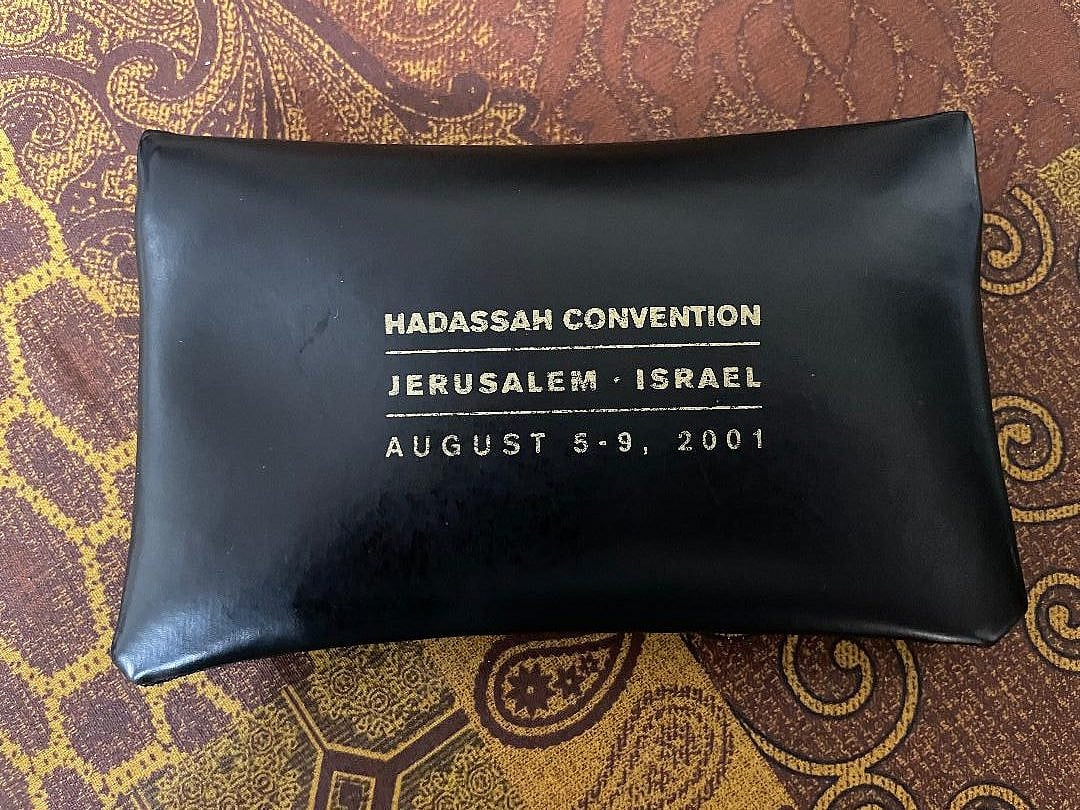
Photo courtesy of the author.
On Rosh Hashanah, we are asked to remember. As I sat in synagogue the day after the 25th anniversary of 9/11, I realized I have vivid memories that tell the story of the hatred toward both Israel and America that led up to the 9/11 terrorist attacks on American soil. My stories help connect the dots.
In July of 2000, under the auspices of US President Bill Clinton and Prime Minister of Israel Ehud Barak met with the Chairman of the Palestine Liberation Organization (PLO), Yasser Arafat, at the US president’s country retreat at Camp David. Barak offered Arafat an independent Palestinian state alongside Israel. Arafat refused the offer. One of the results was the Second Intifada, which had the stated goal of using suicide bombings to spread fear and intimidate Jews in Israel into acceding to Palestinian demands.
The Sbarro Pizza Parlor Suicide Bombing:
On August 9, 2001, I was in Jerusalem attending the National Convention of Hadassah, The Women’s Zionist Organization of America (HWZOA). We were all aware of the ongoing Second Intifada; however, it had not prevented over 500 Jewish women from across the US coming to Jerusalem to show the world that we were ardent Zionists, who believed in saving lives at our hospitals in Jerusalem, regardless of race, ethnicity, or religion.
It was the final day of the conference, and Hadassah delegates were scattered throughout downtown Jerusalem, spending a little time on last-minute sightseeing and shopping before flying back to the US. Suddenly, we heard a very loud “boom” that shook the ground beneath our feet. Within minutes, word came down that a suicide bomber had blown himself up a few blocks away in the Sbarro pizza parlor; the dead and wounded were being taken to either Hadassah Hospital Ein Kerem or Hadassah Hospital Mount Scopus.
As a member of the Hadassah National Board, I frantically began trying to contact the delegates from my region to make sure they were safe. It was no easy task, as cell phone communication had quickly become impossible. After an anxious afternoon, I and my colleagues reached every Convention attendee. They were all safe. I even reached my family in the US to let them know that I was safe.
We later learned that the suicide bomber, Izz Al-Din Shuheil al-Masri, a 22-year-old from a wealthy Palestinian family, deliberately chose to become a martyr for Allah by blowing himself up at the Sbarro pizza parlor. His intent was to murder as many Jews as possible. He killed 15 and wounded 130 innocent men, women, and children who had simply walked by or stopped to eat pizza.
Both Hamas and Islamic Jihad eagerly and proudly claimed responsibility for the bombing. As Sheik Ahmad Yassin, the spiritual leader of Hamas, said in an interview in 2001: “The Israelis . . . will fall to their knees. You can sense the fear in Israel already; they are worried about where and when the next attacks will come. Ultimately, Hamas will win.”
United Nations World Conference against Racism in Durban, South Africa, August 31-Sept 8, 2001.
A month later, back in the US, I attended an HWZOA National Board meeting in New York City to hear a report from the Hadassah delegates to the United Nations World Conference Against Racism, Racial Discrimination, Xenophobia and Related Intolerance, held in Durban, South Africa. To say they were extremely upset is an understatement.
What they had witnessed was a shameful international effort at the UN to delegitimize Zionism and the sovereign right of the State of Israel to exist in the ancient homeland of the Jewish People, once again.
Hadassah members worldwide had spent considerable time and energy refuting the UN General Assembly’s 1975 Resolution 3379, which stated that “Zionism is a form of racism and racial discrimination,” and had been instrumental in the successful effort to revoke the resolution in 1991.
Now, in the aftermath of the UN’s Durban Conference, Hadassah would have to start the fight against the demonization of Israel all over again. What we ultimately learned was that many years of behind-the-scenes organizing and strategizing to delegitimize Israel culminated at that conference in Durban.
The supposed goal of the conference was to combat global discrimination; however, the conference mostly targeted only one country in the world – Israel. The US and Israel were deliberately excluded from all the conference’s planning meetings, which were held in Tehran, Iran.
In particular, the Non-Governmental Organizations (NGO) meetings that preceded the main conference adopted extremely antisemitic rhetoric and reignited the concept that Zionism is racism. Most of the major international aid organizations, including all those that function as part of the UN, signed onto this concept.
Under pressure from the US, the final conference declaration was not quite as virulently antisemitic as the documents that had emerged from the NGO meetings. However, Israel was singled out as the focus of special committees established to examine and condemn any perceived actions that might be construed as racist.
For the past 25 years, these working committees have routinely issued resolutions condemning Israel each year.
On September 16, 2026, Danny Danon, Israel’s ambassador to the UN, stated: “In two weeks, the United Nations will mark 25 years since the Durban Conference, an event that was supposed to fight racism but instead became a platform for antisemitism and the demonization of Israel.”
“There is no reason to celebrate this toxic legacy,” he said. “Countries that genuinely oppose racism and antisemitism should do the right thing and boycott this event.”
The Anti-Defamation League has stated that the 2001 conference and the 2009 Durban Review Conference were “marred by incidents and rhetoric that normalized antisemitism and recast anti-Zionism as human rights advocacy.”
The 9/11 Terrorist Attack
Early on the morning of September 11, 2001, I was walking my dog along the banks of the Mohawk River in Schenectady, NY. My cell phone rang. It was my husband calling from China. He had just seen on the Beijing evening news that a plane hit one of the World Trade Center towers. I raced home and turned on the TV, just in time to see the second tower hit. After my recent experience in Israel, I knew exactly what I was witnessing. This was a terrorist attack by jihadist suicide bombers using planes to murder as many Americans as they could.
Frantically, I tried to reach our son, who lived in Manhattan, not far from the World Trade Center. As I already knew, during a terrorist attack, cell phone communication quickly becomes impossible. Several hours later, our son called me to say he was supposed to have a meeting in one of the World Trade Center towers that morning but had decided to go to the gym first. He was on a treadmill, watching TV, when the first tower was hit. For the next few days, he hosted several friends who could not get home in his tiny apartment.
Because American airspace was closed for several days after the attack, my husband could not fly home. The hotel in Beijing offered him an extended stay at no charge. He was considering flying to Canada and then driving from there. Fortuitously, though, his original flight home was among the first to return to New York.
For those who are not yet old enough to remember September 11, 2001, or who don’t quite remember all the details: Members of Osama bin Laden’s jihadist movement, Al-Qaeda, terrorized the US by hijacking four regularly scheduled civilian flights and using the planes as weapons to murder as many people as possible. Two planes deliberately flew into two of the World Trade Center towers in New York City, causing them to collapse, killing thousands. One flew into the Pentagon in Washington, D.C., causing many deaths. The final plane crashed into a field in Pennsylvania after passengers overwhelmed the hijackers, preventing it from hitting its intended target. Whether that target was Congress or the White House is still debated.
But 2,977 innocent people died that day, and thousands more have died since, as the air that they breathed from the collapse of both towers has caused fatal diseases over the years.
Now, 25 years later, jihadist Islam still seeks to conquer what Osama Bin Laden called the “Zionist-Crusader Alliance,” otherwise known as Western civilization. Today, Iran and its designated proxies, such as Hamas, Islamic Jihad, Hezbollah and the Houthis, are the face of this terrorism, and they remain willing to “martyr” their people to achieve their goals.
Today, Hadassah, The Women’s Zionist Organization of America, continues to advocate strongly for Israel’s right to exist and strives to combat the exponential increase in antisemitism and anti-Zionism that is engulfing the world through advocacy, education and empowerment.
In recent years, Hadassah has adopted the following policy statements:
Strengthening Security to Confront and Protect Against Antisemitic Violence
Denouncing Efforts to Exclude Jews and Zionists
Standing Up to Antisemitism on College Campuses and in Communities Across the Country
UNRWA Accountability and Palestinian Education
–
The author does not speak on behalf of Hadassah and the views expressed herein are the author’s own and not necessarily those of Hadassah.
Patricia is a member of the Hadassah Writers’ Circle, a dynamic and diverse writing group for leaders and members to express their thoughts and feelings about all the things Hadassah does to make the world a better place. It’s where they celebrate their personal Hadassah journeys and share their Jewish values, family traditions and interpretations of Jewish texts. Hadassah members are proud of their Zionist mission and their role as keepers of the flame of Jewish values, traditions and beliefs as well as advocating for women’s empowerment and health equity for all. Since 2019, the Hadassah Writers’ Circle has published nearly 800 columns in The Times of Israel Blogs and other Jewish media outlets. Interested in writing? Please contact hwc@hadassah.org.
Related Topics
Related Posts