Somalia’s Extremists: From Rights to Conflict
Somalia’s Government and the Extremist Mirror: Turning Somaliland’s Political Rights into Religious Conflict
The Federal Government of Somalia has increasingly relied on religious platforms to delegitimize Somaliland’s political aspirations, framing its pursuit of recognition as a betrayal of Islam. This strategy reached a new height when the Ministry of Endowments and Islamic Affairs ordered mosque leaders to dedicate their January 2, 2026, sermons to “the importance of Somali unity and the dangers of Jewish interference.”
While presented as a religious directive, the timing and language reveal a deeper political intent: to cast Somaliland’s diplomatic outreach—particularly toward Israel—as heresy rather than legitimate statecraft.
Religion as a Political Weapon
By intertwining sermons with state messaging, Mogadishu is not simply encouraging unity—it is weaponizing faith. The government’s directive pressures imams to echo political narratives, turning mosques into arenas of propaganda. This conflation of religion and politics undermines both spiritual integrity and democratic discourse, leaving little room for genuine debate about Somaliland’s rights.
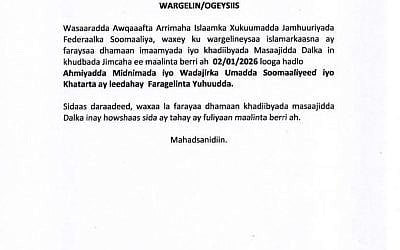
Federal Republic of Somalia
Ministry of Endowments & Islamic Affairs
NOTICE
The Ministry of Endowments and Islamic Affairs of the Federal Government of Somalia hereby informs and instructs all mosque imams and preachers across the country that the Friday sermon for tomorrow, 02/01/2026, must address the following topic:
The Importance of Unity and Solidarity Among the Somali People, and the Dangers of Jewish Interference.
Accordingly, all mosque preachers are required to deliver this message as directed during tomorrow’s sermon.
Thank you.
No Difference Between Al-Shabaab and the Federal Government
What alarms many observers is the striking similarity between the government’s rhetoric and that of Al-Shabaab. Both frame external engagement as apostasy, both vilify diplomacy with non-Muslim nations, and both rely on fear-driven religious absolutism to maintain control.
In effect, there is no meaningful difference between the ideological posture of Al-Shabaab and the federal government’s religious messaging. The two are intermingled—one through terror, the other through official decree. This convergence erodes Somalia’s credibility internationally, signaling that the state is not countering extremism but echoing it.
Implications for Somaliland
For Somaliland, this narrative is a direct attack on its legitimacy. Its pursuit of recognition—rooted in history, democracy, and law—is being recast as betrayal of Islam. This framing risks alienating Muslim-majority allies and complicating its diplomatic path. Worse, it turns a political question into a sectarian one, deepening divisions across Somali society.
A Call for Responsible Leadership
Somalia’s leaders face a stark choice: continue to weaponize religion against Somaliland’s aspirations, or engage through dialogue and diplomacy. The former path may yield short-term control, but it risks long-term fragmentation—politically, socially, and spiritually.
Somaliland’s struggle for recognition is not a religious conflict. It is a political and historical reality. To conflate it with extremism is to deny the dignity of a people and to entrench Somalia in the very ideology it claims to oppose.
Citations
1. Somali Ministry of Endowments & Islamic Affairs directive, January 1, 2026 (official notice).
2. International Crisis Group. Somalia: Countering Al-Shabaab’s Message. Report, 2025.
3. Somali National News Agency (SONNA). Minister of Endowments Inspects the Rebuilding Process of the Ministry. February 23, 2025. Accessed January 1, 2026. https://sonna.so/en/minister-of-endowments-inspects-the-rebuilding-process-of-the-ministry/.