
Middle East Forum Fellow/North Africa Risk Consultant
Somalia’s Fracturing Federalism Is a Red Sea Security Problem
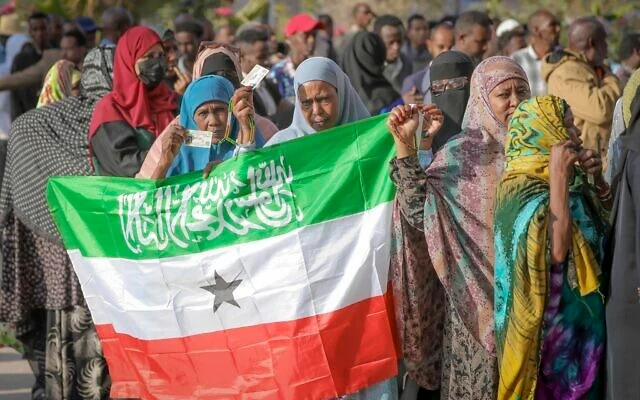
A woman displays the Somaliland flag as people queue to cast their votes during the 2024 Somaliland presidential election at a polling station in Hargeisa, Somaliland, November 13, 2024. (AP Photo/Abdirahman Aleeli)
The political confrontation between Mogadishu and Puntland’s regional administration has escalated from a chronic governance dispute into something more structurally dangerous. When Puntland President Said Abdullah Deni announced last week that he no longer recognizes Hassan Sheikh Mahmoud as Somalia’s legitimate president, he was not merely lobbing a rhetorical grenade at a political rival. He was signaling that Somalia’s federal architecture may be approaching a breaking point, at precisely the moment when the Horn of Africa and the Red Sea corridor demand stability rather than fragmentation.
The comparison to Somaliland is instructive but incomplete. Somaliland declared independence in 1991, exploiting the collapse of the central state, and has since built functioning institutions that have earned it grudging if unrecognized legitimacy. Puntland has not gone that far, and Somali analysts are right to note that the region still nominally participates in federal structures. But the trajectory matters as much as the current position. Puntland is developing independent security forces, withholding cooperation from Mogadishu on multiple dossiers, and now lending political cover to the opposition “Council for Somalia’s Future,” which is calling for weekly protests in Mogadishu beginning in June. The infrastructure of a parallel state is being assembled, even if no declaration of independence has been issued.
The proximate causes are familiar to anyone who has watched post-2012 Somali politics. Deni objects to Hassan Sheikh Mahmoud’s push toward a one-person-one-vote electoral system, which would shift power away from clan-based selection processes that regional powerbrokers like Deni have leveraged for influence. The federal government’s March 2025 constitutional ratification, which the opposition rejected and which effectively extended Mahmoud’s term by a transitional year, deepened those grievances. These are not abstract procedural disagreements. They are disputes about who controls resources, who commands security forces, and whether Mogadishu or the regions will hold the decisive cards in Somalia’s next political dispensation.
What Washington and its partners in the Gulf and Israel need to understand is that this instability does not stay contained within Somalia’s borders. Al-Shabaab, the al-Qaeda affiliate that continues to hold significant territory in southern and central Somalia, has historically benefited from exactly this kind of federal dysfunction. Every time Mogadishu and its regional partners are consumed by mutual antagonism, counter-terrorism operations lose coherence, African Union and Somali National Army pressure on jihadist strongholds slackens, and the group gains operational breathing room. Al-Shabaab is not a passive observer of Somali politics. It actively exploits fractures between the federal government and regional administrations, infiltrating clan networks and positioning itself as an arbiter when state authority retreats.
The Red Sea dimension compounds the stakes. Since the Houthi campaign against commercial shipping began in late 2023, the broader Horn of Africa security environment has attracted intensified attention from outside powers. A fractured Somalia, with ungoverned coastline and competing authorities, is an invitation for hostile external actors to insert themselves. Turkey has already expanded its footprint in Somalia significantly, including a naval facility agreement that gives Ankara a presence in the Indian Ocean. Qatar has maintained financial relationships with Somali political actors across factional lines. If Puntland’s estrangement from Mogadishu deepens into something resembling functional partition, the competition among outside powers to cultivate whichever administration controls the Gulf of Aden approaches will intensify accordingly.
The United States and its partners have limited but real leverage here. International financial flows to Mogadishu, including the debt relief process that Deni himself is accused of obstructing, can be conditioned on federal-regional dialogue. The African Union Transition Mission in Somalia depends on political cohesion to translate military pressure on Al-Shabaab into durable governance outcomes. Washington should be making clear to both Mahmoud and Deni that the international community’s patience with performative political warfare has an expiration date tied directly to counter-terrorism benchmarks and electoral progress.
The harder conversation is about Hassan Sheikh Mahmoud’s own role in this crisis. He is not an innocent party. The rushed constitutional process, the resistance to genuine power-sharing arrangements, and the attempt to leverage the new constitutional framework for a de facto term extension have provided Deni with legitimate grievances to exploit alongside opportunistic ones. A federal government that gives its regions reasons to defect has weakened its own moral authority to demand loyalty.
Somalia’s political class has repeatedly chosen the brink over compromise and then pulled back at the last moment. That pattern may hold again. But the operating environment has changed. The Horn of Africa is now a theater where great-power competition, jihadist insurgency, and maritime security interests converge. Somali politicians gaming their internal disputes against each other are doing so on a board with increasingly high external stakes. Puntland’s rebellion is not simply a local crisis. It is a stress test for the entire architecture of the Somali state, and the consequences of failure will extend well beyond Mogadishu.
Related Posts