Geopolitical Analyst: Bridging Somaliland & Israel to the world
Somaliland’s Sovereignty Case Was Never a Footnote
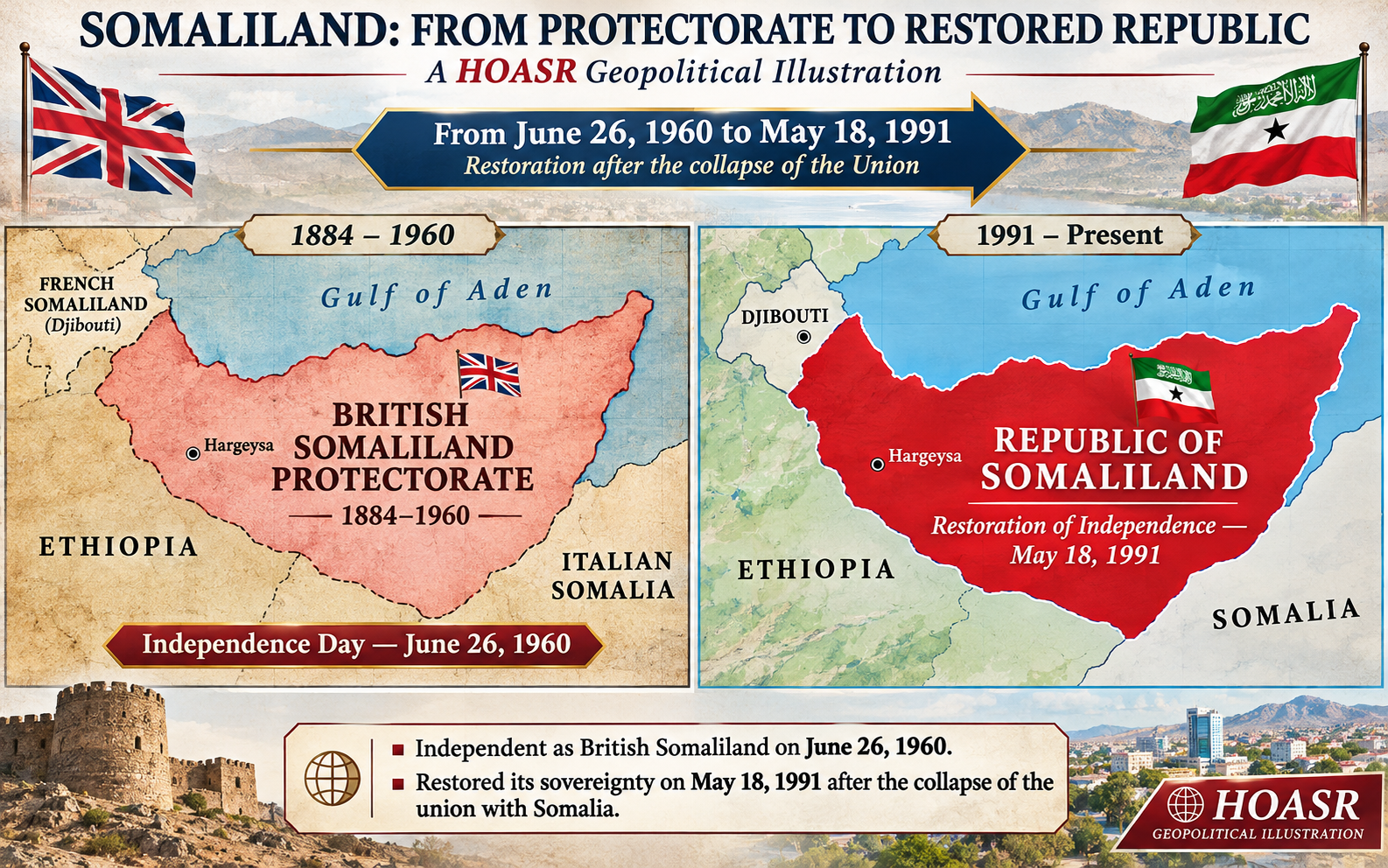
Somaliland's historical journey from the British Protectorate to independence on June 26, 1960, and its declared restoration of sovereignty on May 18, 1991. Credit: HOASR Geopolitical Illustration.
A new international legal study puts the failed 1960 union, African borders and the politics of recognition under renewed scrutiny.
Somaliland’s case for international recognition is frequently discussed as though it begins on 18 May 1991. A new legal study challenges that starting point with its central argument that the decisive date is 26 June 1960, when the former British Somaliland Protectorate became independent—five days before it entered into union with the former Italian-administered Somalia. What followed, the study argues, was not the birth of a “separatist” movement but the collapse of a union whose legal foundations remain contested.
In *The Case for Somaliland’s Sovereign Statehood: A Consolidated Argument*, published by the International Institute for Religious Freedom on 19 October and highlighted again by the International Society for Human Rights on 6 November, Thomas Paul Schirrmacher assembles twelve historical, legal and strategic arguments for Somaliland’s statehood. It combines arguments that are too often treated separately into a single, accessible case for governments assessing recognition.
The union is the legal starting point
The most consequential question concerns the formation of the Somali Republic in 1960. Somaliland’s legislature adopted one union instrument, while the authorities in the former Italian trust territory proceeded with a different text. A later Act of Union was enacted retrospectively in January 1961. These discrepancies are examined in academic research on the formation and failure of the Somali state. Therefore, the Act of Union itself is disputed and does require serious examination before anyone treats the union as a straightforward, uncontested legal transaction.
Schirrmacher places this history alongside the doctrine of state continuity and compares Somaliland with the Baltic states and the dissolution of the Senegambia Confederation. Those parallels illuminate different aspects of the claim, but neither is exact: the Baltic republics endured forcible Soviet annexation, while Senegambia was a confederation of states that had retained separate international personalities. Somaliland’s case rests on its particular sequence—independence, union, collapse and restoration—not on the claim that one analogy can settle it.
African borders and the charge of a dangerous precedent
Somaliland seeks sovereignty within the borders of the former British Protectorate. Schirrmacher argues that this position can be reconciled with *uti possidetis juris*, the African principle of preserving inherited colonial boundaries, rather than overturning it. The African Union’s 2005 fact-finding mission identified the historical distinctiveness of Somaliland’s circumstances and urged a special approach. The mission did not amount to an AU decision to recognise the republic. But its findings undercut the habit of dismissing the case without examining its own history.
Furthermore, the report clarifies the difference between a claimed boundary and control of all territory within it. Disputes over parts of Somaliland’s east remain politically consequential. Nevertheless, a strong case for recognition argument is strengthened, not weakened, by acknowledging that effective administration, popular consent and territorial claims require individual assessment.
Statehood, atrocities and international law
The report turns to the four familiar Montevideo criteria: population, territory, government and capacity for external relations. Somaliland has built functioning state institutions and held competitive elections, including a tightly contested presidential race in 2003. Its record of civilian government and institutional continuity is relevant evidence of effective statehood.
Schirrmacher also examines the destruction inflicted on Hargeisa and Burao under the Siad Barre regime and the claim of remedial self-determination. Those atrocities remain central to understanding the political rupture of 1991. Yet remedial secession is not a universally settled entitlement in international law. Equally, the International Court of Justice’s Kosovo advisory opinion established a narrower point: international law does not generally prohibit declarations of independence. Recognition is now a live diplomatic question
For thirty-four years after 1991, the recognition debate was conducted largely in the abstract. Israel’s formal recognition on 26 December 2025 introduced an actual state-to-state relationship into that debate. Schirrmacher’s report discusses the strong objections expressed by Somalia and regional organisations, as well as growing discussion in Washington and Westminster. The UN Security Council discussion following Israel’s move illustrated how sharply legal interpretation and diplomatic interests can diverge.
Israel’s decision did not settle Somaliland’s status in international organisations. It did demonstrate that recognition is a choice governments can make, subject to their assessment of law, state practice and national interests. In that sense the report arrives at a useful moment: it offers policymakers a structured legal case at precisely the point when recognition has ceased to be hypothetical.
Where the legal case meets the strategic map
The study also examines Berbera, Ethiopia’s search for diversified port access and the security pressures surrounding the Gulf of Aden. These are legitimate considerations, particularly as maritime competition intensifies near Bab al-Mandab. They should not be confused with the legal tests of statehood. Ports and shipping corridors can explain why governments pay attention; they cannot substitute for a convincing account of sovereignty.
This is where Somaliland’s diplomacy faces its next test. A scholarly report, however persuasive, cannot replace bilateral engagement, legal documentation, negotiations or the day-to-day obligations of government. Hargeisa can use the study to sharpen its case before African and international audiences while addressing the questions that critics still raise about territorial authority, the 1960 union and regional stability.
The significance of Schirrmacher’s work is ultimately its refusal to let the discussion begin and end with the word “secession”. Somaliland was independent in June 1960. Its union was a political choice with a disputed legal history. Its later restoration of independence is therefore entitled to scrutiny on its own terms. Governments may reach different conclusions about recognition, but the historical record deserves more than a rigid invocation of Somalia’s “territorial integrity”.
Somaliland has spent decades explaining that history. The new report gives its diplomats and legal advocates another instrument with which to make the case. The next chapter will be written not by legal analogy alone, but by the governments willing to examine the record and act on their conclusions.
Related Topics
Related Posts