A Mermaid in Jerusalem
Sometimes, in Jerusalem, nothing has to happen to know that everything could
One of the things I love most about taking people on walks through Jerusalem’s Old City is that it is never the same Old City twice.
Sure, the stones have been around for a very long time. They’ve watched empires rise and fall, armies march in and out, kings come and go, and entire civilizations disappear into the dust.
And sometimes you’ll literally pass a man who looks like a biblical prophet, or someone who might have stepped straight out of an illuminated medieval manuscript, or someone who apparently never got the memo that the British Mandate ended in 1948.
But the truth is, the city is constantly changing.
It churns.
It spills over.
It is always overflowing with people and prayers and arguments and laughter and the smell of coffee and cardamom and fresh bread and sewage and incense and cigarettes. With church bells and the muezzin and children racing through alleyways and old men sitting in plastic chairs watching the world go by.
Every time you pass through one of the gates, you enter a different city.
And sometimes, if you’re lucky, the city gives you a story you couldn’t possibly have planned.
Thursday evening was one of those times. I had the absolute pleasure of leading an adventure walk through the Old City with 52 Frames, a photography community I’ve been fangirling over since I first heard about it back in 2012.
And our mission was simple:
Chase the light.
Now, usually when I take people through the Old City, I have a particular route I like to follow. It’s a route built around the layers of the city, the contradictions, the complexities, the way one person’s sacred space is another person’s neighborhood, and the way history is never really history here because it keeps bumping into you on the street.
But this time, we couldn’t follow my usual route, because the sun doesn’t care about my weird storytelling.
We set out about an hour before sunset, with a very particular goal: to catch the light as it slipped through archways, spilled across ancient stones, illuminated a face or a doorway for just a few seconds before disappearing.
There were places we needed to reach at exactly the right moment.
And the light was moving fast.
So we hurried through the narrow streets, cameras ready, eyes scanning the rooftops and the shadows, chasing those fleeting moments when Jerusalem turns everything gold.
And somehow, we made it to the rooftops above the markets about 15 minutes before sundown.
And oh, my God.
The Dome of the Rock was ablaze.
The sky behind it looked like someone had taken a paintbrush and dragged cranberry and indigo and peach across the heavens.
The golden dome caught the last fierce light of the day, and for a few moments, the whole city seemed to be holding its breath.
Cameras clicked.
People moved around the rooftop looking for the perfect angle. And then the light began to fade.
But our walk wasn’t over.
I wanted to take everyone somewhere special: The Little Western Wall.
Some people in the group had heard of it before, but I think for most, it was a surprise.
It’s one of my favorite places in the Old City.
But here’s a confession:
I’m not actually much of a Wall person in general. Not the Kotel as most people know it, anyway.
I understand its significance, of course. I understand the history and the longing and the prayers of generations.
But the big Western Wall plaza doesn’t usually move me the way it moves other people.
The Little Western Wall does.
There’s something intimate about it. Something soft and gentle. It’s tucked away in the Muslim Quarter, along a narrow passageway, without the vast plaza or the crowds or the spectacle.
Just ancient stones and a little space to stand before them.
My friend Naava Shafner first showed me its beauty more than a decade ago, and I will always be grateful to her for that.
We stood there quietly.
And then I pointed up.
There was a light on in one of the windows above us.
“Someone lives there,” I told the group. “We’re standing in their courtyard.”
Because that’s another thing about Jerusalem.
What is sacred to one person is literally someone else’s backyard or living room wall.
And a few minutes later, as if the city had decided to illustrate my point, a Muslim family came down from the building.
A mother and her two children.
They saw us.
We saw them.
They greeted us, and we greeted them back.
The vibes were good.
It was one of those small, ordinary moments that happen all the time in Jerusalem and almost never make the news.
And then things got interesting.
We left the Little Western Wall and headed toward the nearby entrance to the Temple Mount, or Haram al-Sharif.
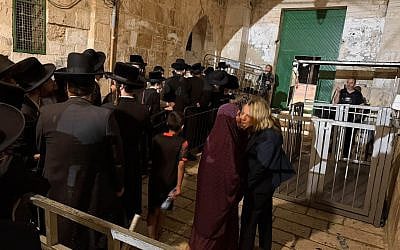
And suddenly, coming down the narrow road toward us, was a sea of black hats.
Nearly 200 Haredi men.
They moved together down the passageway, filling it almost completely.
Some entered the Little Western Wall compound. Others gathered outside, facing the entrance to the Temple Mount.
The police were there, watching them warily.
And there was a reason for that.
This was the day of another major protest, and Jerusalem was already carrying the weight of the political and religious tensions that have become such a familiar part of our lives.
Now, I want to be very clear about something.
The men weren’t behaving aggressively.
They were quiet. Respectful. But there were a lot of them. And the passageway was very narrow. And the police were watching.
And we were standing in one of the most religiously and politically sensitive places on earth. Sometimes in Jerusalem, nothing has to happen for you to become acutely aware of everything that could. We were preparing to leave when I noticed an elderly Muslim woman coming up the road.
She was small and wizened, wearing a long burgundy hijab.
She stopped when she saw the crowd of men blocking the way to the entrance. I guessed she was on her way to daven at Aqsa Mosque.
She looked at the men. Then she looked at me. And she said something in Arabic.
My Arabic wasn’t good enough to understand her, so I answered in Hebrew.
“Do you need my help?”
She nodded.
And then she reached for my hand. I took it. And together, we walked straight into the sea of black hats.
Now, picture it: An elderly Muslim woman in a hijab. Me.
Literally hand in hand.
Walking through a crowd of nearly 200 Haredi Jewish men, toward the entrance to the Temple Mount.
Police standing nearby. Photographers watching.
And for one brief moment, I wondered how this was going to go.
Because this is Jerusalem.
And Jerusalem has a way of turning the simplest human interactions into something infinitely more complicated.
But here’s what happened: Nothing. And everything.
The men moved. They saw us coming, and they made room. Some stepped aside. Others shifted back. The crowd opened just enough for the two of us to pass.
No shouting. No confrontation. Zero drama.
Her hand was small in mine.
And when we reached the entrance, she turned to me.
She took my faced and kissed me on both cheeks.
And then she gave me a blessing in Arabic.
Yeah, yeah, I know, I know, this didn’t bring world peace.
The arguments were still there. The competing histories and fears and claims were still there. The police were still standing at the entrance. The men were still gathered in the passageway.
Nothing about the larger reality had changed.
But for a few moments, something very simple had happened. A woman needed to get somewhere. She asked another woman for help. And a crowd of men made room.
That’s all.
And sometimes, in this heavy city, that’s a lot and I’ll take the deal.
I walked back to the photographers, still trying to process what had just happened.
And I started laughing.
“Listen,” I said to the 52 Frames group. “I’m going to write about this someday, and people are going to accuse me of making it up.”
Because of course they will. They’ll say it’s too cute, too symbolic, too “sunshine and rainbows and kumbaya.”
I mean, come onnnn: An elderly Muslim woman, a Jewish woman, 200 Haredi men, the entrance to the Temple Mount, and a blessing?
It sounds like something a writer would invent to make a point.
But Jerusalem doesn’t need writers to invent these things. It does them all by itself.
And that’s when my friend Barry spoke up.
“We can do better than that,” he said. “We have pictures.”
And we all laughed.
Because of course we did. I mean, it was ridiculous. We had spent the entire evening chasing the light. The last rays of sunlight slipping across the rooftops. The gold of the Dome of the Rock. The cranberry and peach and indigo girls sky. The way the shadows stretched across the ancient stones.
And then, after the sun had gone down, we found ourselves in a narrow passageway, watching people make room for one another.
Don’t worry, I won’t turn this into some grand metaphor about coexistence even though you know me, and obviously I kinda want to do that. But Jerusalem is too complicated for that, and the people who live here deserve better than easy conclusions. There are real tensions here. Real grievances. Real fears. Real injustices. And moments of kindness don’t erase any of them.
But they are real, too.
And this is also Jerusalem.
Not only the Jerusalem of headlines and holy wars and political arguments. But the Jerusalem of ordinary people going about their lives, crossing paths in ancient alleyways, sometimes colliding, sometimes connecting, and occasionally surprising one another.
It’s why I love walking through this city. It’s why I never get tired of it. And it’s why, even after all these years, I still never know exactly what story I’ll come home with.
On Thursday evening, we went into the Old City with our cameras and a mission. We chased the light. And long after the sun had set, we found it.
–
For more stories like these, I hope you’ll read my new book, Fairy Lights in God’s Backyard: A Jerusalem Love Story available on Amazon.
Related Topics