This Way Up: Spiritual Means to Psychological Ends
Sparks Across Worlds: On Kabbalah, Five Elements, and the Feeling of Coming Home
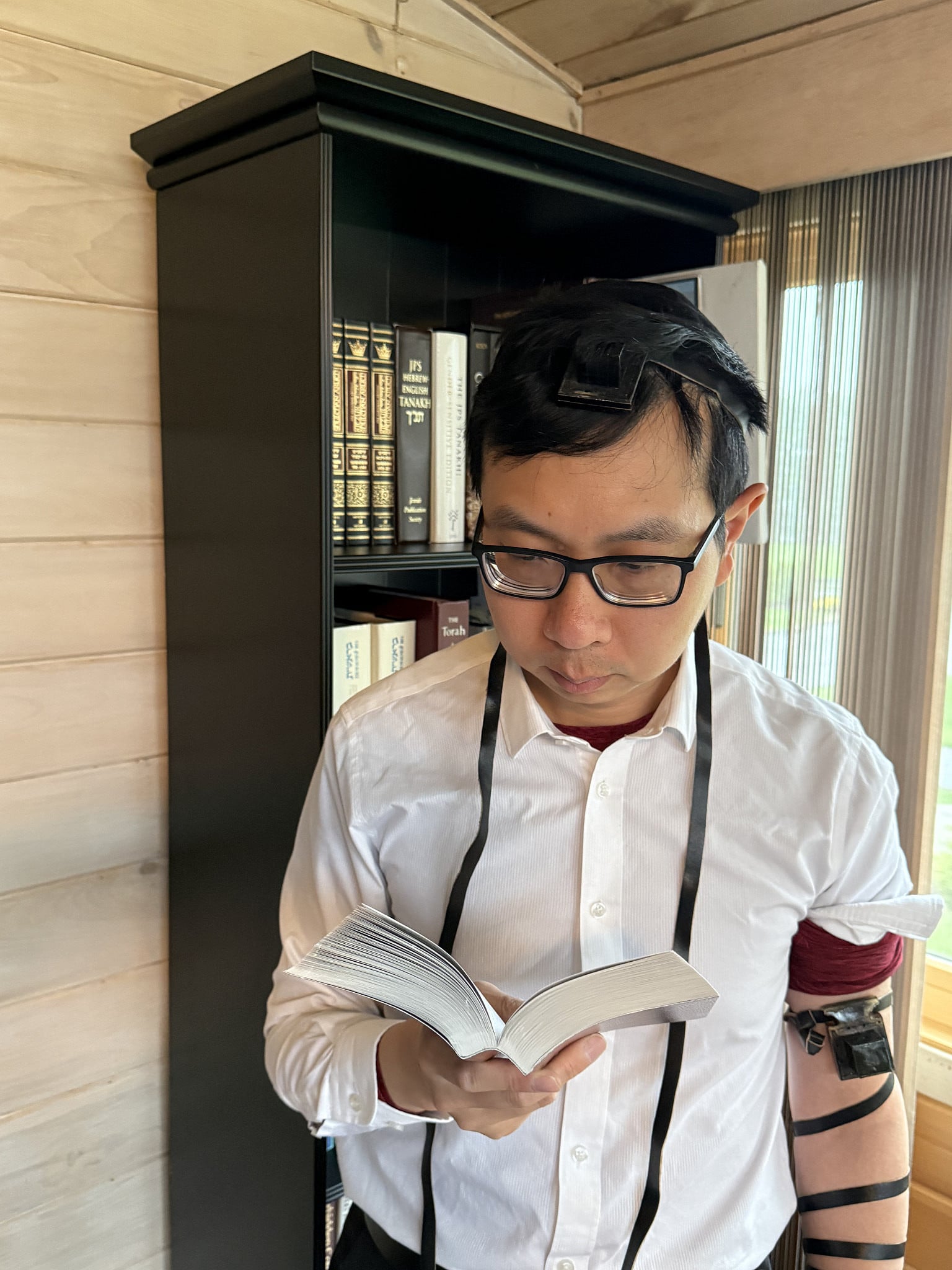
Leo Hu (with permission of Leo Hu)
There is a concept in Lurianic Kabbalah that speaks of nitzotzot: fallen sparks scattered throughout creation. These sparks are fragments of meaning, coherence, and hidden light, dispersed across the fabric of existence. The human task is not merely to observe them, but to gather them—to recognize, reclaim, and reintegrate what has been concealed.
This process, known as tikkun, is often understood as personal or spiritual work. But it may also unfold across cultures.
What if sparks are not only embedded within individual lives, but scattered between civilizations—waiting to be rediscovered through unexpected encounters?
Something like this appears to be unfolding, quietly but unmistakably, in the meeting between Jewish and Chinese worlds.
The Spark That Leaps
Consider the story of Leo Hu. His journey begins, improbably, with Fiddler on the Roof. A theatrical window into Jewish life becomes, for him, a portal. What might have remained a passing curiosity instead opens into sustained engagement—study, practice, and ultimately, a full commitment to Jewish life.
This is not simply admiration across cultures. It is recognition.
Something in the symbolic world of Jewish tradition speaks to something already present, though perhaps unnamed, within him.
The spark does not travel randomly. It recognizes its counterpart.
When a System Becomes a North Star
A parallel movement occurs in the opposite direction.
For some Jewish thinkers and clinicians, the encounter with Chinese philosophy—particularly Five Element theory—has not been a casual borrowing, but a profound reorganization of perception. In the work of Dr. Lonny Jarrett, and in my own clinical and conceptual explorations, Five Element theory functions less as an imported framework and more as a revealing lens.
It is as though the psyche had always been structured in this way, but lacked the language to see itself.
The Five Elements—Wood, Fire, Earth, Metal, Water—offer a grammar of movement, transformation, and relationship. They illuminate human experience in ways that resonate deeply with Jewish mystical and psychological traditions, even where no historical linkage is assumed.
Here too, the experience is not one of adopting the foreign. It is one of recovering the familiar through another culture’s vocabulary.
Another spark, recognized and reclaimed.
The Outsider Who Almost Stayed
In a recent story published in The Jerusalem Post, and echoed in personal accounts circulating online, Chinese individuals living in Israel describe a strikingly similar experience: arriving as outsiders, yet finding themselves unexpectedly woven into the emotional and cultural fabric of the place.
One woman recounts years of returning, learning Hebrew, training as a guide, building relationships, and feeling drawn back even after interruption and departure. She writes of sirens, fear, and the strange dual consciousness of being both insider and outsider.
And yet, in the end, she leaves.
Not because the connection was illusory—but because life, circumstance, and reality sometimes pull us away from what we recognize as meaningful.
This, too, is part of the story of the sparks.
Recognition does not always culminate in permanence.
Sometimes it leaves an imprint—a trace of belonging that continues to shape a life, even from afar.
Tikkun Between Civilizations
How do we understand these patterns?
It would be easy to reduce them to globalization, curiosity, or coincidence. But their depth and directionality suggest something more structured.
Kabbalah offers one language: sparks scattered not only within individuals, but across cultures. Each tradition carries fragments of a larger whole. When individuals cross boundaries in ways that feel less like exploration and more like recognition, they may be participating in a form of intercultural tikkun.
From a Chinese philosophical perspective, one might say that distinct systems—each internally coherent—sometimes reveal unexpected resonance, as though two maps of reality briefly align.
The Feeling of “Already Knowing”
What unites these accounts is a particular experience: the feeling of “already knowing.”
- The Chinese student encountering Jewish texts not as foreign doctrine, but as something strangely familiar
- The Jewish clinician encountering Five Element theory as if it were illuminating an internal structure long sensed but never articulated
- The outsider in Israel who, despite language gaps and cultural distance, experiences a form of belonging that defies biography
This is not the curiosity of the tourist. It is the recognition of the participant.
From Recognition to Responsibility
If sparks are indeed scattered between cultures, then recognition is only the beginning.
There is also a question of responsibility.
What would it mean to actively facilitate these encounters?
To create conditions in which recognition is more likely to occur?
To make it easier for individuals in both communities to find what, in some sense, is already waiting for them?
An Invitation: Gathering Sparks in Our Time
This is the spirit behind a new initiative emerging in honor of Asian/Jewish Heritage Month.
Rather than leaving these encounters to chance, this project seeks to bring them into deliberate focus—to create a space where Jewish and Chinese voices can meet, explore, and deepen their shared questions.
A series of public, free Zoom lectures will bring together leading thinkers and bridge-builders, including:
- Vera Schwarcz and Elliott Malamet in dialogue on the nature of truth across traditions
- Jack Daniel exploring the Book of Genesis through the lens of Chinese medical theory
- A panel of Chinese allies speaking directly about the importance of confronting antisemitism and supporting the State of Israel
- Additional lectures and conversations designed to illuminate points of resonance, difference, and mutual discovery
These events will be freely available and archived through the CAEF website, extending their reach beyond the moment.
Bringing Home the Sparks
If the language of Kabbalah offers a metaphor, then perhaps this initiative is a small act of tikkun.
Not by resolving differences or collapsing traditions into one another, but by creating encounters in which recognition becomes possible.
By helping sparks find their way back into relationship.
There is something quietly urgent about this moment in history—fracture, misunderstanding, and distance seem to be growing in many directions at once.
And yet, beneath that, there are also currents of convergence.
People who feel, often without being able to explain why, that something in another tradition speaks directly to them.
That something long scattered is asking to be gathered.
Perhaps the work now is to make that gathering a little more visible, a little more intentional.
To create the conditions for more homecomings—however temporary, however partial, however unexpected.
To bring the sparks a little closer to where they belong.
Related Topics
Related Posts