Standing Up for My Murdered Family
The photograph is the answer to every name Lithuania has called me.
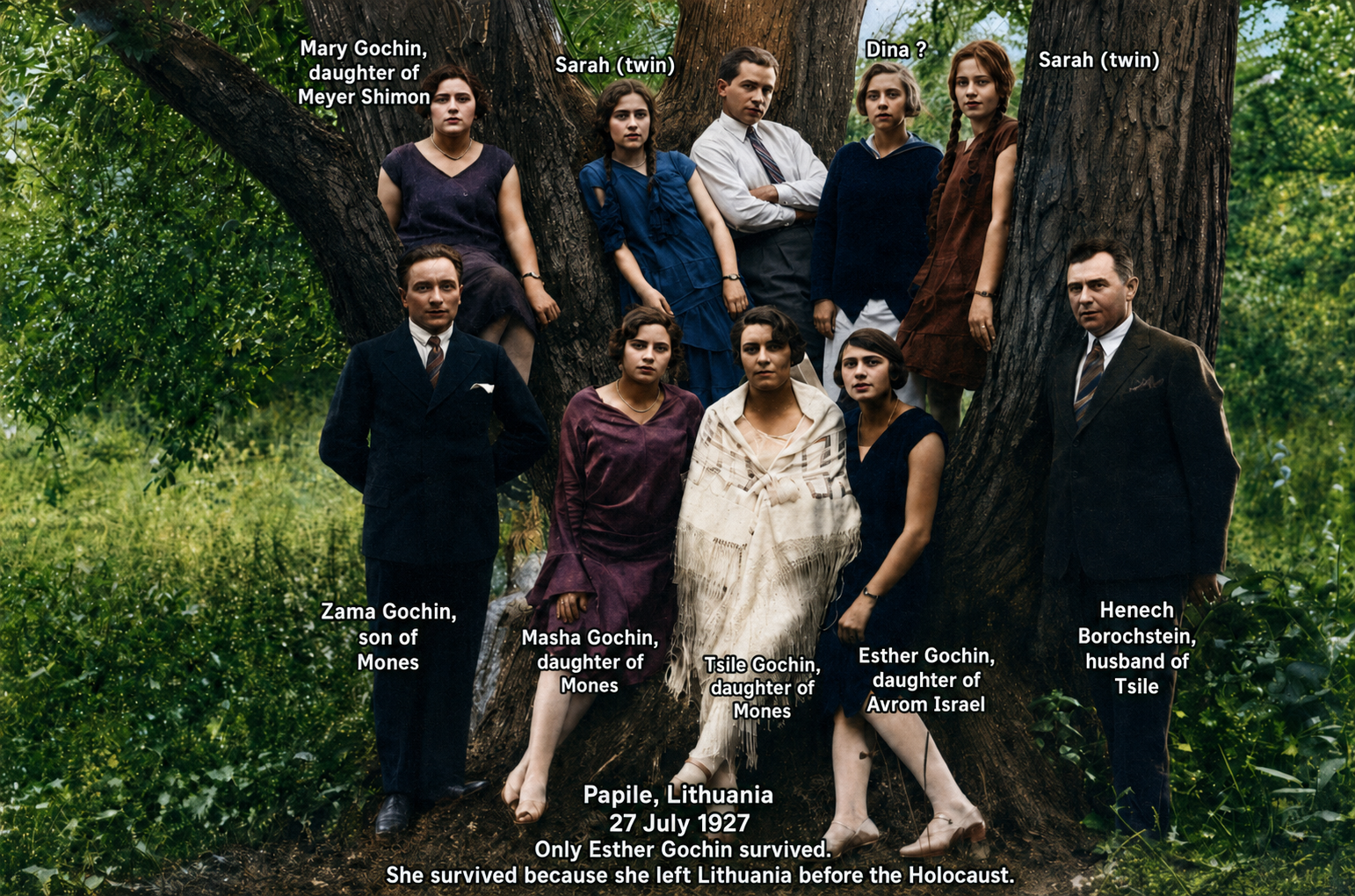
Photo colorized and restored by ChatGPT.
Image source: Papilė family photograph, July 27, 1927.
I have spent decades documenting Lithuania’s Holocaust record. The Lithuanian state has spent the same years naming me.
It has called me an agent, a criminal suspect, a Nazi propagandist, a Russian agent, a staff blackener of Lithuania, and trash. I placed the full catalogue on the public record in On What Grounds Should I Not Be Adversarial?, my open letter to Lithuanian Consul General Sandra Brikaitė.
That letter is the catalogue.
This article is the answer beneath it.
The answer is a photograph: my murdered family in Papilė, Lithuania, before the Holocaust. Lithuania can name me any way it chooses. My standing comes from them.
I stand for Mary Gochin, Sarah, Dina, Sarah, Zama, Masha, Tsile, Henech, and the others in the family frame whose lives were destroyed when Lithuanian neighbors, collaborators, administrators, police, shooters, and institutions joined the annihilation of Lithuanian Jewry.
Of the ten people in that photograph, one survived. Esther survived because she left Lithuania before the Holocaust. The others were murdered by Lithuanians, on Lithuanian soil, with Lithuanian organization. Their names exist now because one person got out.
That is why the names Lithuania has called me do not work. They are not stronger than the photograph.
The State Method
Lithuania’s attacks on me have never been merely personal. They are institutional vocabulary. Different officials, different years, different offices, same function.
When I filed documents, Lithuania answered by naming the Jew who filed them. When I challenged the state’s record on Jonas Noreika, Lithuania attacked the claimant. When I asked the state to apply its own Holocaust-denial statute to its own Holocaust-distortion institution, Lithuania refused. When I litigated, the state shifted the frame from evidence to loyalty. When the historical record became difficult, the Jewish complainant became the problem.
That is the method.
It does not require a conspiracy. It requires an architecture. The LGGRTC, prosecutors, courts, parliamentarians, diplomats, and state-adjacent public voices do not need to coordinate if they already share the same instinct: protect the Lithuanian national narrative, and discredit the Jew who demands that the documentary record be read.
For years that method was applied to me: criminal suspicion, vulgar pressure, Nazi-propaganda accusation, Russian-agent slur, staff-blackener label, and trash. The words varied. The function did not. The goal was to make the claimant toxic so the record he carried could be avoided.
Why I Did Not Stop
I did not stop because the people in the photograph cannot speak.
They cannot file complaints. They cannot answer parliamentary insults. They cannot sue the LGGRTC. They cannot ask Lithuanian prosecutors why no Lithuanian has served punishment for murdering Jews. They cannot ask why Noreika was honored, why Brazaitis was defended, why Škirpa was protected, why Rakutis was excused, why the state’s Holocaust memory remains structured to dilute Lithuanian perpetration into abstraction.
They cannot ask why Lithuania commemorates rescuers while defending murderers, why Jewish victims are named as tragedy while Lithuanian perpetrators disappear into formula, or why the descendants of the murdered are treated as enemies when they produce documents.
So I ask.
It is not because I enjoy litigation, seek conflict, or hate Lithuania. I demanded that Lithuania behave like the European Union and NATO member it claims to be. I demanded that the state correct its own record and stop transforming Holocaust evidence into state innocence.
Lithuania answered with names. The photograph answered back.
Fridman Is the New Iteration
Artur Fridman is not a separate story. He is what happens when the vocabulary Lithuania used against me becomes a criminal file against a Jew Lithuania can physically reach.
I am an American. Silvia Foti is an American. Eugene Levin is an American. Michael Kretzmer is British. Lithuania can denounce us, insult us, mischaracterize us, ignore us, and smear us. It cannot easily summon us before a Vilnius court.
Fridman lives in Lithuania. That is the difference.
He is a Jewish citizen of Lithuania. He visited his grandfather’s grave at Antakalnis Cemetery on May 9, 2024 and posted on Facebook. Lithuania responded with Case No. 02-2-00512-24, a 220-page indictment under Article 170² §1 and Article 313 §2.
The same state refused to apply Article 170² §1 when I asked it to examine the LGGRTC’s own Holocaust record. It did not charge Valdas Rakutis after his January 27, 2021 Holocaust Remembrance Day article attributing Holocaust perpetration to Jews. Rakutis was not charged. Fridman was indicted.
That is why Fridman belongs in this article. He is not an appendix to my case. He is the next iteration of it.
The pattern is visible. First the state names the Jewish claimant as disloyal. Then it treats him as hostile. Then, when the Jew is within territorial reach, the vocabulary becomes prosecution. With me: insult and refusal. With Fridman: indictment. That is the escalation.
The Same Architecture
The issue is not one former director, prosecutor, diplomat, consular letter, court memorandum, or offensive phrase. The issue is the Lithuanian state’s recurring method when confronted with Jewish evidence of Lithuanian Holocaust participation: refuse correction, protect honored perpetrators, convert documentary challenges into attacks on Lithuania, treat Jewish persistence as disloyalty, and name the Jew rather than answer the record.
This is why I reject the idea that I am adversarial without cause. On what grounds should I not be adversarial?
My family was murdered. The state honors some of the men and institutions connected to the machinery that destroyed Lithuanian Jews. The state has not punished any Lithuanian for the murder of Jews. The state’s Holocaust-history institution has repeatedly defended the national narrative against the documentary record. The state has called the descendant of the murdered a Russian agent, a Nazi propagandist, a staff blackener, and trash. And now the state is prosecuting a Jew for Holocaust-related speech.
There is no neutral posture available to me. Neutrality would be collaboration with the lie.
The Stood and the Silent
A few people have stood up for Fridman. Congressman Brad Sherman, Dillon Hosier of the Israeli-American Civic Action Network, and Rabbi Ahud Sela of the Board of Rabbis of Southern California have put concern on the record. Others have not stood up publicly. That record matters, but this article is not primarily about institutional silence. I have written elsewhere about medals, photographs, readouts, diplomatic cover, and the absence of organized Jewish institutions.
This article is simpler. If our institutions will not stand, descendants must. If organizations will not name the case, private Jews must. I am one private American citizen, not on payroll, who has spent decades and hundreds of thousands of dollars documenting the Lithuanian Holocaust record. I have done this because the murdered cannot.
That is my authority.
My Grandfather’s Charge
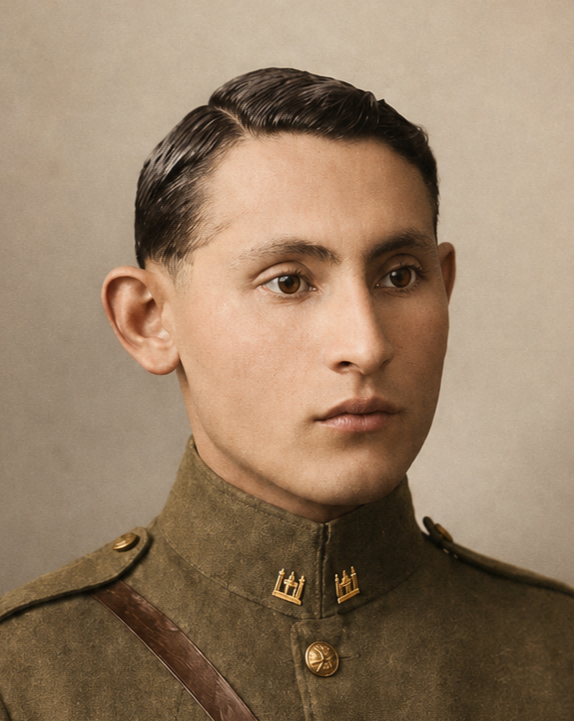
My grandfather Sam Gochin instructed me to carry the memory forward.
That instruction is the frame.
Sam survived because he left Lithuania before the Holocaust arrived. The branches of the family that did not leave were murdered. Sam knew the names, the photographs, and what had been done in Papilė, in Šiauliai, and in the towns where the family had lived for generations. He passed the obligation to me.
He did not tell me to protect Lithuania from inconvenient facts. He did not tell me to defer to the diplomatic comfort of the perpetrator state. He did not tell me to weigh Litvak memory against the convenience of the Lithuanian Foreign Ministry.
He told me to carry the memory.
I carry it. That is the predicate beneath all of it. The forty-nine refusals are the documentary proof. The names the state has called me are the rhetorical proof. Sam Gochin’s instruction is older than any of it. I can not, and will not disobey my Grandfather’s charge.
We Remember Egypt. We Are Asked to Forget Lithuania.
Every year, at every Seder, in every Jewish home, we tell the story of our liberation from Egyptian slavery 3,500 years ago. We name the oppressors. We name the deliverance. We name the obligation that passes from one generation to the next. The Haggadah is the architecture of Jewish memory. We have not forgotten in 3,500 years.
Lithuania asks us to forget the slaughter of our families within living memory.
The murders are not ancient. The grandchildren of the murdered are still alive. The photographs, archives, and signed orders still exist.
How can any self-respecting Jew agree to that asymmetry? How can Jews who hold a Seder each year for events 3,500 years distant stay quiet about events within their own families’ lifetimes?
The asymmetry is not theological. It is political. Lithuania finds the recent memory inconvenient because the recent memory implicates Lithuanian state institutions, honored figures, and post-war silence. The Pharaohs are safely dead. Noreika still has defenders inside the Lithuanian Foreign Ministry.
I refuse the asymmetry.
The same Jewish duty that requires us to retell the Exodus requires us to tell the truth about the Lithuanian Holocaust. The Haggadah and the photograph sit on the same Jewish foundation.
That is what my grandfather meant by carrying the memory forward.
Why I Stand
I stand for the people in the photograph at the top of this article.
They could not fight. The Lithuanian neighbors who would murder them did not give them that option. Lithuania’s state record has never reckoned with what happened to them, who did it, who benefited, who was honored afterward, and who remains protected in the national story.
I fight for them, for my grandparents, for every Lithuanian Jew the State of Lithuania still refuses to count honestly, and for future victims of the same ideology.
I fight for my son, and for any grandchildren I am one day fortunate enough to have, so they may live in a world where the lie is harder to tell because the record was placed in public by people who refused to let it pass.
I fight by example, and for example.
Injustice is not answered only by courts. Sometimes it is answered by a file, a lawsuit, a photograph, or a refusal to go quiet.
Silvia Foti’s Storm in the Land of Rain exposed the family record of Jonas Noreika, the Lithuanian nationalist hero whose public honors Lithuania has fought to protect. Eugene Levin has documented Lithuania’s conversion of Holocaust evidence into state innocence. Michael Kretzmer’s J’Accuse! forced viewers to confront what Lithuania prefers to dilute. Fridman now faces criminal prosecution inside Lithuania.
These are not separate cases. They are one Memory War. If Silvia Foti, a Catholic Lithuanian granddaughter can put her life on the line to preserve Jewish memory, so too can our Jewish organizations.
Lithuania’s strategy is to fragment the record: one insult here, one refusal there, one prosecution somewhere else, one plaque, one medal, one embassy photograph, one consular letter, one court memorandum, one Article 170² file.
The answer is to put the fragments together. That is what I have tried to do.
The forty-nine refusals are on file. The names the Lithuanian state has called me are on file. The Fridman indictment is on file. The murdered Jews of Šiaulių District are on file. So is the photograph.
The photograph is the answer to every name.
I will never not stand up for Lithuania’s Jewish victims. I will never not stand up for my family. I will never not stand up for Fridman, because Fridman is the reachable Jew in the next round of the same state method.
The people in the photograph had no chance to answer.
I do.
Am Yisrael Chai.