The Prosecution of Artur Fridman
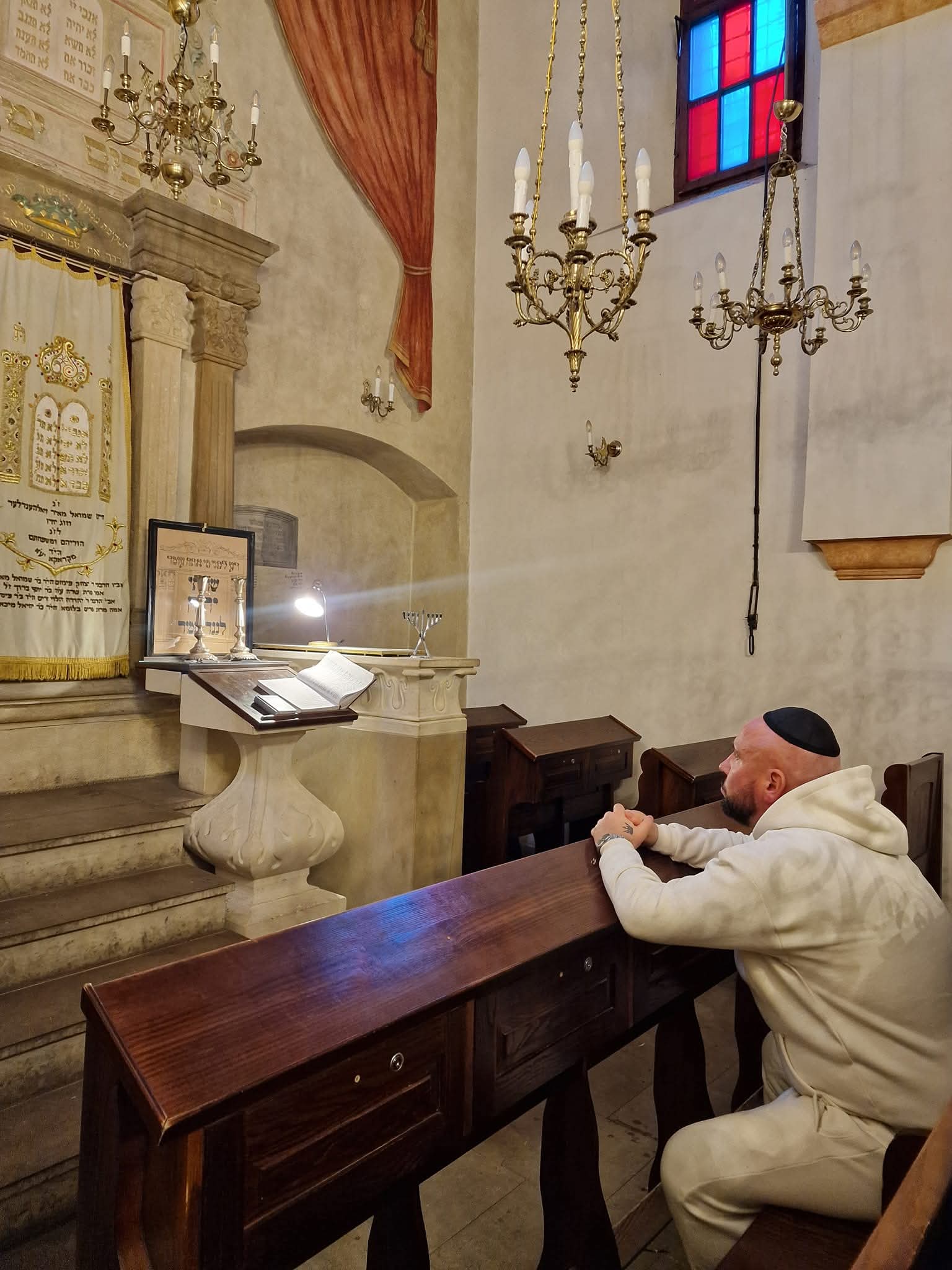
On May 9, 2024, Artur Fridman, a Jewish citizen of Lithuania, visited Antakalnis Cemetery in Vilnius to honor his grandfather Aron Fridman, a Jewish soldier who fought against Nazi Germany in the Red Army. He posted a Facebook message praising those who fought fascism and questioning the heroization of Adolfas Ramanauskas-Vanagas, whom Lithuania has elevated to head-of-state-rank commemorative status. On January 8, 2025, Lithuanian authorities imposed a written pledge preventing him from leaving the country. On October 30, 2025, prosecutors filed charges under Articles 170-2 §1 and 313 §2 of the Lithuanian Criminal Code, Case No. 02-2-00512-24. The indictment runs to 220 pages.
Seventeen months for a 220-page criminal pleading is not urgency; it is institutional decision-making.
Five claims, five inversions
Lithuania presents itself to foreign governments and Jewish institutions through five claims: rule of law, freedom of expression, an independent judiciary, honest investigation of the crimes of two occupation regimes, and a new 157-point Action Plan against antisemitism under IHRA-compatible Holocaust memory. The Fridman prosecution refutes all five. Rule of law fails because Article 170-2 §1 was unavailable against a Lithuanian parliamentarian whose Holocaust-related publications blamed Jews and fully available against a Jewish citizen who criticized a state hero. Freedom of expression fails because criticism of state mythology is treated as criminal injury, contrary to Perinçek v. Switzerland. Independent judiciary fails because LGGRTC outputs are non-justiciable when challenged civilly and criminally enforceable when invoked against a Jew on Facebook. Investigation fails because Lithuanian nationalist forces operating before, during, and alongside Nazi authority are inside neither the LGGRTC mandate nor the International Commission framework, and no Lithuanian perpetrator of the Holocaust has ever been punished by the Lithuanian state. The Action Plan fails because it was adopted in coalition with a party whose leader was convicted of antisemitic hate speech, while the prosecution of a Jewish citizen for Holocaust speech proceeded uninterrupted.
The case for dismissal
Article 170-2 §1 requires public approval, denial, or gross belittling of specified crimes, in a manner threatening, insulting, offensive, or disruptive of public order. Mr. Fridman’s post did not approve, deny, or grossly belittle Soviet crimes. It honored a Jewish anti-Nazi grandfather and questioned the heroization of one named partisan. Silence is not approval. Criticism of a state-sanctified figure is not public disorder. The complainant was directed to the post by a third party. Directed offense is not public order.
Article 313 §2 requires falsity. “Pseudohero” is a value judgment, not a falsifiable factual assertion. The prosecution’s own case file references LGGRTC letter No. 13R-645 acknowledging that Ramanauskas-Vanagas was the subject of a Soviet security-services recruitment contact in January 1945 under the codename Džūkija. The defense need not prove the recruitment was operationally successful. It need only show that Mr. Fridman’s claim was not fabricated.
The Rakutis comparator
On January 27, 2021 — International Holocaust Remembrance Day — Member of the Seimas Valdas Rakutis published an article attributing Holocaust perpetration to Jews. The article was condemned the same day by the U.S., Israeli, and German ambassadors. On January 29, 2021, U.S. Commissioner Paul Packer demanded retraction and apology. On March 24, 2021, the three ambassadors jointly met the Speaker of the Seimas. On April 22, 2021, Israeli-American Civic Action Network CEO Dillon Hosier wrote to Secretary of State Antony Blinken on the same conduct.
On February 22, 2021, the Vilnius District Prosecutor declined to investigate Rakutis under Article 170-2 §1. Less than five years later, the same statute was deployed against a Jewish citizen for a Facebook post. Holocaust-distorting speech by a Lithuanian Member of Parliament on International Holocaust Remembrance Day: prosecutorial restraint. A Jewish citizen’s Facebook post at his grandfather’s grave: 220 pages.
The State-Innocence Machine
No Lithuanian perpetrator of the Holocaust has ever been punished by the Lithuanian state. The LGGRTC then converts the absence of punishment into evidence that there is nothing to investigate. The International Commission’s mandate is the crimes of two occupation regimes — Nazi and Soviet. Lithuanian nationalist forces operating before and alongside Nazi authority — Lithuanian Activist Front formations, white-armband units, local police, partisans of the killing season — are inside neither mandate as an autonomous Lithuanian regime of perpetration. The third regime is investigated by no Lithuanian institution.
Lithuanian courts complete the architecture. They classify LGGRTC outputs as non-justiciable informational acts when challenged civilly. They treat the same outputs as binding evidentiary authority when invoked criminally against a Jewish citizen. Approximately thirty civil and administrative proceedings testing LGGRTC findings since 2015 have produced not one merits ruling. One Facebook post produced a 220-page indictment in seventeen months.
The Notice Record
Lithuania cannot claim it was not told. Congressman Brad Sherman of California has written multiple times since 2019 documenting LGGRTC fabrications. Lithuania has not replied. Three American cities — Beverly Hills, West Hollywood, and Los Angeles — adopted resolutions in 2020 condemning Lithuanian Holocaust denial and naming the LGGRTC. Lithuania never meaningfully answered the substance. The World Jewish Congress called the LGGRTC’s 2019 Noreika document “nothing short of Holocaust revisionism.” The American Jewish Committee criticized the same legal effort. IHRA-linked authorities invoked the Working Definition of Holocaust Denial and Distortion against the Centre. On September 21, 2023, Yad Vashem Chairman Dani Dayan addressed the Seimas and named Noreika, Škirpa, and Krikštaponis as figures Lithuania must stop glorifying. The U.S. Department of State Reports on International Religious Freedom for Lithuania have documented the same conditions annually. In March 2026, Lithuania’s own Seimas-established expert council reported that the LGGRTC is “de facto a bureaucratic institution.”
The Antisemitism Plan as cover
Lithuania’s 157-point Action Plan to Combat Antisemitism, Xenophobia, and Hate was adopted on January 21, 2026, while Mr. Fridman was already under written travel pledge and before the indictment was filed. The government adopting the plan sat in coalition with Nemunas Dawn, whose leader Remigijus Žemaitaitis was found guilty by the Vilnius Regional Court on December 4, 2025 of inciting hatred against Jews and grossly minimizing the Holocaust. Foreign Minister Kęstutis Budrys then presented the plan to AJC CEO Ted Deutch in February 2026.
A plan against antisemitism that does not withdraw the Fridman prosecution, correct LGGRTC falsifications, or revoke a single state honor for a Holocaust perpetrator is not an antisemitism plan. It is a diplomatic instrument designed to manage Jewish perception while the machinery continues to run.
Who has defended Mr. Fridman
On the public record of formal correspondence engaging Lithuania over the Fridman prosecution, one civic organization has consistently engaged. The Israeli-American Civic Action Network, under the leadership of Dillon Hosier, formally wrote to the Lithuanian Consul General in Los Angeles on March 15, 2026 demanding answers. ICAN is the only civic organization, on the public record, that has actively engaged in the protective defense of a Jewish citizen against an antisemitic Holocaust-revisionist state action of this character.
What other Jewish organizations actually do — beyond holding events, issuing statements, accepting state hospitality, and legitimizing governments that have not earned it — remains a question their donors should ask.
Every outcome convicts Lithuania
Conviction confirms an EU member state has criminalized historical dissent by a Jewish citizen for a single Facebook post. Acquittal confirms the Prosecutor-General mobilized seventeen months of resources on a foundation that could not survive trial. Withdrawal confirms the apparatus was activated and abandoned when the public record began to expose the state. Suspended sentence confirms the criminal stigma was always the objective. Settlement confirms the indictment was a coercive instrument rather than honest application of criminal law.
No outcome leaves Lithuania clean. The indictment is the injury.
Lithuania on trial
Michael Kretzmer’s analysis, “Lithuania has put itself, not Artur Fridman, on trial,” states the principle: the indictment exposes the state’s legal and historical vulnerabilities. Silvia Foti, in Storm in the Land of Rain: A Mother’s Dying Wish Becomes Her Daughter’s Nightmare, established what one Lithuanian Catholic descendant of a perpetrator can do when she chooses truth over institutional comfort. Mr. Fridman, a Jewish grandson of an anti-Nazi soldier, has now been charged for the equivalent act of historical conscience.
By 1944, more than 96 percent of Lithuanian Jews had been murdered — the highest destruction rate in occupied Europe. May 9, 1945, was the date the conditions under which Lithuanians had murdered Jews with impunity began to end. A Jewish citizen marking that date at his grandfather’s grave is not celebrating Stalin. He is honoring the date that began the end of the Lithuanian killing season.
Lithuania has chosen to answer through prosecutors. That is why this case belongs to every Jewish family whose history Lithuania would prefer to manage, sanitize, or silence. It also belongs to every Jewish organization that claims to defend Holocaust memory or Jewish security. They must go on record now. Silence while this prosecution proceeds will not be neutrality; it will be a public record of non-intervention. If Jewish institutions decline to contest the prosecution of a Jewish citizen for Holocaust-related speech, they will have to explain why they left him exposed to the machinery of a state already warned, repeatedly, about its Holocaust distortion.
Mr. Fridman is the defendant on the indictment. Lithuania is the defendant before history.
I am not a lawyer, and I do not write as anyone attempting to practice law or to provide legal advice. The full forensic argument for dismissal — including element-by-element analysis of Articles 170-2 §1, 313 §2, and Article 10 of the European Convention; Drėlingas and Vasiliauskas under the Genocide Convention; the Koniuchowsky Archive; the State-Innocence Machine; the complete notice record; the Antisemitism Plan as cover; and forty-five footnoted sources — is published in full at grantgochin.substack.com/p/the-prosecution-of-artur-fridman.