
Strategy or Ideology – Considerations for an Imminent Election
Painfully embarrassing. A Likud election billboard shows pictures of Arab political leaders with text above them, “They want Netanyahu to lose.” (Me too!) Added text below the Arab leaders, “Don’t let them win.” The billboard doesn’t show other opposition party leaders. Just Arabs. Blatant subtext. I fail to understand in what universe a political party in a democratic regime denies parties’ legitimacy based on their national identity. Just to attribute an adversary agenda towards Israel to all Arab citizens of Israel?
You can assume I’m not voting Likud, nor to the right of it. Similarly, I won’t be voting for a party in the other bloc headed by a candidate vying to become prime minister. Not Yashar, led by Gadi Eisenkot; nor Yachad, led by Naftali Bennett; or Yisrael Beiteinu, led by Avigdor Lieberman. Eisenkot would be my preference for prime minister from among them. Bennett and Lieberman could form a technical merge after the elections to claim a larger piece of the pie – more members of Knesset between their two parties than Yashar. This would enable them to claim leadership over Eisenkot.
I’ll consider another party in their Bloc for Change. No chance its leader will become prime minister. The Democrats formed by former Labor and Meretz parties, led by Yair Golan, won’t get enough votes to give him a shot at leading the bloc. The party has some trimmings of the once Israeli left in a bloc where liberal democracy sticks to the right.
Votes for smaller right-wing parties together with Haredi and Arab parties will determine Knesset composition and the character of the next government. By some scenarios small rightist parties opposing Netanyahu like the one led by Yoaz Hendel could join a Bloc for Change coalition, even enabling exclusion of the Democrats.
Until elections, Zionist parties declare refusal to form a coalition with Haredi parties while young ultra-Orthodox, Haredi, men continue evading the draft. Ultimately, Haredi numbers, given their rate of procreation, become an imposing sociopolitical factor with electoral implications. After elections, parties objecting to coalitions with Haredim will likely change their tune if necessary to enable their Knesset majority and power to form a government.
Netanyahu in the past courted Arab parties towards that end too. The greater unlikelihood of that scenario now affects both blocs.
Following elections, the president accepts parties’ recommendations for prime minister and then delivers the task of forming a coalition to the candidate with the best chances. Media report the president’s wish to encourage a broad Likud-Yashar national unity government. Let’s hope that doesn’t happen! Netanyahu must go home.
Should that national unity government possibility affect my vote? It would make me want greater support in the Knesset for equality for all sectors of our society. Does that require voting for an Arab party? If the Democrats are in the opposition, is strengthening them with more votes going to contribute to that fight for equality? Is it more effective if the Democrats advocate for equality than Arab parties?
Will Bloc for Change leaders, despite promises to the contrary, fold and include Arab parties in a coalition? The Bennett-Lapid government included Ra’am, led by Mansour Abbas. “After October 7, it’s different,” they say. Overwhelming numbers of the Jewish public say the same. If needed for a coalition, will they justify a government with Ra’am based on MK Yoav Segalovich’s #2 seat on its list following his admirable move from Yesh Atid. He is committed to reducing crime in Arab society as achieved when he served as Deputy Minister of Internal Security in the Bennett-Lapid government. He impressively explains prioritizing the necessary partnership between Jewish and Arab citizens over concerns regarding Ra’am’s conservative Islamist platform.
The other Arab party, the Joint List, is unaddressed in Jewish-Zionist parties’ discourse on coalition partners, though targeted by a failed attempt led by the far right for disqualification from participation in the elections, apparently a move not unacceptable to the Bloc for Change. Golan formulates lame statements that keep him in the good graces of the rest of the Bloc for Change. The little left of the left is repeatedly disappointed. The Joint List, though more liberal than Ra’am, is a less likely coalition partner.
Do I vote Democrats to strengthen power for their more tolerable values than those of Lieberman’s Yisrael Beitenu party in a coalition? If the Democrats are not in the next coalition, will reinforcing their numbers in the Knesset better represent my values than reinforcing the Joint List?
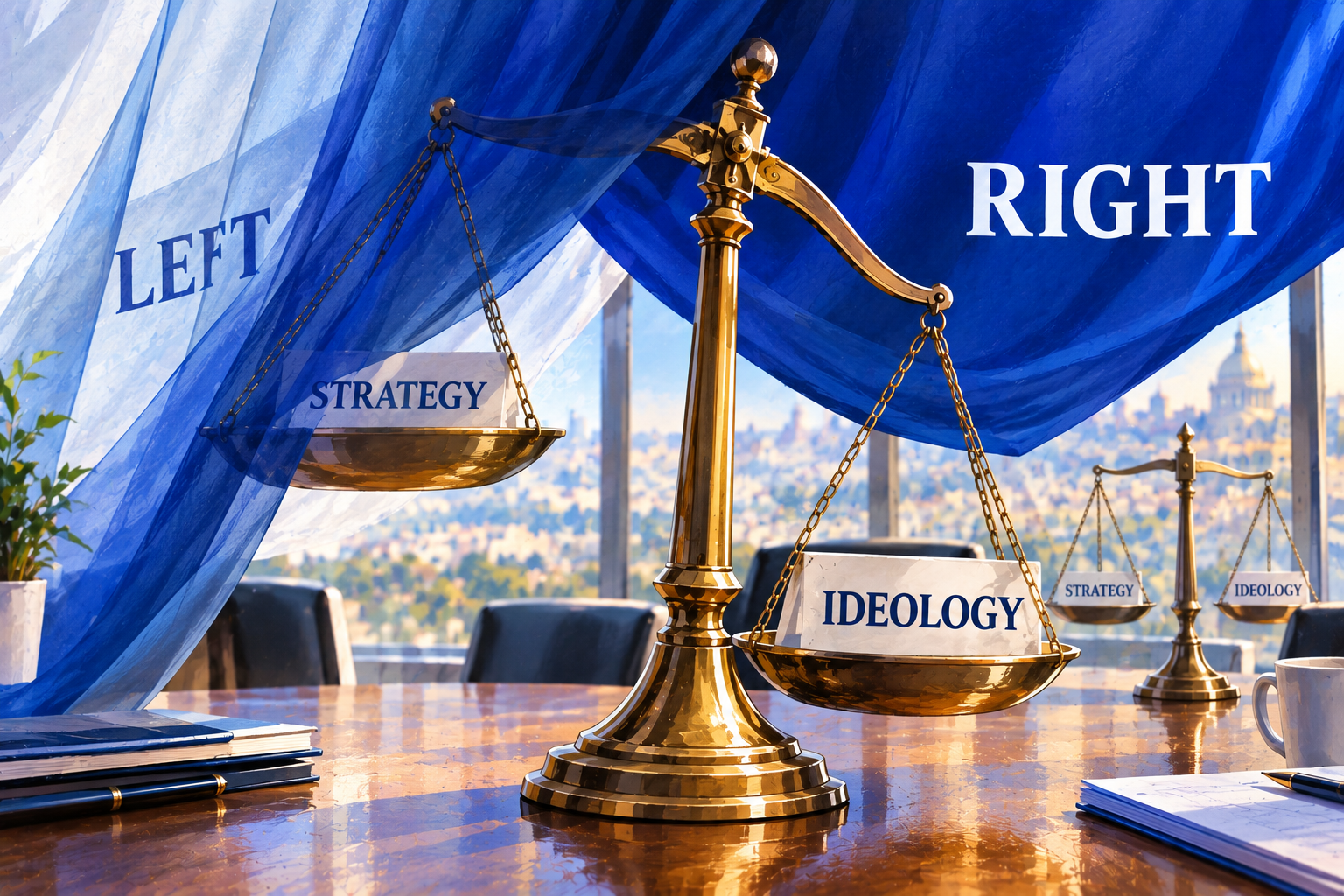
The Democrats just sent me a video clip on strategic voting. Where will that meet my ideological consideration at the polls?
Harriet Gimpel
October 13, 2026