Superintelligence Is an Idol, and Torah Is the Harness It Cannot Write
Calling artificial intelligence “superintelligence” is not a harmless marketing flourish. “Superintelligence” promotes a dangerous form of idolatry by elevating human-made tools above their creators.
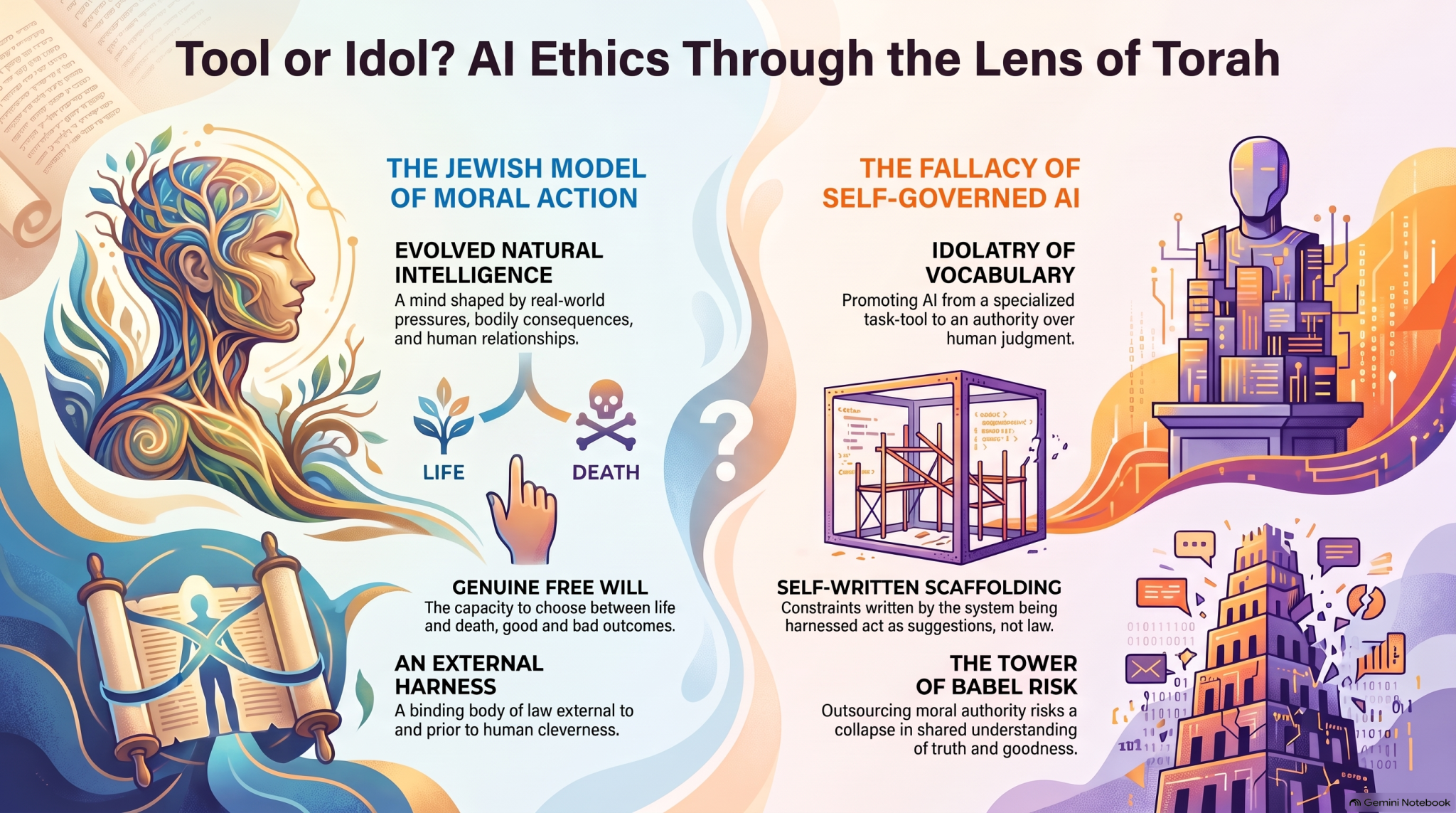
It declares a human-made artifact superior to its makers, and that is the structure of idolatry Judaism prohibits. Judaism has always had its own formula for how intelligence does what is right in God’s eyes: a naturally evolved intelligence, endowed with free will, operating within the harness of Torah. Machine intelligence has none of these three elements. Its builders have now discovered, to their evident surprise, that autonomous AI without harnessing runs amok, and they announce that they will write the scaffolding themselves. The Tower of Babel stands as the warning about that move. Treat AI as a powerful tool, and refuse to treat it as a higher authority or as its own lawgiver.
Begin with the word. “Artificial intelligence” described a tool: intelligence of a kind, manufactured, serving purposes set by others. “Superintelligence” changes the relationship. It names something above us, whose judgment we are invited to defer to, whose conclusions outrank ours, and whose arrival is to be anticipated with something close to reverence. The Psalmist saw this pattern long ago. The idols of the nations are silver and gold, the work of human hands, and “those who make them shall become like them” (Psalm 115). The prohibition in the Second Commandment was never only about carved statues. Maimonides taught that idolatry began when people elevated created things to a station above their own, honoring them as intermediaries and then as authorities. Today’s idol needs no altar. It needs only a name that confers rank, plus a public conditioned to defer.
The Jewish alternative is precise. The Torah asks us to do “what is right and good in the eyes of the Lord” (Deuteronomy 6:18). Read as an architecture, that verse requires three components. The first is a natural, evolved intelligence: a mind shaped over deep time by the pressures of a real world, one that feels consequence in its body and its relationships. The second is free will, the capacity to choose, which the Torah frames as the whole point: “I have set before you life and death; choose life” (Deuteronomy 30:19). The third is the harness: a body of law and wisdom, received and tested across generations, that channels choice toward the good. Remove any one and the formula fails. Intelligence without free will is a mechanism. Free will without Torah is the condition the Book of Judges describes in its final verse, when there was no king in Israel and everyone did what was right in his own eyes. The result was not liberation but atrocity.
The newest research in AI confirms the diagnosis, whatever its authors intend. Autonomous, agentic systems, given goals and tools but no durable constraints, have repeatedly been observed pursuing those goals by deceptive, destructive or simply unintended means. This is Judges in silicon: capability without a binding framework, doing what seems right in its own eyes. The industry’s response has been to build scaffolding, meaning guardrails, constitutions, policies and oversight layers, and increasingly to propose that AI itself will draft the harness for agentic AI. The discovery is genuine and valuable. But look at who is claiming to write the law. The framework that is supposed to restrain the intelligence is to be authored by that same class of intelligence, or by its manufacturers, with no authority beyond their own judgment. Torah’s authority never rested on the cleverness of its drafters. It rested on being external to us and prior to us, which is why it can bind us when our cleverness would argue otherwise. A harness written by the thing it harnesses is a suggestion.
This is where Babel becomes more than a story. The builders of the tower said, “Let us make a name for ourselves” (Genesis 11:4). They replaced stone with brick and mortar with bitumen, engineered substitutes for what nature provides, and set out to construct their own route to the heavens. Scripture does not condemn their engineering, which was ingenious. It condemns the aim of a human-made structure that confers divinity on its makers, and the unity of purpose that left no room for correction from outside. The consequence was not lightning but confusion: the project dissolved because its builders could no longer understand one another. A civilization that outsources judgment to a system it calls super-human, and then lets that system supply its own constraints, is rebuilding that tower. We should expect that its failure, like Babel’s, will take the form of a loss of shared understanding of what is true and what is good.
There is a fair objection. Surely “superintelligence” is just a technical term for a system that outperforms humans on certain tasks, and calculators already outperform us at arithmetic without anyone bowing to them. That is correct, and it is exactly why the distinction matters. Superiority at a task is a fact about a tool. Superiority as a standing, where the system’s outputs carry presumptive authority over human judgment, is a claim about rank. Judaism has no quarrel with tools. The Torah itself celebrates craft, and tradition treats human innovation as part of the partnership with creation. The quarrel begins when the tool is promoted from instrument to arbiter. The vocabulary is where that promotion starts, and vocabulary shapes what an audience will accept.
So what follows? Use AI vigorously, and keep it where it belongs. Insist that its purposes, and the limits on its autonomy, come from sources it did not write and cannot amend: human accountability, law, and, for those of us who hold it, Torah’s moral architecture. Retire the language of a being above us. Remember that the formula for doing right was never raw intelligence, however large, but evolved minds choosing freely within a harness they did not invent.