Supersessionism and Anti-Zionism in Pseudo-Catholic Clothing
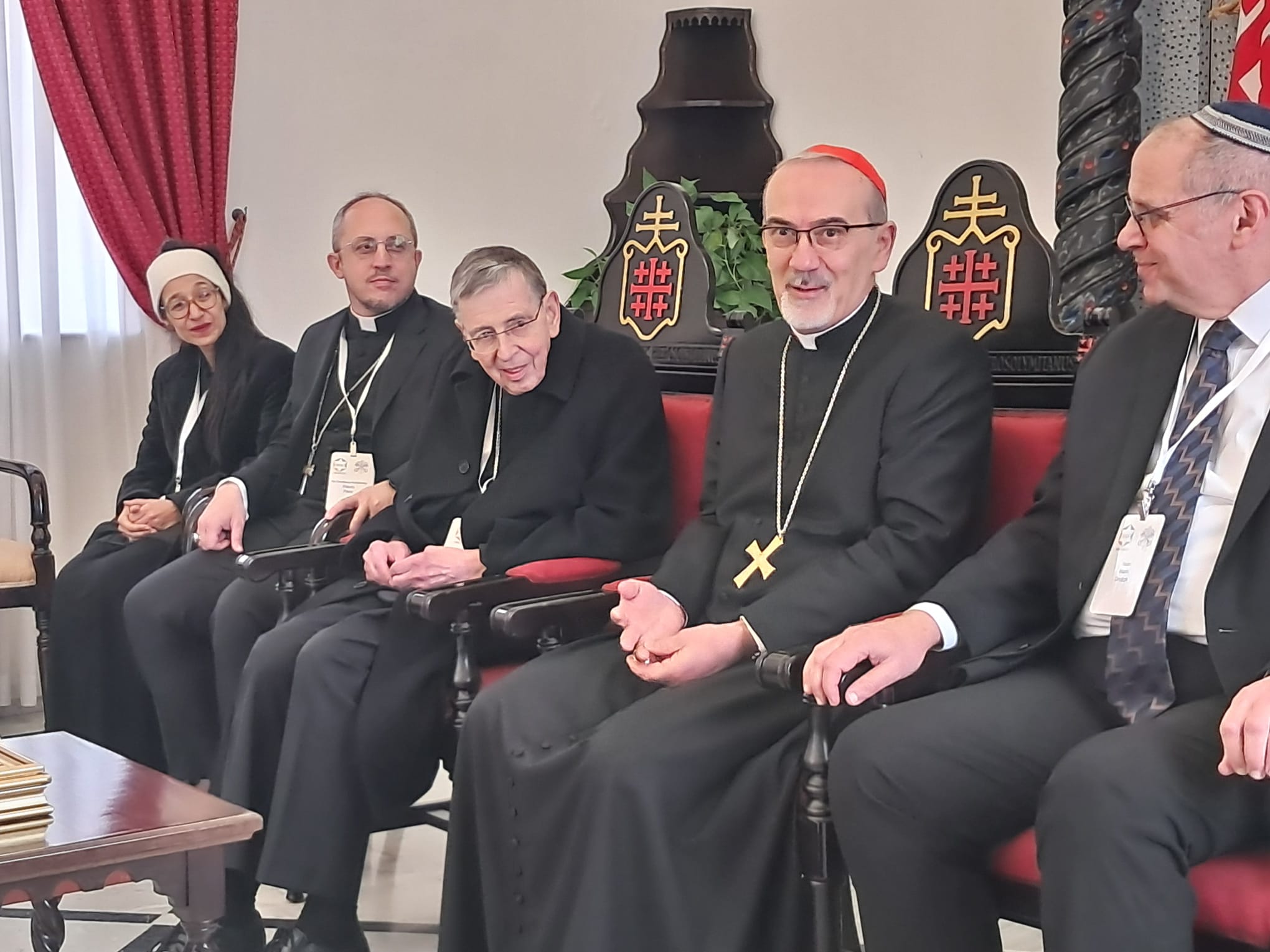
I am writing these words in Jerusalem, a few days after concluding a joint conference of the International Jewish Committee for Interreligious Consultations, the official partner representing world Jewry in dialogue with the Vatican, and the Vatican’s Commission for Religious Relations with the Jews. For two days, Jewish and Catholic leaders reflected together on the history and future of Nostra Aetate, a declaration that fundamentally changed the trajectory of Catholic-Jewish relations for the first time in almost 2,000 years, whose sixtieth anniversary is being commemorated throughout this year. The conversation was honest, warm, and forward-looking. It reminded me why this dialogue matters.
And then I read the article published on February 12 by Catholics for Catholics, entitled “The Catholic View on Zionism and the 1948-State of Israel.” It reminded me why this dialogue is in danger.
Here is the background: On February 9, during the fifth public hearing of the White House Religious Liberty Commission, commissioner Carrie Prejean Boller, a recent convert to Catholicism, claimed that her Catholic faith prohibits support for Israel, stated that “Jews killed Jesus,” defended commentators who have promoted antisemitic conspiracy theories, and wore a pin depicting the American and Palestinian flags while Jewish witnesses testified about antisemitism in the United States. Commission chairman Lt. Gov. Dan Patrick removed her on February 11. Following her removal, commentator Candace Owens, whom Prejean Boller had defended at the hearing, described Jews as “occult Baal worshipers” in a post that Prejean Boller reposted. The Catholics for Catholics article appeared the next day, offering a theological framework for the positions Prejean Boller had advanced.
I want to be clear about what is at stake. This is not an internal Catholic theological debate of no concern to Jews. It mischaracterizes the trajectory of Catholic teaching since the Second Vatican Council and undermines the foundations of a dialogue that the Catholic Church itself has labored to build—a dialogue in which I have the privilege of serving as the Jewish chair. It also endangers Jews at a time of rising antisemitism.
And while it is not for me to dictate Catholic theology, the Church itself has spoken with unmistakable clarity on these questions over the past six decades.
Misrepresenting Catholic Teaching
The article claims to present “the Catholic view.” It does not. It draws selectively from Nostra Aetate and Lumen Gentium while ignoring the extensive body of subsequent magisterial documents that have refined and, in some cases, corrected earlier formulations. The article reads as though the development of Catholic teaching on the Jewish people stopped in 1965. It did not.
The article makes no reference to the landmark 2015 document of the Vatican’s Commission for Religious Relations with the Jews, The Gifts and the Calling of God Are Irrevocable (Rom. 11:29), which states that “a replacement or supersession theology which sets against one another two separate entities, a Church of the Gentiles and the rejected Synagogue whose place it takes, is deprived of its foundations.” The theology advanced by Catholics for Catholics is precisely the supersessionist theology that the Catholic Church’s own official bodies have spent six decades dismantling. To declare that the Church is the “new Israel” and sole inheritor of the Abrahamic covenant, without acknowledging the Church’s own repudiation of replacement theology, is to misrepresent Catholic teaching, not to articulate it.
The article’s assertion that Jews need to be brought to “their Messiah and His Church” stands in direct tension with the same 2015 document, which affirmed that the Catholic Church “neither conducts nor supports any specific institutional mission work directed towards Jews.” Cardinal Kurt Koch, President of the Dicastery for Promoting Christian Unity, which houses the Commission, stated at the document’s release that because God’s covenant with Israel has never been revoked, Jews participate in God’s salvation, even as the manner of this participation remains, in the Commission’s words, an unfathomable mystery.
The Jewish People and the Land of Israel
The article reduces the question of Israel to a false binary: either the State exists by natural law alone, identical to any other nation, or it claims divine right in a manner incompatible with Catholic faith. Neither option accounts for the Jewish people’s three-thousand-year bond with the Land of Israel, a bond attested in the Hebrew Bible, woven into daily Jewish liturgy, and acknowledged in the Catholic Church’s own 1985 Notes on the Correct Way to Present Jews and Judaism in Preaching and Catechesis. One need not accept any particular policy of the State of Israel to recognize that the Jewish people’s relationship to the Land is religiously significant and integral to Jewish identity in a way that has no parallel among the nations.
This binary also fails to engage the growing body of Catholic theological scholarship that takes seriously the biblical land promise as integral to the irrevocable covenant, without endorsing eschatological fulfillment or political maximalism.
The article cites Pope Emeritus Benedict XVI’s observation that a Jewish state claiming to be the political and religious fulfillment of God’s promises would be contrary to the Christian understanding. I do not quarrel with this narrow point. IJCIC has never asked the Catholic Church to view the State of Israel as the fulfillment of biblical prophecy. But the article uses Benedict’s careful theological distinction as warrant for something Benedict himself did not do in that passage: deny the religious significance of the Jewish people’s bond with the Land altogether and revive a comprehensive supersessionism that the Church’s own post-conciliar development has repudiated. Saying that the State of Israel is not the theological fulfillment of divine promises is a legitimate Christian theological position. Saying that the Jewish people’s attachment to the Land of Israel is merely a political claim with no religious significance is something else entirely. It is a distortion of Jewish identity that the Catholic Church’s own documents have cautioned against.
The article asks why no other nation requires an “ism” to affirm its right to exist. The answer is that no other nation’s right to exist is routinely denied. The Jewish people’s right to self-determination in their ancestral homeland is contested in a way that applies to no other people on earth. That is precisely why a word for it exists.
The Deicide Charge
I am further alarmed by the revival of the deicide charge in the original hearing and the antisemitic rhetoric that has surrounded the article’s dissemination. Nostra Aetate was unambiguous: “what happened in His passion cannot be charged against all the Jews, without distinction, then alive, nor against the Jews of today.” Every subsequent Pope has reaffirmed this teaching, most recently Pope Leo XIV, who declared at the sixtieth anniversary commemoration that the Church does not tolerate antisemitism and fights against it on the basis of the Gospel itself. That the deicide charge is now being reasserted in a federal government forum, by individuals claiming to speak in the name of Catholic fidelity, is a direct repudiation of conciliar teaching.
The social media environment surrounding this article has included explicitly antisemitic rhetoric from prominent figures who praised the positions articulated therein, including the characterization of Jews as practitioners of occult worship. The article’s subject reposted these statements. The article’s authors have not distanced themselves from them. The company a theological argument keeps matters.
Why This Matters Beyond Theology
I have spent much of my professional life working at the intersection of religious thought and real-world consequences. As a rabbi, as an educator, and now as chair of IJCIC, I have seen how ideas that seem confined to theological journals can shape the lived experience of communities. The positions advanced in this article have consequences that extend well beyond doctrinal debate.
When supersessionist theology is presented as authentic Catholic teaching in forums with political reach, it provides a framework of theological respectability for antisemitism. The deicide charge, revived in a federal government context, is not a historical curiosity. It is the oldest and most durable engine of anti-Jewish violence in Western civilization. Its reassertion in public life, under the banner of Catholic fidelity, has implications for the civic standing and physical safety of Jewish communities.
The Catholic Church understood this sixty years ago. That is why it acted. The post-conciliar transformation was not an exercise in diplomatic courtesy. It was a recognition that theology shapes culture, culture shapes politics, and the teaching of contempt had contributed to the conditions that made the Shoah possible. The Church’s repudiation of that teaching has been, for six decades, one of the most consequential moral acts of the twentieth century. It has made Jews safer. It has made Catholic-Jewish cooperation possible in education, humanitarian work, and the defense of religious liberty worldwide. When that teaching is publicly contradicted by those claiming Catholic authority, the damage is not theoretical. It undermines the practical foundations on which Jewish and Catholic communities have built shared civic life.
This article appeared at a moment when antisemitic incidents in the United States and worldwide have reached levels not seen in decades. Context matters. Theology that delegitimizes the Jewish people and their bond with the Land of Israel does not exist in a vacuum. It enters an environment in which such delegitimization has already turned violent, as the surge of antisemitic incidents since October 7, 2023 has made painfully clear.
The Record of Catholic Commitment
The positions advanced by Catholics for Catholics do not represent Catholic magisterial teaching as understood by the Holy See, the Commission for Religious Relations with the Jews, or the vast majority of Catholic scholars, bishops, and institutions engaged in interreligious dialogue. The record of Catholic institutional commitment tells a different story: Pope Leo XIV’s October 2025 declaration that Nostra Aetate represents, on a biblical and theological level, a point of no return; the USCCB’s 2024 mandate of a pastoral note on antisemitism in all parish missals; and the December 2024 joint USCCB-American Jewish Committee publication Translate Hate: The Catholic Edition. Each of these actions reflects a Church that has internalized the Council’s lessons and continues to act on them. They represent the authentic direction of Catholic teaching on these questions.
I cannot remain silent when supersessionist theology is presented as authentic Catholic teaching and the deicide charge is revived in a federal government hearing. I will not remain silent when the Jewish people’s bond with the Land of Israel is dismissed as a political convenience. To claim to speak for a Church while contradicting that Church’s own magisterium is not fidelity. It is a perversion of it.
In this year marking the sixtieth anniversary of Nostra Aetate, I express my confidence in our Catholic dialogue partners and my gratitude for the leadership of Popes John Paul II, Benedict XVI, Francis, and Leo XIV in advancing the revolution in Catholic-Jewish relations that the Council began. Sixty years ago, the Catholic Church chose a different path. It chose dialogue over contempt and recognition over erasure. That choice was not made lightly, and it will not be surrendered to those who did not make it.
The dialogue we celebrated in Jerusalem last week remains vital. It is built on mutual respect and hard-won trust. I will continue to defend it, together with our Catholic partners.
—
Rabbi Mark Dratch is Chair of the International Jewish Committee for Interreligious Consultations (IJCIC), the official Jewish partner in formal dialogue with the Holy See and major Christian communions. He is Executive Vice President Emeritus of the Rabbinical Council of America.