
Where history exposes power and moral failure
Supporting Soldiers Shouldn’t Sideline Disabled Civilians
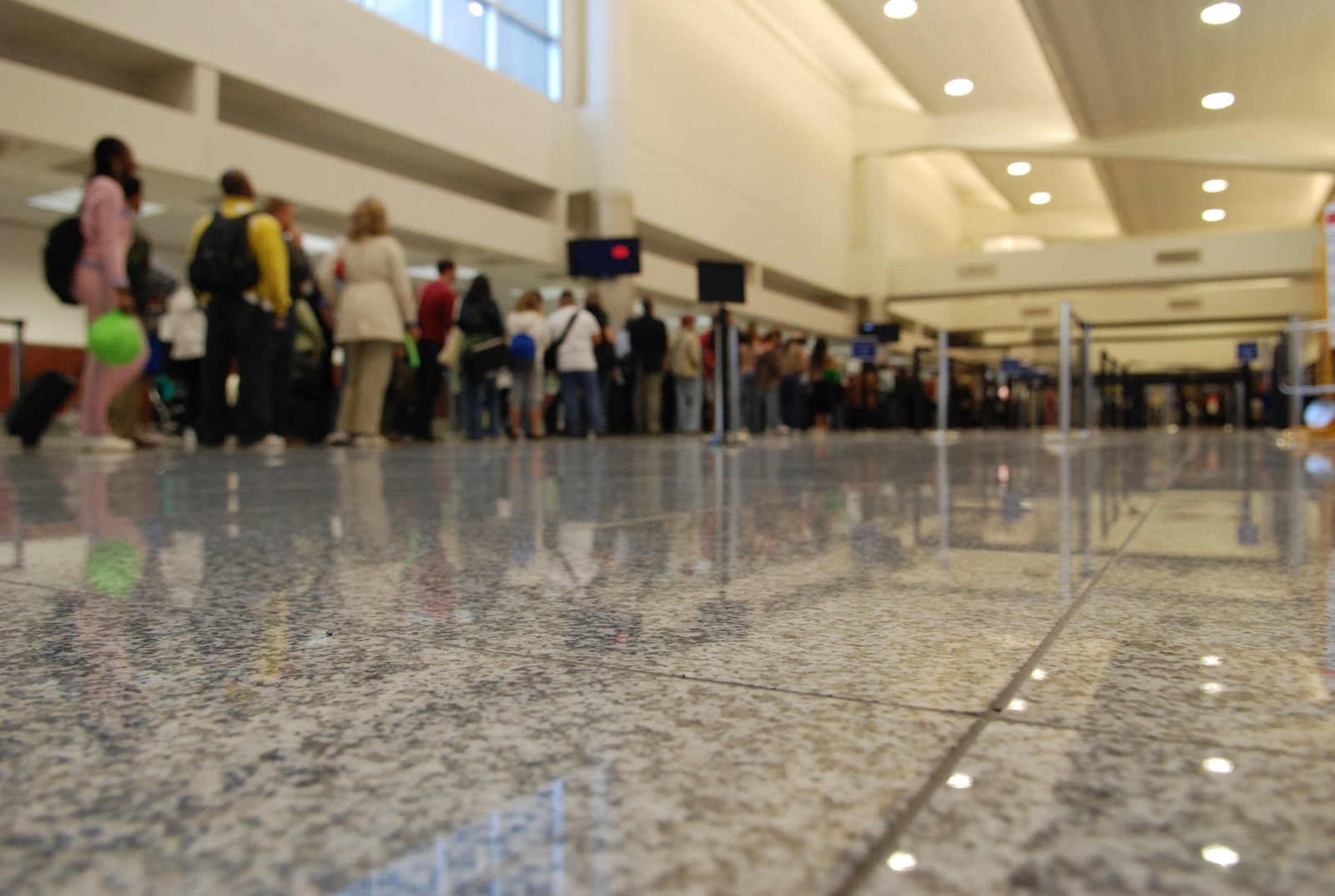
Photo: Atlanta Security Line by Josh Hallett, Wikimedia Commons (CC BY 2.0)
H.R. 9328 has coasted through Congress so far as one of the easiest votes placed before it during one of the most tumultuous periods in modern US history. That may be excellent news for active-duty military personnel and their families who want to move through airport security more quickly. It is the latest piece of absolutely terrible news for disability civil rights.
The Improving Travel for Military Members Act passed the House with overwhelming bipartisan support and now sits before the Senate. Few members of Congress appear eager to argue that military families should spend longer in airport security lines. Airports already provide a familiar stage for public gratitude toward service members, where strangers thank them for their service. A bill promising to make travel easier for those same service members arrives wrapped in all the same moral reassurance. Democrats and Republicans can support it together, praise military families, and avoid almost any political cost.
The House also approved language allowing the Transportation Security Administration to open and close screening lanes and shift available resources to carry out the bill. I have found no public disability-impact assessment examining what those decisions would mean for the Americans whose screenings already require the greatest amount of TSA time, staff, space, and attention. I have found no public record of consultation with Disabled travelers or disability organizations about the effect of creating another expedited class within an already strained screening system. The bill appears to have moved forward without serious public consideration of the people most likely to absorb the operational consequences.
Most people carry a very simple picture of a wheelchair user at airport security. They imagine an elderly passenger sitting in an airport chair while an attendant pushes them through the checkpoint. The other familiar image is one of the internet’s favorite villains: the supposedly fraudulent traveler who claims disability merely to skip the line. These two figures, the frail elderly passenger and the presumed faker, have become the public’s default understanding of disability at airports.
Many Disabled travelers resemble neither. Some cannot stand for screening. Some cannot transfer into another chair. Some use power wheelchairs weighing hundreds of pounds, individually configured around their posture, skin protection, breathing, circulation, and ability to function. Some have pacemakers, ventilators, feeding tubes, oxygen equipment, implanted ports, braces, or other medical devices. Some have muscles that fatigue rapidly, joints that dislocate easily, severe pain when touched or repositioned, or medical conditions that make prolonged delays dangerous. Their screenings may require officers to search them while they remain seated, inspect the wheelchair piece by piece, swab the chair and equipment for explosive residue, move cushions and bags, examine medical supplies, and call additional staff or a supervisor.
The same checkpoint serves autistic children and adults who may panic when touched without warning, Blind travelers trying to follow spoken instructions amid overlapping announcements and crowd noise, Deaf passengers who cannot hear directions shouted from behind them, Little People whose bodies do not fit standard screening assumptions, and passengers who require a private room because the screening itself is intimate, painful, or humiliating. Some travelers need a Passenger Support Specialist to help them navigate the process safely. All of this requires officers, time, screening space, and operational attention. Every one of those resources is finite.
TSA has already acknowledged that limitation to me in writing. The agency has stated that Passenger Support Specialist availability depends upon staffing and operational resources. That admission matters because H.R. 9328 assumes that resources can be redirected toward a new expedited population without publicly accounting for the services already dependent upon those same officers and operational capacity. Congress cannot treat TSA staffing as finite when explaining why disability assistance may be unavailable, then treat it as elastic when offering a politically attractive benefit to military families.
The House has voted to create another group entitled to expedited screening. It had the authority to make that choice. It did not publicly demonstrate how the officers, checkpoint space, private screening rooms, Passenger Support Specialists, and additional time required by Disabled travelers would remain available after resources were shifted to satisfy the new mandate. The people affected already possess rights under federal disability law. Many already experience inconsistent assistance, degrading searches, avoidable pain, damaged mobility equipment, confusion, and delays under the current system. H.R. 9328 has not yet become law, and the Senate still has time to prevent those existing failures from becoming worse.
As a historian, I understand why the House behaved as it did. If I had been an able-bodied member of Congress this summer, watching an anxious reelection calendar and searching for one uncomplicated bipartisan achievement, I might have voted for H.R. 9328 myself. Most career politicians probably would have. During a period of extraordinary polarization, the bill gave Democrats and Republicans an opportunity to stand together behind active-duty military personnel and their families. Every member could issue a favorable press release, record a campaign advertisement, post a photograph, and return home having supported something almost no voter would condemn.
The political bargain becomes even easier because the people likely to lose from it are largely invisible. A senator or representative receives immediate credit for helping military families. There is no comparable photograph of the non-ambulatory passenger waiting for an officer who has been reassigned, the autistic child deteriorating in a crowded checkpoint, or the Blind traveler left without the promised assistance. The benefits are easy to announce. The costs will appear later, one traveler at a time, inside airports where each failure can be dismissed as a local staffing problem rather than traced back to the priorities Congress created.
That is why the House’s lack of scrutiny deserves attention. Measures carrying the emotional force of military support can pass with very little resistance because opposition is easily recast as hostility toward service members themselves. A legislator who asks whether finite TSA resources are being redistributed at the expense of Disabled travelers risks sounding obstructive, unpatriotic, or indifferent to military families, even when the question concerns the lawful operation of a federal agency. The political culture surrounding military service makes the bill easy to support and difficult to examine.
The House celebrated helping one deserving group without publicly establishing that another would not pay part of the cost. The Senate can still require that accounting before the bill advances. It can ask TSA for staffing projections, disability-impact analysis, consultation records, and a concrete plan for preserving Passenger Support Specialists and disability-related screening capacity at every affected airport. The opportunity to correct the omission remains open because the legislative process is not finished.
The pattern behind H.R. 9328 is familiar far beyond the United States. Democracies often lower their guard when legislation is attached to a revered institution, an honored population, or a national story that politicians fear appearing to challenge. Military necessity can be real. Ukraine is fighting a large-scale war following Russia’s invasion. Sudan, Myanmar, Syria, and Yemen remain consumed by devastating internal conflicts and regional intervention. Somalia and Nigeria continue to confront insurgent violence. Haiti faces severe armed instability. Israel, the Palestinian territories, Iran, Lebanon, and the wider region are living through active hostilities whose consequences reach directly into civilian life. Governments operating under those conditions may sometimes have legitimate reasons to move soldiers, reservists, emergency personnel, or military families quickly. They may have to redirect transportation, public space, staff, equipment, and money toward immediate defense, evacuation, mobilization, or survival.
The existence of those conditions does not abolish disability rights. It does, however, create a serious question of necessity that must be examined honestly. A temporary military priority may be defensible when a government can identify the operational purpose it serves, demonstrate that the urgency is real, limit the measure to what the emergency requires, and protect Disabled civilians from avoidable and disproportionate harm. War can force a democracy to make difficult allocations. It cannot relieve the government of explaining them.
H.R. 9328 does not arise from that kind of necessity. The United States is not creating expedited airport screening to move mobilized troops toward an active front, return reservists to units during a national emergency, evacuate military families from immediate danger, or preserve the functioning of a state under sustained attack. Congress has not established that ordinary airport screening times are obstructing defense operations or placing military readiness at risk. It is creating a permanent preference within a civilian transportation system because support for military families is politically attractive and resistance to that preference would be politically expensive.
The difference is not semantic. In a genuine emergency, the military benefit and the burden imposed upon civilians may be connected to a concrete public necessity. Under H.R. 9328, the benefit is largely ceremonial and reputational while the costs are operational. Members of Congress receive credit for honoring service members. TSA must find the officers, lanes, screening space, supervisory attention, and staff time required to deliver the promised preference. Disabled travelers will encounter the consequences only if the Passenger Support Specialist is unavailable, the private room is occupied, the officer needed for a seated pat-down has been reassigned, or the checkpoint lacks sufficient staff to complete a complicated screening safely.
The American military-industrial complex is sustained by far more than weapons contracts and Pentagon procurement. It also depends upon a political culture in which nearly any measure presented as support for service members or military families receives a presumption of virtue before its actual effects are examined. The emotional language of sacrifice and gratitude helps protect an enormous network of military spending, contractors, legislators, federal agencies, veterans’ organizations, campaign messaging, and public ritual from ordinary democratic scrutiny. H.R. 9328 sits comfortably inside that system. It gives Congress a cheap opportunity to display loyalty to the military while shifting the practical burden onto Disabled civilians whose rights are less politically useful and whose suffering will occur out of public view.
In the United States, even insisting upon enforcement of existing civil-rights law can be treated as an act of disrespect when the competing interest has been wrapped in military language. A Disabled person who asks whether federal screening resources are being redirected away from legally required assistance is easily recast as hostile to service members rather than concerned with the conduct of a federal agency. The same distortion greets public advocacy. The demand that Congress account for disparate harm becomes, in the hands of the military-industrial culture, an accusation against soldiers and their families. That is how scrutiny is punished before it can become effective: the person raising the legal question is shoved outside the moral community, while the institution that created the conflict escapes examination.
America has built an entire civic language around supporting the troops. It has built almost none around standing beside Disabled civilians when the federal government fails to enforce the rights it has already promised them. Congress will rise together to celebrate military families, yet scarcely pause to ask whether Disabled Americans will lose meaningful access to a federal service as the price of that celebration. A country confident enough to praise sacrifice should also be confident enough to distinguish actual military necessity from political theater and to insist that its civil-rights laws survive contact with politically untouchable institutions.
The United States is hardly the only democracy wrestling with the relationship between military necessity and civilian life. Across Europe, Russia’s full-scale invasion of Ukraine has forced governments to rethink defense spending, military readiness, and national resilience. France has experienced some of the sharpest public debates, as questions of rearmament, strategic autonomy, defense budgets, and military capability compete with equally urgent demands for investment in health care, education, disability, transportation, and the broader social state. Those arguments are contentious because they concern genuine allocation. Resources devoted to one national priority are resources unavailable for another, and claims of military necessity must still be tested against what the state continues to owe its civilian population.
France is not Ukraine. Its Bastille Day parade is not an emergency mobilization or an evacuation from an active front. The state chooses to maintain the personnel, security operations, vehicles, aircraft, street closures, and logistical machinery required for an enormous public display of military power. It therefore cannot invoke limited capacity as an indefinite explanation for inaccessible Métro stations, public buildings, housing, and transportation already required by law. A government may decide that military ceremony has civic value. It may not treat the resources devoted to that ceremony as untouchable while presenting disability access as an aspiration to be pursued when money, personnel, and political attention eventually become available.
Israel lives with the relationship between military power and civilian life at an intensity few democracies experience. Military service, reserve duty, mobilization, bereavement, displacement, and national security enter ordinary family life with a directness Americans usually encounter only during war. In the present regional conflict, soldiers and reservists may need to move quickly for reasons tied to active operations, emergency mobilization, family evacuation, or the functioning of a citizen-soldier system under sustained pressure. A priority serving those purposes cannot simply be equated with an American congressional benefit designed to make routine air travel more pleasant. The operational question in Israel may be real in a way Congress has not shown it to be in the United States.
That reality increases the need for scrutiny rather than eliminating it. Many Israelis have long understood that proximity to military power creates a duty of examination rather than a reason for silence. Arguments over conscription, exemptions, reserve burdens, conscientious objection, religion in military policy, the unequal distribution of service, the treatment of Palestinians and other neighbors, and the conduct of military operations remain central to Israeli political life precisely because the armed forces exercise such extensive power within and beyond the state. The existence of real security threats has never required citizens to approve every deployment of personnel, money, authority, or force. A society that repeatedly asks people to place their bodies, careers, marriages, and children at the disposal of national policy has every reason to demand a full account of who bears those costs, whose lives are constrained by them, and which civilian needs are deferred in the process.
That democratic expectation should apply with equal force to Disabled Israelis. The state cannot treat accessibility, personal assistance, transportation, housing, medical support, and community services as secondary claims to be addressed only after the urgent work of security has been completed, because security policy has no natural endpoint at which civilian rights can safely resume. Liberal Israelis already reject the proposition that military importance places state conduct beyond legal review, public protest, investigative journalism, parliamentary oversight, or judicial challenge. The same principle must govern disability policy.
A military priority may be justified when it serves an identifiable operational necessity. That justification cannot be assumed merely because the policy concerns soldiers or their families. The government must be able to explain what the preference accomplishes, why existing procedures are insufficient, whether the measure is temporary or permanent, and how Disabled civilians will be protected from losing transportation, assistance, public services, and physical access as a result. Security responsibilities and the civil rights of Disabled Israelis remain concurrent obligations of the same government. The invocation of one cannot suspend the other.
Israel also cannot display aircraft, weapons, troops, and military ceremony as evidence of state capacity while treating accessible transportation, public services, community infrastructure, and disability support as aspirations to be fulfilled when circumstances eventually improve. Emergency operations and military ceremony are not the same thing. Personnel and resources required for an immediate defense operation may be necessary. A public display remains a choice. State capacity cannot appear abundant when military power is being celebrated and suddenly become scarce when Disabled civilians invoke rights the law already recognizes.
Civilian rights cannot become contingent upon whatever resources remain after a government has met every military demand, because military and security demands can expand without a natural stopping point. Countries facing invasion, civil war, insurgency, state collapse, or active regional hostilities may sometimes make temporary and unequal allocations that a peaceful country could not justify. Even then, necessity must be demonstrated rather than presumed, and the burden placed upon Disabled civilians must be limited rather than ignored.
The United States Congress has not made that showing. It cannot answer the consequences of H.R. 9328 by saying that TSA staffing is finite while offering no evidence that expedited screening is required for mobilization, defense, evacuation, or public safety. Once Congress chooses to redirect federal personnel toward a newly created military preference, it must demonstrate that Disabled travelers will retain the assistance, time, space, and lawful access they already possess. In countries confronting active war, a military travel priority may sometimes rest upon a defensible operational need. In the United States, H.R. 9328 offers theatrical support for the troops, political profit for Congress, and an unexamined risk of discrimination against Disabled Americans.
Related Topics
Related Posts