
Surviving the War Room
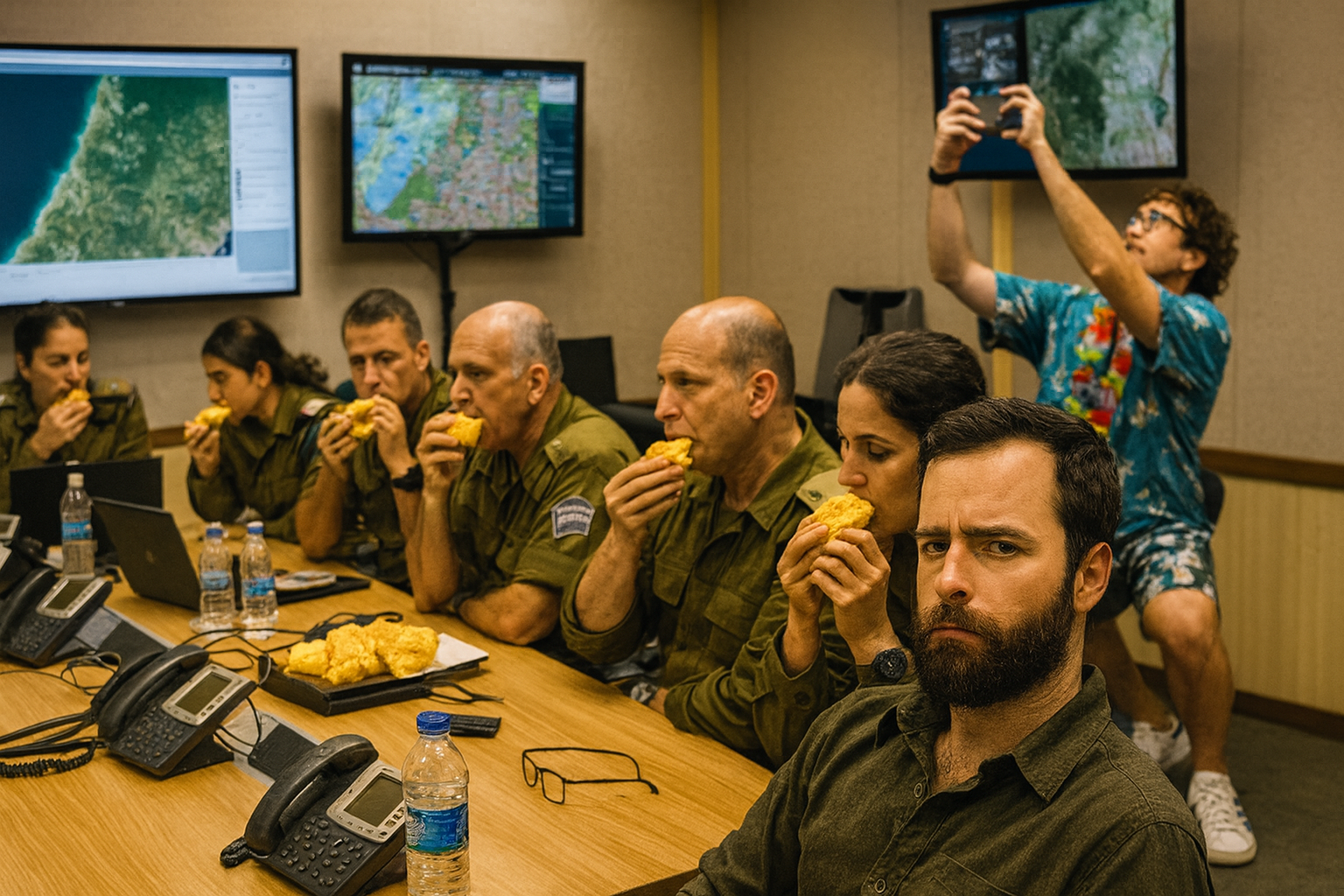
There are moments in life and war when you expect terror, adrenaline, maybe even philosophical reflection.
October 7th came, and Israel started to be pounded by daily rocket attacks from Hamas and constant sirens. The entire Municipality of Tel Aviv shifted to help the refugees from the North escaping the Hezbollah bombing and the homeless people from Gaza´s envelope who survived the massacre. At my department, where we worked with tourism and business generation, that shift meant sending us to the war room to operate a hotline for hotels in case they were hit by a bomb or in case they could welcome in refugees. That’s what is amazing about Israel: the unique way an entire society adapts to a situation of war and, from that abnormal state, has the ability to shift seamlessly back to normality. It is a country that applies like few the Bertrand Russel principle that “war does not determine who is right — only who is left.”
The morning I arrived at my war room station to work in a language I did not fully understand, in a country that was already trembling, I was greeted not by a supervisor, but by an onboarding checklist in Hebrew. A colleague passed by minutes later when she finished her shift and, in that usual Israeli tachlas way, said, “When the hotels call, you pick up the phone and write the available rooms here. Simple, right?”
I was in panic. She left. Behind me, two military personnel casually discussed the apocalypse on the surface. I had barely put my bag down when I heard one of them say, in the calm, collected way, of someone who makes a catastrophe sound like a weather update:
“Be’met? If the rockets hit the buildings in the city, we will have to let them collapse.”
I froze. The other soldier nodded, sipping his coffee like he was rating its aroma.
“Ken, Ken… military infrastructure is the priority.”
Great!
Day one.
No Hebrew.
No clue what my job actually involved, and apparently no guarantee that my infrastructure, physical or emotional, would be prioritized in the event of Armageddon. But around me this magical ability to treat disaster like background music.
I smiled politely, pretended I understood 7% of the conversation, and sat down at my desk with the confidence of a man who definitely did not.
And then — the siren.
One long, rising wail that makes your heart drop straight into your shoes. Everyone froze for a second. I was trying to remember if my boss had told me what to do in this scenario or if I had just imagined that part. But suddenly the room erupted, not in panic, not in screaming, but in:
“MA PITOOOOM?!”
“Who took the Wi-Fi?!”
“Lo machshir! Lo machshir! It’s not connecting!”
Forget Iron Dome, the real emergency was the Hawaiian-shirt man in Adidas sneakers. He was in his mid-40s, balding, friendly face, the kind of man who probably teaches his neighbors’ kids how to ride bikes.
But the moment he realized he could not get online, he transformed into a tragic Shakespearean hero. He clutched his phone with trembling hands:
“I was in the middle of sending a very important message.”
He never clarified to whom. I suspect it was a GIF. Then he started pacing in circles in his pineapple-covered Hawaiian shirt, asking the staff for the password as though they had personally severed the fiber-optic cable.
“TLV2023?”
“TLV_2024?”
“TELAVIVFREE?”
He tried them all like a man cracking ancient codes in the Da Vinci Wi-Fi. Meanwhile, the two army guys behind me, who had been moments ago discussing national collapse, switched instantly from strategic defense planning to:
“Try turning off and on.”
“Nah, brother, the router probably exploded.”
“It’s war, Achi, nothing works.”
Inside the location, chaos outside felt strangely distant. As for me, I was adapting to a new culture, a new language, a new reality, one where sirens, rocket alerts, soldiers in uniform, and pineapple shirts all existed in the same 12 square meters. Someone pulled out an espresso machine. Someone else unwrapped schnitzel from the aluminum foil. A major in uniform asked casually whether anyone had seen a spoon. And me? I stood there thinking: “This is Israel.”
A place where war and Wi-Fi compete for attention.
Where soldiers discuss national collapse next to a guy arguing with his phone. Where chaos outside transforms into comedy inside, because if you don’t laugh, fear wins. And somehow, surrounded by strangers speaking a language I barely knew, staring at a blinking router that refused to obey, listening to the rising sound of sirens above us…
I felt myself adjusting.
Adapting.
Belonging.
Because in Tel Aviv, even underground during a bombing, the most urgent universal truth is: “My brother, the Wi-Fi is down, and THIS is unacceptable.”
Meanwhile, staff and off-duty army reservists were trying to act professionally, but half of them were already live-streaming the situation to family WhatsApp groups titled “MILUIM 2023,” “MILUIM FRIENDS,” “MILUIM BUT NO POLITICS,” and “PRIMI FAMILY WITHOUT DAD.” As if the Wi-Fi meltdown was not enough, there was the catering, or as Israelis call it, “the real front line.”
Someone rolled in a cart loaded with burekas, overboiled eggs, and tiny cups of Turkish coffee. Within minutes, every army guy had turned it into a tactical mission. You’d think they were distributing ammunition.
“Hot bureka! Hot! Who ordered cheese?? Who took the potato one? We said no potato!”
Reserve soldiers were analyzing the food like they were dismantling a suspicious object:
“This hummus wasn’t made today.”
“It’s war, Yossi, nothing is made today.”
One major sat next to you with a plate overflowing like he’d looted a wedding buffet. He casually whispered, mid-chew: “If they attack again, I’m grabbing the coffee machine, and we’re evacuating.”
All around him, officials were attempting to coordinate responses, army reservists were checking maps, and one genius wandered around explaining his personal strategy to end the war using the power of “positive messaging” and a Canva presentation.
“Listen, if I had been Minister of Defense, this would be over by Thursday. MAX.”
You weren’t sure whether to laugh or to start screening for head injuries.
Israelis get sentimental underground. People lingered, finishing their coffee, arguing about soccer, and eating leftover burekas as if they were savoring the first meal after a long journey. Somewhere in the back, someone muttered, half-jokingly echoing Kubrick’s “Doctor Strangelove’s” classic line:
“Gentlemen, gentlemen, no fighting in the war room.”
And that’s when it hits you: forget geopolitics, forget strategy, forget bunker drama. In Israel, no matter the crisis, one universal truth reigns supreme: without coffee, burekas, and at least one army guy casually snacking nearby, the country simply cannot function.