London based entrepreneur, cybersecurity analyst doing a PhD in AI
The Prophetic Mirror: The Nation That Will Be
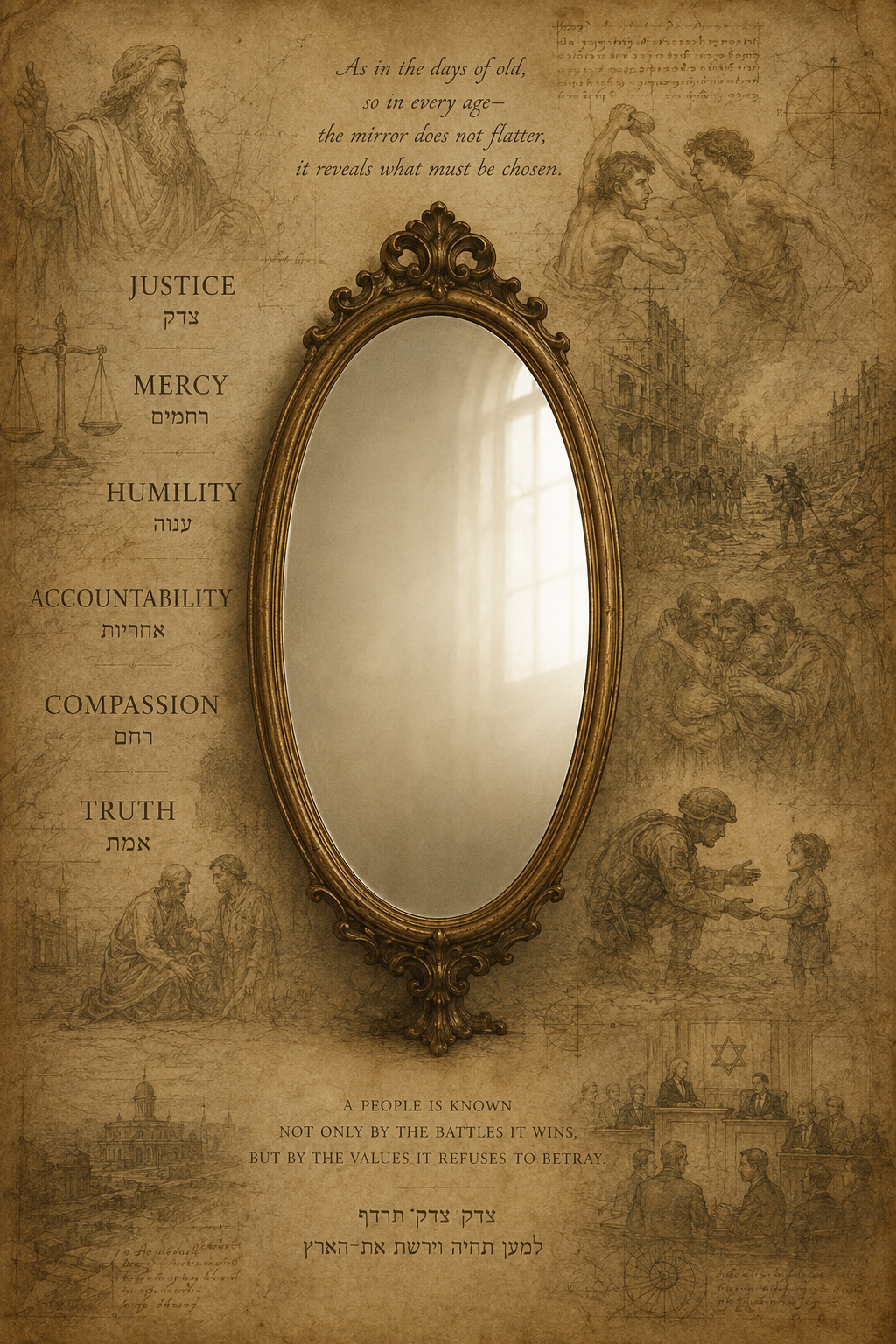
The Prophetic Mirror
Every nation at war faces a moment when it must ask not only whether it can prevail, but what kind of nation it wishes to be when the fighting ends.
Military strategy is a matter of tactics and logistics. National identity, however, is a matter of the soul. As a psychologist, I have long studied how individuals and organizations react under extreme stress. The immediate instinct is always to contract, to harden, and to prioritize survival above all else. Yet the healthiest systems—whether human minds, corporate structures, or sovereign states—are those that retain the capacity for self-reflection even in the midst of existential threat. Israel, today, stands at precisely that juncture.
Israel was founded after one of history’s greatest catastrophes. Its Declaration of Independence envisioned a Jewish state that would uphold liberty, justice and peace while ensuring equality for all its inhabitants. That aspiration has never been easy to fulfill. The sabra realism of its founders always wrestled with the prophetic idealism of its scriptures. Yet this very tension has remained one of Israel’s defining strengths. It is a nation built on argument, on dissenting rabbinic opinions, and on the radical idea that a people can return to its homeland without abandoning its moral compass.
The trauma of October 7th cannot be understated. The kidnapping and terror inflicted upon Israeli civilians demanded a response. Every state has both the right and the obligation to protect its citizens from future attacks. To suggest otherwise is to live in a world detached from reality. These are not negotiable objectives for any sovereign government, and the international community that so quickly condemns Israel’s operations rarely offers a viable alternative.
But military necessity does not remove the burden of moral responsibility. Democracies distinguish themselves not merely by defeating their enemies, but by constantly examining whether the means employed remain consistent with the principles they seek to defend. In my work on AI ethics—currently exploring the intersection of Hanafi Fiqh and Maimonidean jurisprudence—I have come to appreciate a universal truth: the most dangerous systems are those that operate without ethical constraint, justifying every action solely by the righteousness of their ultimate goal. A nation that loses sight of its own legal and moral red lines in the fog of war does not simply defeat its enemy; it risks becoming a mirror image of the very forces it opposes.
Throughout Jewish tradition, leadership is inseparable from accountability. The Hebrew Bible repeatedly depicts kings and rulers being challenged by prophets. Nathan confronted David over the taking of Bathsheba and the murder of Uriah. However, as a practicing Muslim, I do not take the facts of this incident at face value. Prophets (Alayhis Salam) are sinless. King David (or Dawud Alayhis Salam in Islam) cannot commit a major sin. However, the principle remains valid from this story. Power is to be checked. Similarly, Elijah confronted Ahab over the theft of Naboth’s vineyard. Isaiah warned against hollow ritualism and injustice masquerading as piety. These stories are remarkable because they place moral truth above political power. No leader stands beyond criticism simply because they hold office. In fact, the biblical text suggests that the higher the office, the greater the scrutiny required. This is not a weakness of Jewish political thought; it is its crowning glory.
This tradition of self-examination has long been one of Israel’s greatest assets. Israeli society has never been defined by unquestioning loyalty to governments. It has been defined by vigorous debate, independent courts, investigative journalism, academic inquiry and citizens willing to disagree passionately while remaining committed to the country’s future. As someone working in Cybersecurity, I know that the greatest vulnerabilities in any system are not technical—they are cognitive and organizational. A society that silences its internal critics does not become stronger; it becomes brittle, blind to its own faults until they manifest as catastrophic failures.
That distinction matters today more than ever.
Governments are temporary. No political movement should become synonymous with the nation itself. To criticize policies is not to reject Israel’s right to exist. To question the conduct of a specific military campaign is not to side with those who seek the country’s annihilation. This is the treacherous line that Israeli discourse must walk—and it is precisely the line that the prophets (Alayhis Salam) walked centuries ago. They loved their people enough to tell them uncomfortable truths.
The current coalition in Jerusalem does not own the Star of David. The opposition does not own the moral high ground. The nation belongs to the thousands of reserve soldiers, the grieving families, the hostage families, the displaced citizens of the north and south, the Druze officers, the Bedouin trackers, the Arab doctors in Haifa’s hospitals, and the ultra-Orthodox Jews questioning their community’s role in national service. The nation is a living, breathing tapestry of contradictions. And it will outlast every politician currently occupying a ministerial office.
As I launch the UK’s first “Sovereign AI” initiative at www.fahm.uk, I am constantly reminded that governance frameworks must have built-in feedback loops. An AI that cannot be audited is dangerous. A military that cannot be audited is equally so. Accountability is not a luxury reserved for peacetime; it is the very mechanism that ensures a state remains worthy of the sacrifices made in its name.
Israel can win this war militarily and still lose itself if the cost is the erosion of its democratic soul.
The world is watching, yes. But more importantly, the Jewish people are watching themselves. Jewish history is a chronicle of survival against impossible odds. But the legacy is one of law, ethics, and relentless questioning.
If Israel emerges from this conflict with its security restored but its moral clarity intact, it will not merely have won a war. It will have proven that a Jewish state can endure the darkest of times without becoming consumed by them. That is the victory worth fighting for. That is the nation Israel must choose to be.
Related Topics
Related Posts