Susya: An ancient synagogue and a modern tragedy
In January 2024, shortly after the Gaza war began, I went to spend three months living in a Palestinian village in the South Hebron Hills – along with several other volunteers 40 years my junior – to participate in “defensive presence” in Area C. This is the part of the territories that are under complete Israeli military control, and it encompasses nearly all of the West Bank Jewish settlements. The Palestinian villagers are modest people, mostly shepherds and subsistence farmers. Each village was attacked during the week after October 7th by armed settlers who set cars on fire, killed livestock, beat residents up, and shot holes in their water tanks. The choice was simple, the settlers told them: Leave your village within the next 24 hours, or we’ll come back and kill you all.
Some did leave; most had nowhere to go.
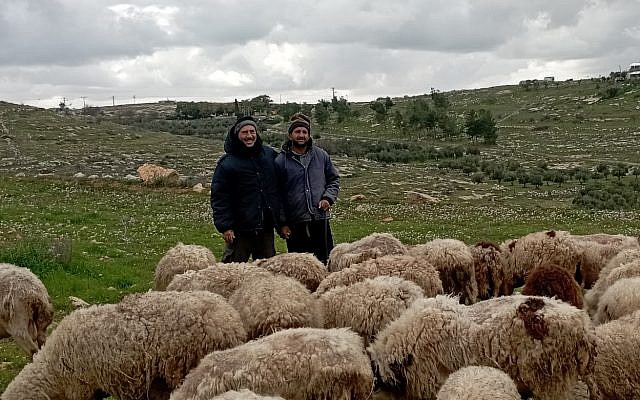
Our job was to be physically present with a camera. We were not to engage with the settlers, not to confront anyone, but just to be there so that when there was an altercation, it could be filmed and perhaps reported. For the most part, when we were present at any given spot (shepherding, farming, walking Palestinian children to school, spending the night sleeping on the floor of their hut), violence was less likely, and when it did occur, it was not as bad as it could have been. The experience, to say the least, was an eye-opener. I witnessed violence against innocent people, an organized attempt to scare them off their land, and a slow erosion of their ability to work, travel, acquire food or medicine, or raise their families.
I was focused on the present, neither investigating the past (“How did we get to this and whose fault is it?”) nor visualizing the future (“What are the possible solutions?”), but only helping innocent people who need it, today. I should also point out that the scope of my understanding is geographically limited to the South Hebron Hills, a region called Masafer Yatta. Area C is a land of Catch-22s, and what I describe is limited to that specific and unfortunate netherworld between the Palestinian Authority and the Israeli military occupation.
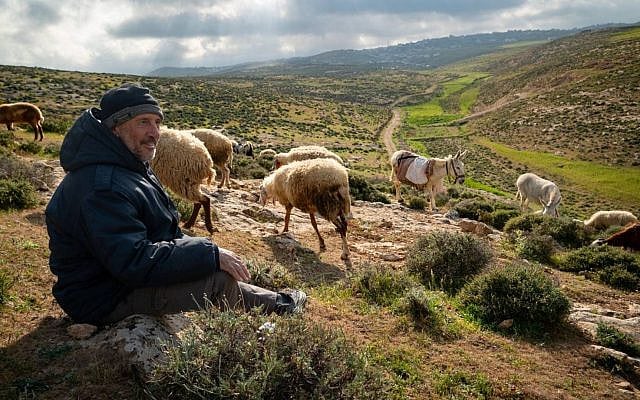
If the plight of these poor villagers was the only reality that I encountered, this would have been a sad three months indeed, but, in fact, at times it was wonderful. Sitting atop hills that looked like the Alps from the opening scene of “The Sound of Music,” surrounded by sheep sniffing the flowers and chewing the grass, I was at peace in a way I rarely am in my busy life at home. At the end of a day of shepherding, I was invited back home to the tent, the cave, or the shack for lunch: flatbread straight from the oven, olives from their orchard, olive oil from their press, cheese from their goats, and greens gathered from the valley.
It was the original farm-to-table experience, everything produced with their own hands literally within a stone’s throw. The feeling was absolutely Biblical, and in the most idealized version. I felt like I was a daily guest in the tent of Abraham and Sarah. In fact, I was constantly reminded of the conflict between Abraham’s shepherds and those of Lot. If those two ancient cousins could resolve their feud, couldn’t we?
Whiplash
Of the dozen villages where we volunteered, I probably spent the most time in Susya. Susya can mean several different things: It can mean the relatively bourgeois Jewish settlement established in 1983, numbering about 1,500 residents. Susya also refers to the nearby national park with the remains of a Byzantine-era Jewish town. The jewel in the crown of this park is the synagogue with lovely mosaic floors. It would be an idyllic little spot if it did not mask a terrible injustice. Up until 1986, it was the site of the Palestinian village of Susya, whose residents were expelled when it was turned into a national park. Half of them settled in the midst of their agricultural fields and built temporary houses that now constitute the new Palestinian hamlet-cum-shantytown of Susya.
On the ruins of their former village, a group of Jewish settlers built an illegal settlement, and the residents (the family of Shem Tov Luski, who has been arrested multiple times on charges of violent behavior, as well as a group of young followers) spend much of their time harassing the Palestinians. So, in this Kafkaesque situation, there are no fewer than five Susyas: Susya the large Jewish settlement, Susya the small Palestinian village, Susya the homestead and outpost of violent settlers, Susya the national park, and, if you look closely enough, Susya the earlier Arab village abandoned to make way for the development of the archaeological site. It is particularly galling to see that those who are terrorizing the already unfortunate denizens of “new” Susya are doing so from atop the very ruins of what was once their village. To those who find this confusing, you’re not alone.
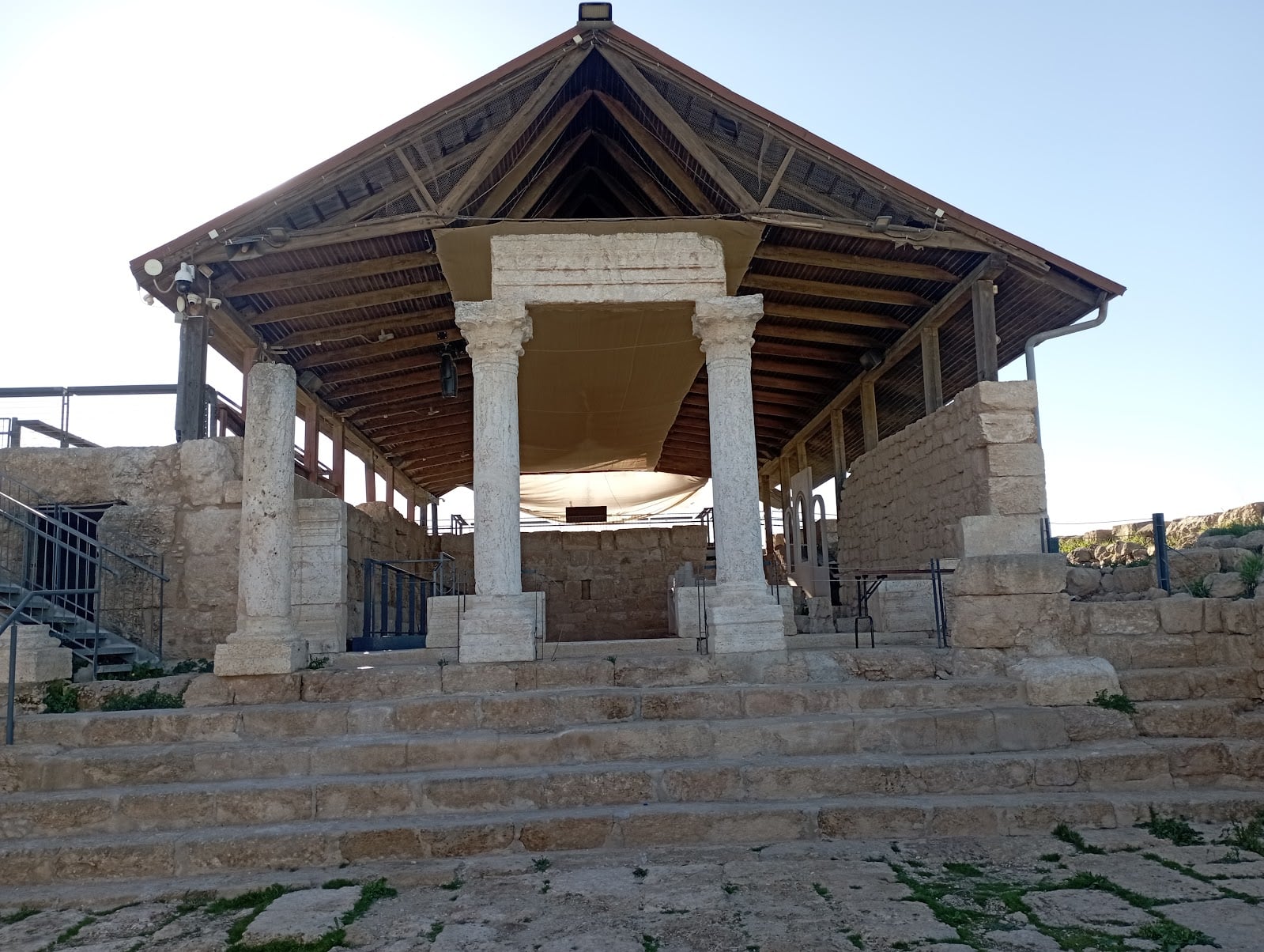
From the moment I arrived in Masafer Yatta, I found myself staring at the ruins of the ancient synagogue of Susya. It was a mere five-minute walk from where I often accompanied shepherds. I am a tour guide and have always been fascinated by the many ancient synagogues dotting the country. I wanted to get a look at this one as well. My fellow volunteers made it clear that this was a bad idea: The relationship we have with the Palestinian villagers is very fragile, and if I were seen by one of the local shepherds walking into this place, it would cast doubt on our whole mission: They might suspect that I was in league with the settlers.
My friends were also worried about me being beaten up by settlers who might recognize me from our altercations in the field. The wisest old volunteer said to me, “Look, don’t do it while you’re with us. If you show up on your own, with your own car and avoid being seen, then maybe it’s okay.” So, the next time I had a car at my disposal, I drove to the park wearing a long-sleeve button-down white shirt (typical of settlers), my tour guide’s badge, and a very large kippa (I was, after all, going to visit a synagogue).
The subterfuge was unnecessary. No one saw me: Not the shepherds, not our people, and best of all, not the settlers. The beautiful park was completely empty. The restored ruins of the synagogue are wonderful, with lovely mosaic floors, including Hebrew inscriptions that any Israeli elementary school student can read. The synagogue was built in approximately 400 CE, but coins were found in the village from as far back as the period of the Hasmoneans (160 BCE).
One of the most intriguing finds from the excavations of the synagogue was a coin from the Great Rebellion, 68 CE, with the Hebrew words “For the Redemption of Zion.” This suggests a Jewish presence of almost a thousand years. Thirty mikvas (ritual baths) have been uncovered here, and it has been suggested that this is one of the spots to which the Kohanim priests of Jerusalem fled as their holy city burned. A lot has happened to this people and this land in 2,000 years, but that little coin speaks volumes.
I have anthropological whiplash from the wildly conflicting narratives: They are so extreme that they might as well be talking about different places. A month earlier, a well-dressed, English-speaking Palestinian had pointed out the site of the synagogue in the distance, referred to the “Ancient Canaanite Culture,” and said that the building was built by Salah a-Din. I smiled and nodded, but said to myself, Huh? Salah-a-Din conquered this land fully 200 years after the building was destroyed. He couldn’t possibly have built it.
The great Muslim general (according to this articulate local) had in his army Jews, Muslims, and Christians, and so he built the structure as a combination church, mosque and synagogue. At the risk of sounding rude, this account is pure fairy tale. For one thing, the building precedes Salah-a-Din by 800 years. This proud and well-meaning man did not even mention the existence of an ancient Jewish village. It’s a nice story, and it illustrates Salah a-Din’s legendary restraint, respect, and pragmatism (which we could do well to emulate today). But that’s as far as it goes.
As for the settlers, their narrative is much simpler. There was a Jewish village here for a thousand years. The Jews were forced out of their homes, their villages, and their synagogue, and now they are returning. Islam is the true colonial power, they say. Beginning with a small tribe in central Arabia, Muslims took over huge swaths of land, slaughtered millions of people, and forced a quarter of the world to adopt their religion, their language, and their worldview. We are merely reclaiming the tiny land that we had for millennia before Mohammad was born.
And finally, there are my friends, my comrades, my young Israeli-born fellow activists, who would be appalled if they found out that I even visited this place, and cannot for the life of them understand why anyone places any value on this pile of rocks. I love them, but mourn their total lack of any sense of history. We do not have to deny our own heritage in order to show respect for that of our neighbors.
A Zionist response
Perhaps I have another kind of whiplash when it comes to my ideological stance as well. I am a Jew and a Zionist, and I am moved by the presence of my ancestors in this ancient land. Fifteen–hundred-year-old synagogues inspire me. But our treatment of the Palestinian villagers makes me ashamed.
I spent the winter in Masafer Yatta, not in spite of my Zionism, but because of it. Unforgivable things are being done by Jews in my name, in the name of my people. I can’t put a stop to it, but I can help a few people at a time once in a while, and make a statement, at least to myself, about where we should be headed as a nation. Shem Tov Luski and his thugs do not represent me.
But of course, in a way, they do represent me, and that is the most difficult part of spending time in the South Hebron Hills, where I continue to come for a 24-hour shift once a week. I cannot claim the glory that is the ancient Jews of Susya and then turn around and pretend that I have no connection to the violent settlers of the illegal outpost on the same hilltop. “Klal Yisrael” – the principle of Jewish solidarity – includes both.
The time I spend in Masafar Yata is a response to the settlers’ self-righteous campaign to drive Palestinians off their land. But what troubles me about the settlers is not just violence. I think they look at Susya and don’t understand what the place means. They see in the ancient synagogues here proof that this land belongs to them, and them alone. But what Susya shows is that it has never belonged to one people alone. Susya has been Hellenist and Hasmonean and Roman and Byzantine and Mameluke and Crusader and Ottoman and Palestinian. Something like this is true of every bit of this land that some people call Israel and others call Palestine.
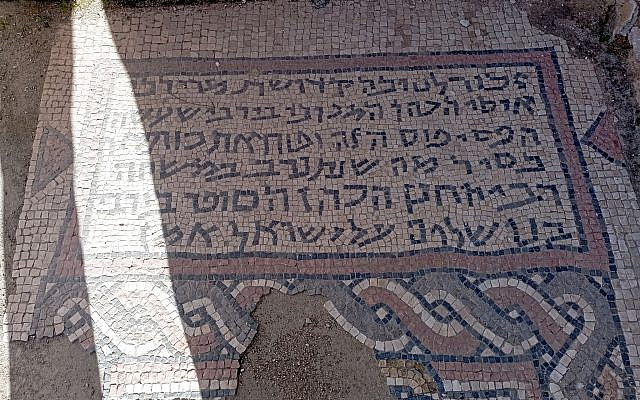
The mosaics that adorn the synagogue of Susya reflect the artistic taste of the time – the extremely Christian Byzantine Empire – including, among other things, a wheel of the zodiac, representing God’s presence in our daily life and in the agricultural seasons, but also reflecting the Hellenistic style of the day, much like American synagogues are built in the style of Protestant churches. The Susya synagogue’s floor is similar to the floors of chapels built at the same time that one can visit all over this country. One of the inscriptions reflects both the importance of unity within the community and the importance of peace in the world:
May he be remembered for good — the holy one, my lord and my rabbi, the honorable Issi ha-Kohen, son of the rabbi, who made this mosaic and lime-plastered its walls, with willing contribution from his son, Rabbi Yohanan ha-Kohen the scribe, son of the rabbi. May peace be upon Israel. Amen.
Indeed. May peace be upon us all.
Amen.