Exploring Jewish heritage through global travel and culture
Sweden’s Yiddish Story: How Sweden Became a Guardian of Yiddish
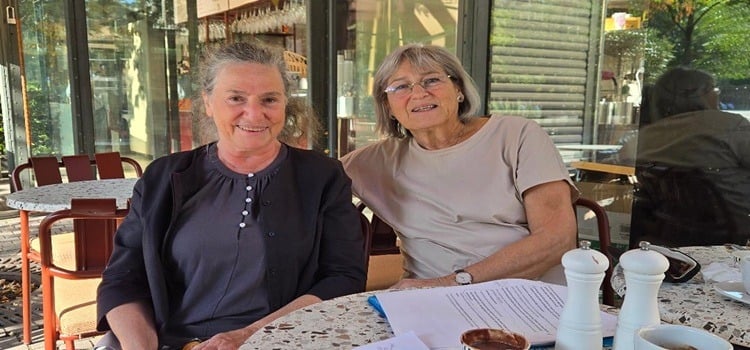
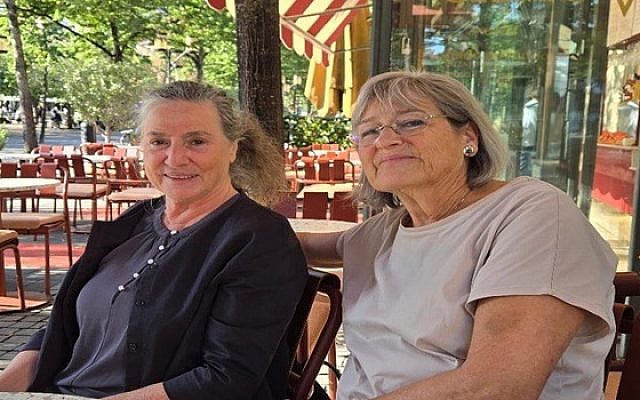
Eva Fried (left) and Deanne Mannelid. Photo: New York Jewish Travel Guide.
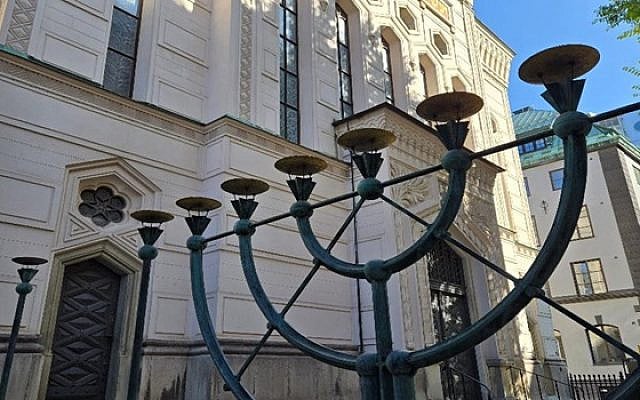
When travelers think about Sweden’s Jewish heritage, they may think first of Stockholm’s Great Synagogue, the rescue of Danish Jews during the Holocaust, or the remarkable story of Raoul Wallenberg. But there is another, less familiar chapter of Jewish life in Sweden—one that can be heard in a language.
Yiddish.
In 1999, Sweden officially recognized Yiddish as one of the country’s five national minority languages. For a country whose Jewish population is relatively small, this was a remarkable recognition of a language deeply connected to Jewish history, culture, literature, music, family, and memory.
But Yiddish in Sweden is not simply a story about government recognition. It is a story of immigrants who brought the language with them, families who spoke it at home, a generation that moved toward Hebrew and Swedish, and determined individuals who later worked to ensure that Yiddish would not become merely a memory of their parents and grandparents.
During my visit to Sweden as part of Jewish Copenhagen’s Jewish Heritage Tour, I spoke with Eva Fried, Chair of the Swedish Yiddish Association, and Deanne Mannelid, President of the Yiddish Society, about the history of Yiddish in Sweden, their experiences growing up in Yiddish-speaking families, and the continuing effort to ensure that Yiddish remains part of Sweden’s Jewish cultural heritage.
From Aaron Isaac to the Yiddish-Speaking Immigrants
NYJTG: Could you tell our readers about the history of Yiddish in Sweden and its connection to the country’s Jewish community?
Eva Fried & Deanne Mannelid: The roots go back to the first Jews permitted to settle in Sweden without converting to Christianity. They came from northern Germany, and Yiddish was part of their linguistic world. Early records of Stockholm’s Jewish community include documents written in Hebrew letters and Yiddish.
Later waves of Jewish immigration brought Yiddish speakers from Eastern Europe, including what is today Poland, Ukraine, Russia, and the Baltic states.
After World War II, Sweden received approximately 25,000 Holocaust survivors, many of whom brought their Yiddish language and culture with them. Some eventually moved to other countries, while others remained and became part of Sweden’s postwar Jewish community.
The Extraordinary Decision to Recognize Yiddish
NYJTG: Sweden recognized Yiddish as one of its national minority languages in 1999. Why was that recognition so significant?
Eva Fried & Deanne Mannelid: We met the criteria, but we also had to fight for recognition.
After the Holocaust, survivors and others began recognizing the need to preserve Yiddish and its culture. Sweden’s 1999 decision made Yiddish one of the country’s five national minority languages, alongside Finnish, Meänkieli, Sami, and Romani Chib.
To establish Yiddish’s status, it was important to demonstrate that the language had been present in Sweden for more than 200 years. Historical records from the early Jewish community, including documents written in Yiddish, helped provide that evidence and are preserved in the Swedish State Archives.
The recognition gave Yiddish an official place in Swedish society and strengthened efforts to keep the language and culture alive for future generations.
When Yiddish Was Spoken at Home but Not at School
NYJTG: How did the relationship between Yiddish and Hebrew play out in Sweden?
Eva Fried & Deanne Mannelid: We were both products of the Jewish school. At the time, nobody really talked about Yiddish, even though many of our parents spoke it at home.
The school, which had existed since the 1950s, emphasized Hebrew. Israel had recently been established, and there was tremendous enthusiasm for building a new Jewish identity centered around the Hebrew language.
For our parents, however, Yiddish was still their language.
Around 90 percent of the students came from Yiddish-speaking homes, but their parents were eager for them to learn Hebrew.
So there was a fascinating contrast: Yiddish was the language of home, while Hebrew represented the future.
“I Heard Yiddish, But I Didn’t Speak It”
NYJTG: Did you speak Yiddish at home with your families?
Eva Fried & Deanne Mannelid: One of us did not speak Yiddish at home, but heard a great deal of it. There was a fascination with the language from childhood, but it was only later in life—around the age of 40—that she began learning it more seriously.
This experience was not unusual. Yiddish was often the language parents spoke, while their children answered in Swedish.
As a result, an entire generation grew up understanding Yiddish emotionally and culturally without necessarily feeling completely comfortable speaking it themselves.
Yiddish Is More Than a Language
NYJTG: Yiddish carries literature, music, traditions, humor, history, and collective memory. How would you describe its cultural significance to Sweden’s Jewish community?
Eva Fried & Deanne Mannelid: Yiddish culture is present in many community events today. For many people, it carries a strong sense of nostalgia and connection to the past.
Music is an important part of that connection—Klezmer, Yiddish songs, and comedy. The Holocaust is also deeply connected to the history people associate with the language.
But we don’t want Yiddish to exist only as nostalgia. There is a revival of Yiddish in many places around the world, including the United States, Poland, Germany, Israel, and the Baltic states.
The challenge is to look forward and consider how Yiddish can survive and grow.
Yiddish Is Alive in Stockholm
NYJTG: Is there an active Yiddish cultural scene in Stockholm today?
Eva Fried & Deanne Mannelid: Yes. Stockholm has musical events, including Jazz and Klezmer programs, as well as other cultural activities.
The National Yiddish Association also organizes an annual two- or three-day seminar devoted to Yiddish language and culture, with sessions in both Yiddish and English. Yiddish activities also take place in cities such as Malmö and Gothenburg.
There was an interesting postwar Yiddish community in Borås, near Gothenburg, where Holocaust survivors found work in the textile industry. They created a community where activities were conducted entirely in Yiddish. It continued until the late 1970s, when younger generations moved away, and the textile industry declined.
From a Mother’s Language to a Learned Language
NYJTG: How has the role of Yiddish in Sweden changed over the generations?
Eva Fried & Deanne Mannelid: The change from the 1960s to today has been enormous.
Our parents were native Yiddish speakers who had grown up in completely Yiddish-speaking environments. Our generation grew up with Swedish and Hebrew as important languages. Many parents continued speaking Yiddish to their children, but the children often answered in Swedish.
Today, people are trying to revive the Yiddish they remember from home. It may not feel completely natural at first, but something remarkable happens when people come together.
At the first seminars, some participants suddenly began speaking the Yiddish they had heard from their parents. Teachers from Oxford and Cambridge were fascinated because they recognized that participants were speaking a form of Yiddish that reflected the language their parents had spoken.
Today, there are still native speakers, but there are also many people who have learned Yiddish through study. It is a different kind of Yiddish, but it represents a genuine revival.
The Biggest Challenge: The Next Generation
NYJTG: What is the biggest challenge in passing Yiddish on to younger generations?
Eva Fried & Deanne Mannelid: The biggest challenge is helping young people understand that Yiddish is not simply something from the past.
They may associate it with their grandparents and recognize it as something connected to family history, but they don’t always see themselves as part of its future.
That is the challenge: helping the younger generation understand that Yiddish is not only nostalgia and history; it is also the future.
Music is one way to introduce children to the language. Yiddish songs can be taught in preschool, while youth programs and summer camps can provide additional opportunities to encounter the language and culture.
Yiddish as a Bridge Across Jewish History
NYJTG: How does preserving Yiddish contribute to maintaining Jewish identity and connection to Jewish heritage?
Eva Fried & Deanne Mannelid: One of our challenges is helping younger generations understand the connection between Yiddish culture and their own history.
But Yiddish isn’t only Jewish history. It is also European history and part of the history of Jewish communities around the world, including Argentina, where large Yiddish-speaking communities developed.
Yiddish has no physical borders. It connects communities across countries and continents. There are connections between Swedish Yiddish speakers and cultural centers in places such as Berlin and New York.
There are also non-Ashkenazi Jews who have learned Yiddish and become enthusiastic about the language and its culture. Even non-Jews in Sweden have learned Yiddish, including one who has become a Yiddish author and poet.
In that sense, Yiddish has become an international cultural bridge.
“Mama Lüshi”: The Language of My Mother
NYJTG: From your personal perspective, what does Yiddish mean to you?
Eva Fried & Deanne Mannelid: Mama lüshi—mother tongue.
It means my first language and my first culture. Literally, it is the tongue of my mother, and that makes it the first emotional language you have.
It carries memories. It represents identity and a connection to the generations who came before.
There are also expressions in Yiddish that communicate certain feelings and sensations in a way that can be difficult to capture in another language.
For me, Mama lüshi says so much.
A Language That Refuses to Disappear
Sweden’s recognition of Yiddish in 1999 is much more than a legal designation. It is an acknowledgment that a language can carry an entire world within it.
For Swedish Jews, Yiddish connects generations—to parents and grandparents, to Eastern European Jewish life, to music and literature, to humor and family memories, and to a history that was nearly destroyed during the Holocaust.
But the story told by Eva Fried and Deanne Mannelid is not simply one of loss.
It is a story of revival.
A language once spoken in Jewish homes across Sweden is being taught again. Children are encountering it through songs. Adults are returning to the language they heard from their parents. Cultural organizations are bringing speakers together, while seminars, music, Klezmer, literature, and education are creating new spaces for Yiddish.
And perhaps most importantly, a new generation is being asked to see Yiddish differently—not simply as the language of their grandparents, but as something that can belong to them as well.
In Sweden, Yiddish is not merely being remembered. It is being given another chance to live.
By Meyer Harroch | New York Jewish Travel Guide
This press trip was hosted by Jewish Copenhagen. Special thanks to Charlotte Thalmay, Ronen Thalmay, and their team for curating the Jewish heritage journey across Scandinavia.
For information about Jewish Copenhagen and its Jewish heritage tours:
info@jewish-copenhagen.dk
jewish-copenhagen.dk
Related Topics
Related Posts