Sydney: Why IRAN Should Be the Prime Suspect
Ashtyako Poorkarim, Leader of the Kurdistan Independence Movement
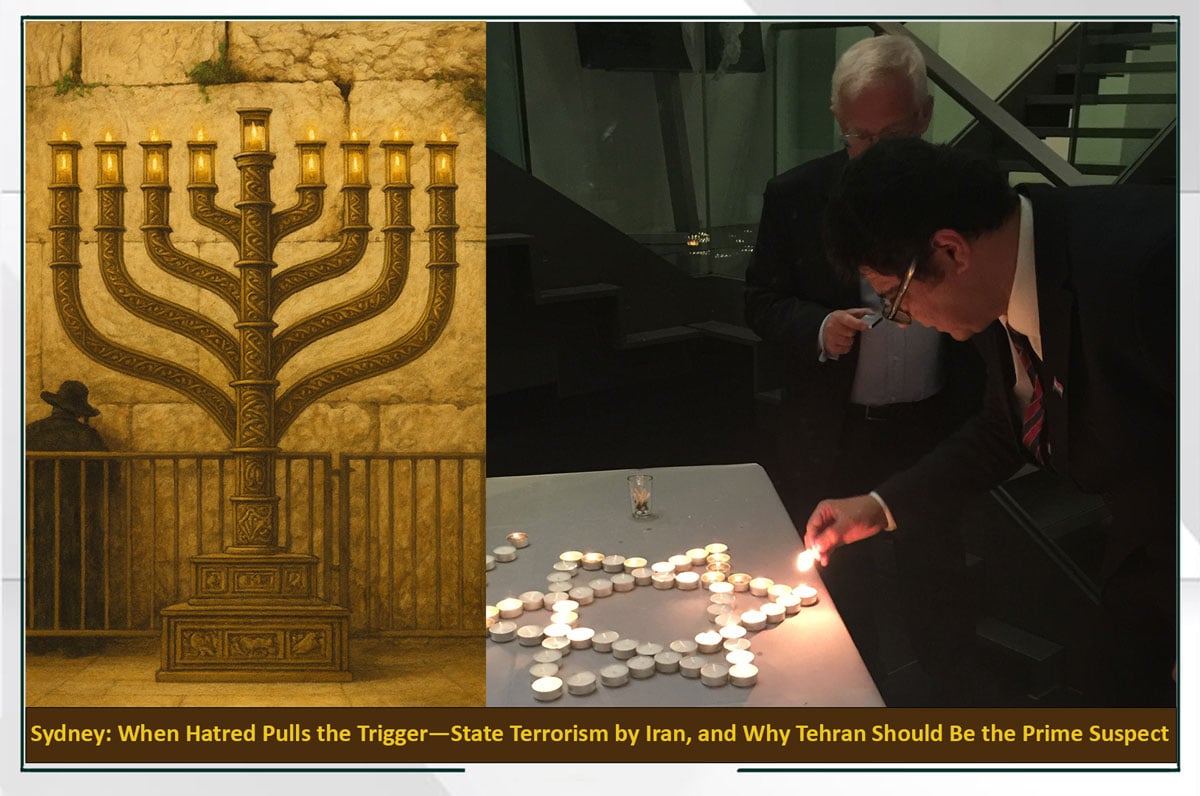
The deadly attack in Sydney, in the middle of a public religious gathering—where families had come together to celebrate Hanukkah—was not just a human tragedy; it was a message. Two armed attackers opened fire on a crowd attending “Chanukah by the Sea,” a family-oriented event held in a highly visible public space. In minutes, an ordinary evening became collective death, panic, and lasting trauma.
But if we reduce what happened to “two gunmen on the ground,” we end up repeating a dangerous mistake that scholars of contemporary terrorism have warned about for years: modern terrorism is rarely just a single burst of violence. It is often the outcome of overlapping forces—an ideology of hatred, facilitation networks, propaganda ecosystems, and sometimes state-linked mechanisms that cultivate insecurity while preserving deniability. The central question is not only who pulled the trigger—though that matters for prosecution—but who helped make the trigger-pull possible, and who benefits when fear goes viral.
There is a common temptation in cases like this: when signs point toward extremist symbolism, the story is quickly filed under familiar categories—individual radicalisation, online recruitment, a “lone” operation. Yet Sydney does not exist in a vacuum. In recent years, Australian security and political debates have already placed Iran under suspicion in connection with anti-Jewish intimidation and attacks inside Australia, raising the broader issue of whether Tehran leverages transnational networks—sometimes through intermediaries—to target Jewish and Israeli-linked communities abroad. That context matters, because it reshapes what this incident might represent: not merely domestic violence, but potentially a node in a larger pattern.
So the hard question is unavoidable: can an attack with such symbolic weight—mass violence against Jews during a public religious ceremony—really be separated from geopolitical realities? If terrorism’s strategic aim is to manufacture fear and polarisation, this setting is almost “perfect”: an assault on Jewish life in its most public form, in a global city, in an age where every local event instantly becomes global content. That is where the role of states—actors capable of long-range strategy, proxy warfare, and plausible deniability—comes back into the analysis.
This is precisely why, from an analyst’s standpoint, Tehran should be treated as the primary suspect at the strategic and network level—unless and until evidence proves otherwise. Not as a slogan, but for three straightforward reasons.
First, there is the issue of precedent in the same geography. When a state has already been credibly suspected—or officially accused in political and security discourse—of enabling hostile activity against Jewish targets in a particular country, it becomes analytically irresponsible to treat a later, more severe incident as if it emerged from nowhere.
Second, the operational logic of deniable violence fits the broader pattern attributed to Iran over decades: the use of intermediaries, non-state actors, criminal facilitators, and informal channels that create distance between decision-makers and perpetrators. This “deniability architecture” is not an incidental detail—it is a method. It keeps the centre insulated while the violence appears local, spontaneous, or ideologically self-generated.
Third, in the immediate aftermath of major attacks, experienced security communities routinely examine the likelihood of transnational facilitation—money, contacts, travel routes, digital communications, and links to known networks. In a world where Iran is repeatedly associated with proxy activity and extraterritorial operations, it is logical—indeed necessary—that investigators test whether this event intersects with that ecosystem.
To be clear: suspicion is not proof. Publicly asserting certainty without evidence is irresponsible. But pretending that the most plausible strategic suspect should not be scrutinised—when motive, capacity, and alleged precedent exist—is the greater error, particularly when the goal is preventing repetition. A serious investigation must move beyond the identities of the attackers to the infrastructure around them: financing channels, encrypted communications, cross-border contacts, facilitators, and any signals of coordination or encouragement.
If even a narrow, legally defensible link to a state-linked network emerges, the response must operate at that same level: targeted financial disruption, legal pursuit of facilitators and coordinators, intelligence coordination with allies, and raising the cost of proxy violence. Because if the cost remains low, the cycle continues.
Sydney should be mourned—and understood. Mourning is a moral duty: solidarity with the victims and their families, and an unequivocal rejection of antisemitism and terror. Understanding, however, is a strategic and academic duty: recognising that today’s terrorism is not only the act of killing—it is an ecosystem. And when an ecosystem of hatred meets an ecosystem of deniable power, the key question is no longer only “who fired,” but “who produced the hatred,” “who enabled it,” and “who benefits when fear becomes policy.”
If those questions are not confronted seriously, Sydney will not remain a tragedy. It will become a template—and that is exactly what every hate network, every terror infrastructure, and every state that profits from instability wants.