
Author and Global Affairs Commentator
Syria, Iraq, and Trump’s Energy Bet
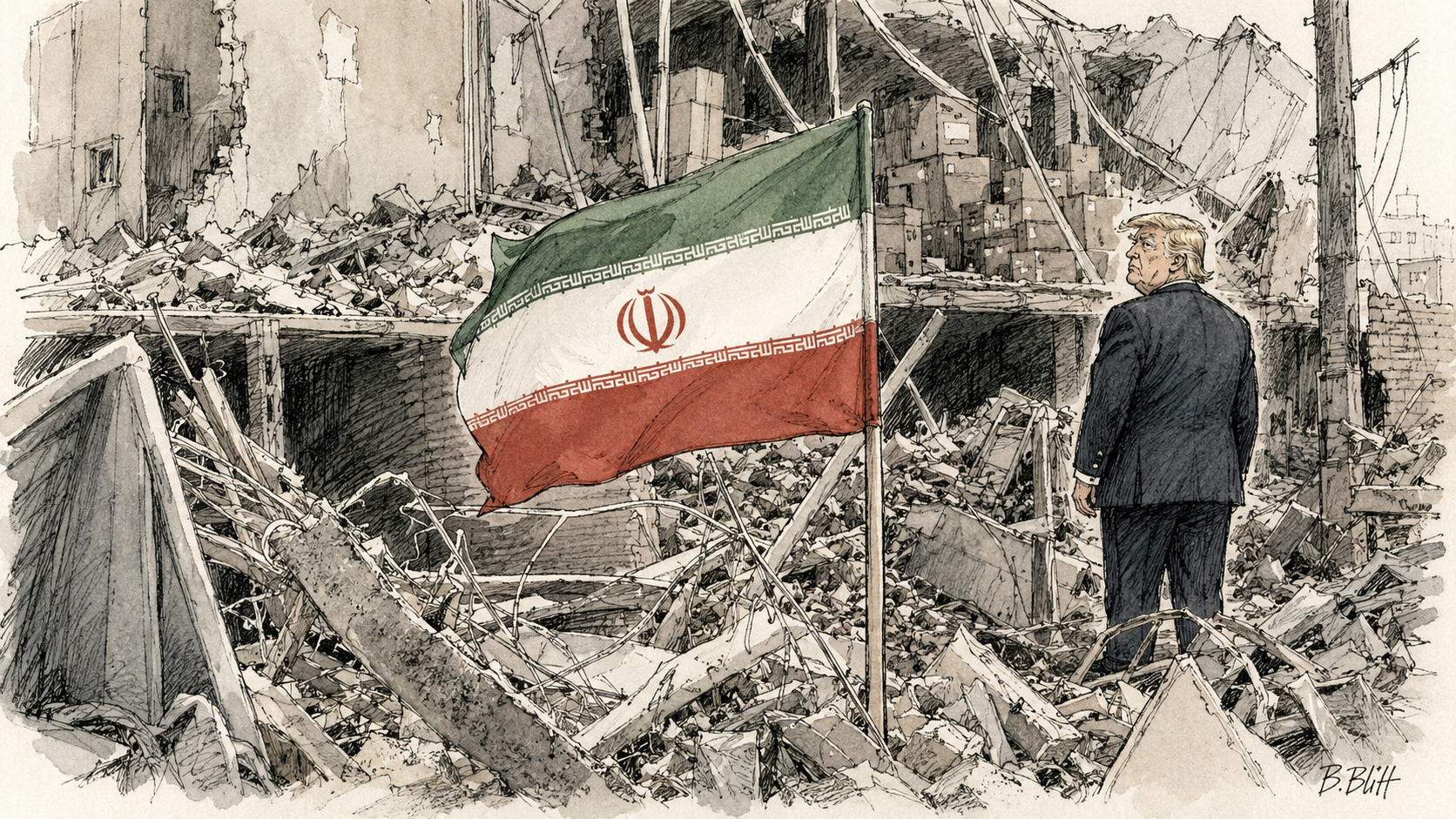
Washington must demonstrate that economic pressure is intended to produce a political outcome rather than become an end in itself. (ChatGPT AI generated image of Donald Trump looking back at the flag of Iran amidst rubble in Tehran. Trump is moving beyond degrading Iran's nuclear ambitions or targeting the IRGC. The emerging objective is to weaken the regime's capacity to govern.)
Can energy infrastructure reshape the Middle East’s strategic balance?
The Trump administration appears to believe it can. By supporting the revival of a long-dormant Iraq-Syria oil pipeline, Washington is pursuing more than an infrastructure project. The initiative aims to reduce reliance on the Strait of Hormuz, deepen economic ties with Damascus and Baghdad, and weaken one of Iran’s most important sources of regional leverage.
President Donald Trump’s recent diplomacy with Syria and Iraq suggests that Washington is pursuing a broader strategic realignment in the Middle East, one centered on economic integration, energy security, and reduced dependence on maritime chokepoints dominated by Iran.
During the NATO summit in Ankara on July 8, Trump met Syrian President Ahmed al-Sharaa to discuss Syria’s economic recovery, foreign investment, and the future of bilateral relations. Following the meeting, Trump announced that the United States would remove Syria from its list of State Sponsors of Terrorism, ending a designation that had been in place since 1979.
According to both Syrian and U.S. accounts, Trump pledged to eliminate obstacles to Syria’s reconstruction and encouraged American companies to invest in the country. He also publicly praised Sharaa’s efforts to stabilize Syria, signaling a marked shift in Washington’s approach to the post-Assad government.
A week later, Trump hosted Iraqi Prime Minister Ali al-Zaidi at the White House. Their discussions focused on expanding economic cooperation, particularly in Iraq’s energy sector, where both governments endorsed new agreements involving American investment. Zaidi also reaffirmed his commitment to bringing all armed groups, including Iran-backed militias, under state authority, while confirming that the remaining U.S. military presence in Iraq is expected to conclude by September 30, 2026.
Although absent from official statements, both meetings appear connected to a more consequential initiative: the revival of the historic Kirkuk-Baniyas oil pipeline linking northern Iraq to Syria’s Mediterranean coast.
Originally completed in 1952, the roughly 500-mile (891-kilometer) pipeline transported Iraqi crude to the Mediterranean until Baghdad shut it down during the Iran-Iraq War after Syria aligned itself with Tehran. Restoring the route would require constructing an almost entirely new pipeline, a project expected to take several years.
Its strategic value is considerable. The pipeline would provide Iraq with an export route that bypasses the Strait of Hormuz, reducing dependence on one of the world’s most vulnerable maritime chokepoints. Oil reaching Syria’s Mediterranean ports could move directly to European markets without transiting the Persian Gulf, shortening shipping routes by roughly 3,000 nautical miles and reducing transit times by more than a week. Lower shipping costs, reduced insurance premiums, and diminished exposure to regional disruptions would make Iraqi exports more competitive while decreasing Iran’s ability to influence global energy flows.
Reports indicate that the project has advanced beyond preliminary discussions. Tom Barrack, the U.S. ambassador to Turkey and special envoy for Syria and Iraq, is reported to have played a central role in negotiations before Zaidi’s visit to Washington. American support for the project appears increasingly explicit, and U.S. energy firms are expected to participate in reconstruction, although no major company has formally committed publicly.
The pipeline also fits into a broader vision of Syria as a regional energy corridor. Additional projects under consideration could connect Gulf producers, including Saudi Arabia and Qatar, to export terminals on Syria’s Mediterranean coast, creating alternative routes to European markets.
Syria itself possesses meaningful energy potential. While its proven oil reserves are modest, geological assessments suggest substantially larger undiscovered onshore and offshore resources. Since U.S. sanctions have been lifted, international investment has accelerated. Earlier this year, Chevron signed a memorandum of understanding with Syria’s state petroleum company and Qatar’s Power International Holding to develop the country’s first offshore oil and gas project. Days later, Saudi and American energy companies announced plans to explore additional oil and gas blocks while helping rebuild northeastern Syria’s energy infrastructure.
Political normalization is central to this strategy. Removing Syria from the terrorism list reduces legal and financial barriers for international investors, making it easier to finance pipelines, modernize export facilities, and negotiate long-term energy contracts. Infrastructure investment thus becomes both an economic and geopolitical instrument.
Yet significant risks remain. Turkey retains substantial influence over Damascus, complicating Syria’s relationships with regional actors, including Israel. Russia has also preserved an enduring military and commercial presence through its naval facility at Tartus and its air base at Khmeimim, while expanding commercial logistics operations along Syria’s Mediterranean coast. These realities ensure that Syria will remain an arena of strategic competition even as Western investment increases.
The pipeline initiative therefore reflects more than an energy project. It represents an effort to reshape regional alignments by tying Syria and Iraq more closely to Western markets and reducing Iran’s leverage over global oil exports. Whether this strategy succeeds will depend not only on engineering and investment, but also on the durability of Syria’s political transition, Iraq’s internal stability, and the willingness of regional governments to sustain economic cooperation despite continuing geopolitical rivalries.
Related Topics