
Middle East Analyst
Syria – The Forgotten Crisis
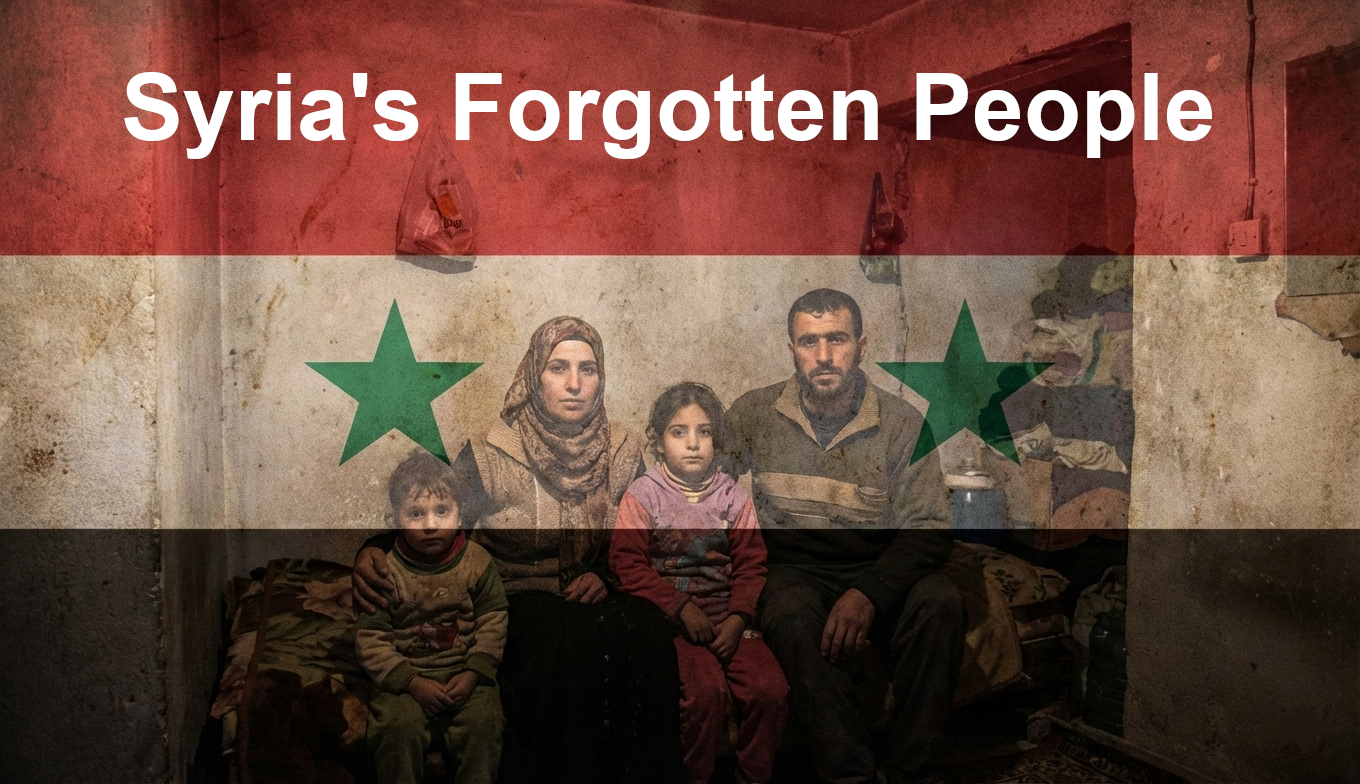
graphic by author/Nano Banana
Syria remains one of the world’s largest and most structurally damaging humanitarian catastrophes, even after the political landscape shifted dramatically with the removal of Bashar al‑Assad and the rise of a new, internationally recognized government backed by a relatively cohesive military. The United States, Turkey, and Gulf states are now working with this government to stabilize the economy and rebuild institutions. But the humanitarian crisis that the war produced has not receded. It remains vast, unresolved, and capable of undermining the fragile transition if not addressed with urgency.
Syria is a country of 185,000 square kilometers—roughly the size of Washington State—with a pre‑war population of 22 million. Today, after more than a decade of conflict and mass displacement, 18–19 million people remain inside the country, while millions more live abroad as refugees. The scale of human need relative to the size of the nation is staggering.
A Humanitarian Catastrophe of Historic Scale
The Syrian conflict has killed an estimated 600,000 people—roughly ten times more than the Gaza war to date—and injured millions. Many of the wounded live with permanent disabilities, including tens of thousands of amputees. Entire neighborhoods were erased. Hospitals and clinics were systematically targeted. Schools were destroyed or abandoned. Detention, torture, and chemical attacks left deep psychological scars.
Today, over 16 million Syrians inside the country require humanitarian assistance, the highest level since the conflict began. Roughly 7.4 million remain internally displaced, many living in tents or makeshift shelters. Another 4.4 million Syrians live as refugees in Turkey, Lebanon, Jordan, Iraq, Egypt, and Europe. Many have been displaced for a decade or more, with no clear path to return.
Food insecurity affects a majority of the population. The economy is in freefall. Families rely on debt, child labor, early marriage, and asset liquidation to survive. Child malnutrition—once rare in pre‑war Syria—is now widespread. Explosive ordnance contamination continues to kill and maim civilians, especially children.
The war’s frontlines may have shifted, but the humanitarian emergency has not ended. It has simply become chronic.
The Geography of Destruction: The North as the Humanitarian Epicenter
Although the conflict touched every governorate, the heaviest destruction occurred in the northern opposition belt—Idlib, northern Hama, and the Aleppo countryside. These were the areas where anti‑regime forces were strongest and where siege warfare and aerial bombardment were most intense.
Two dynamics explain the scale of devastation:
- Russian airpower conducted sustained, high‑intensity bombardment that flattened entire districts.
- The former regime used indiscriminate aerial munitions, including crude but devastating helicopter‑dropped explosives, to depopulate opposition strongholds.
The result is a humanitarian landscape defined by:
- entire towns reduced to rubble
- infrastructure collapse
- mass displacement toward the Turkish border
- dense clusters of camps and informal settlements
By contrast, Latakia—the Alawite heartland and long‑time stronghold of the Assad regime—remained largely under government control throughout the war. It experienced sporadic attacks but not the systematic devastation seen in the opposition‑held north.
Stabilizing Syria requires stabilizing the north. It is the humanitarian epicenter, the displacement engine, and the region where grievances are deepest and the risk of renewed instability is highest.
From Civil War to Fragile Consolidation
The Syrian conflict evolved from a domestic uprising into a multi‑layered war involving the regime, opposition factions, jihadist groups, Kurdish forces, and a constellation of external sponsors. Importantly, no Gulf or Western coalition forces fought directly against the regime; instead, the United States, Turkey, and Gulf states provided arms, training, and financial support to opposition groups, while Iran, Hezbollah, and Russia intervened directly on Assad’s behalf.
In December of 2024, Hay’at Tahrir al-Sham (HTS) and aligned forces consolidated enough power to overthrow the Assad regime which was left vulnerable after Israel weakened Hezbollah. HTS formed a new government that has gained international recognition. This government commands a more unified military than the fragmented opposition structures of the mid‑war period. It controls major population centers and is working with external partners to stabilize the currency, restore basic services, and rebuild state capacity.
Yet the transition is fragile. Skirmishes with Alawite and Druze communities, unresolved property disputes, and lingering pockets of armed resistance create a landscape of tense consolidation rather than settled peace. Explosive ordnance contamination, warlord networks, and unresolved grievances remain potent sources of instability.
The political war has a winner. The humanitarian and social war is far from over.
Comparison to Gaza: Different Timelines, Shared Urgency
Syria and Gaza are distinct conflicts, but comparing them helps expose how scale and time distort attention.
- Gaza presents a compressed, highly visible catastrophe: enormous destruction in a small, enclosed territory under intense global scrutiny.
- Syria presents a vast, slow‑burning catastrophe: destruction spread over a decade, across a country the size of a large U.S. state, with suffering that has become normalized.
By crude numbers, Syria’s war has been more lethal and more displacing than Gaza. But because the crisis is older and more diffuse, it has slipped from global consciousness. The world sees the absence of large‑scale battles and assumes the emergency has passed.
It has not.
Why Syria Is Overlooked
Several dynamics push Syria toward invisibility:
- Victory optics: A new government and cohesive military create the impression of order, even when daily life remains precarious.
- Competing crises: Gaza, Ukraine, Sudan, and climate disasters dominate political bandwidth.
- Donor fatigue: After fourteen years of appeals, funding has declined even as needs remain extreme.
- Moral displacement: External actors feel they “did their part” by supporting the transition, even though the humanitarian wreckage remains.
Syria is “forgotten” not because it is resolved, but because the world has quietly decided it can live with the suffering.
A Looming Threat to Regional Stability and the Abraham Accords
Ignoring Syria’s humanitarian crisis is not just a moral failure; it is a strategic risk. A country with millions of impoverished, displaced, traumatized, and disenfranchised people is not stable. It is combustible.
- Fertile ground for radicalization
Millions of young Syrians are growing into adulthood with little education, high unemployment, unresolved trauma, and memories of violence and betrayal. This is fertile ground for jihadist recruitment, sectarian militias, and criminal networks.
- Ethnic and sectarian flashpoints
Alawite, Druze, Kurdish, and Arab communities all carry grievances. If humanitarian needs are not addressed equitably, localized clashes can escalate into wider conflict, threatening the cohesion of the new military.
- Refugee and migration pressure
Millions of Syrians in Turkey, Lebanon, Jordan, and Europe are watching the transition. If conditions inside Syria remain bleak, return will stall. Host-country fatigue could trigger forced returns, unrest, or politically weaponized migration, echoing President Erdoğan’s earlier threats to “open the gates” and send refugees into Europe.
- A quiet constraint on the Abraham Accords
The Abraham Accords rest on the idea of a new, more stable regional order. But leaving Syria as a permanent humanitarian crater undermines that architecture:
- Anti‑normalization actors will weaponize Syrian suffering
- Iran‑aligned networks will exploit ungoverned spaces
- Israel’s northern front will remain unstable
- Arab publics will see normalization as detached from human realities
If Syria’s humanitarian crisis is not addressed, the political bridgework of normalization will rest on unstable ground.
Strategic Takeaway
Syria’s war produced one of the largest humanitarian disasters of the 21st century, and that disaster did not end with the fall of Assad. It persists—in amputated limbs, empty refrigerators, ruined schools, overcrowded camps, and entire cohorts of children growing up malnourished and undereducated.
The new Syrian government and its partners are right to focus on macroeconomic stabilization. But unless the humanitarian and social dimensions are treated as core security issues—not peripheral charity—the transition will remain brittle, and the broader regional order, including the Abraham Accords, will sit on a fault line.
Syria is “The Forgotten” only if we allow it to be. In reality, it is still here, still huge, and still capable of unravelling what the region is trying to build.
Related Topics
Related Posts