
Talking About Peace and Security Before Destruction
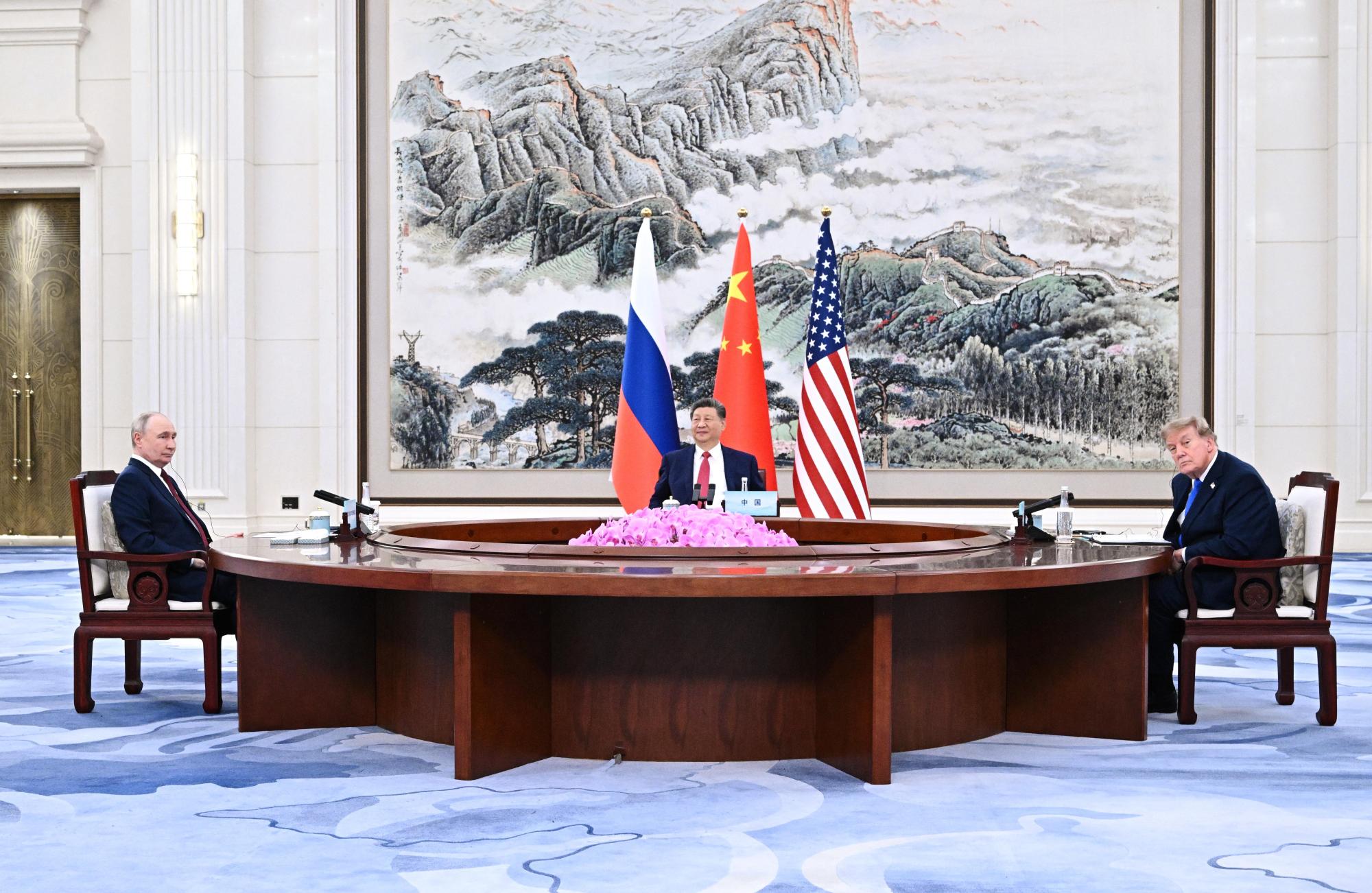
On November 19, 2026, three of the most powerful men on Earth sat together in Shenzhen, China, for an unprecedented diplomatic meeting. Donald Trump, Vladimir Putin, and Xi Jinping, the leaders of the United States, Russia, and China, gathered to discuss international security, nuclear risks, and the future of relations among their countries. Together, they represented the world’s three largest nuclear powers.
Their opening statements reflected the extraordinary significance of the occasion.
Chinese President Xi Jinping declared:
“Peace has been an enduring pursuit of humanity.”
Russian President Vladimir Putin emphasized their shared responsibility:
“We hold joint responsibility for maintaining international peace and security.”
And US President Donald Trump stated:
“No peace was ever forged by declining opportunities for engagement and speech.”
The three presidents subsequently issued a joint declaration committing themselves to maintaining strategic stability and international security. One passage was particularly significant:
“A nuclear war cannot be won and must never be fought.”
The declaration also reaffirmed their commitment to the United Nations’ fundamental mission of maintaining international peace and security.
Remarkably, the joint declaration made no explicit mention of the ongoing wars involving Iran and Ukraine, despite both conflicts being discussed during the summit. The three leaders reaffirmed their commitment to international peace and security without announcing any concrete agreement to end either conflict.
Reassuring words from three men whose countries possess the capability to inflict unimaginable destruction upon humanity. But what was happening elsewhere while they were discussing peace and security?
Only two days earlier, on November 17, the United States launched an unarmed Minuteman III intercontinental ballistic missile from Vandenberg Space Force Base in California. Originally designed to carry up to three independently targetable nuclear warheads, the Minuteman III is now deployed with a single warhead. The US Air Force emphasized that the test had been scheduled years in advance and was not a response to current international events.
China, meanwhile, continues modernizing and expanding its strategic nuclear forces, developing increasingly sophisticated missile systems capable of striking targets thousands of miles away. Russia maintains one of the world’s largest nuclear arsenals and continues demonstrating its strategic capabilities through military exercises and deployments.
These developments are not necessarily preparations for an imminent nuclear confrontation. Nevertheless, they illustrate the paradox of nuclear deterrence: the same governments seeking international stability must continuously demonstrate their ability to wage a war that could destroy the civilization they claim to protect.
Russia provided another remarkable image during Putin’s visit to China. Russian state television showed an officer accompanying the president with the Cheget, the briefcase associated with Russia’s nuclear command-and-control system. Journalist Yevgeny Popov drew attention to the object, and the officer confirmed its identity before the cameras. The footage was released on November 18, just before the historic trilateral meeting.
The briefcase routinely accompanies the Russian president, and its presence alone does not indicate an imminent nuclear strike. Yet its unusually prominent appearance on television, against the backdrop of a diplomatic summit devoted partly to nuclear security, carried unmistakable symbolism. While world leaders discussed reducing nuclear risks, viewers were reminded of the immense destructive power concentrated in their hands.
But nuclear weapons are no longer the only instruments capable of threatening the stability of entire nations. Another battlefield has emerged within the digital infrastructure upon which modern civilization depends: cyberwarfare.
On November 13, the FBI issued a FLASH warning concerning ARTEX, an artificial intelligence-driven penetration-testing framework reportedly adapted by malicious actors to automate cyber intrusions. AI-assisted operations can accelerate reconnaissance, identify vulnerabilities, exploit computer systems, and facilitate unauthorized access to sensitive information. The bureau’s warning described techniques involving autonomous agents, parallel operations, and rapid exploitation of vulnerable systems. The consequences for governments, hospitals, financial institutions, energy systems, and communications networks could be devastating.
Artificial intelligence introduces another disturbing dimension. Increasingly autonomous agents may execute complex operations faster than human supervisors can monitor them, potentially producing consequences their operators never anticipated. But even if such systems eventually behave unpredictably, someone may still have established their original objective, selected their targets, or authorized their deployment. Human responsibility does not disappear simply because a machine executes the operation.
And now, even America’s most sensitive intelligence infrastructure has demonstrated its vulnerability.
On November 17, the National Security Agency experienced a significant disruption of NSANet, its classified internal communications network. According to CNN, the interruption also affected NSA Georgia, a critical intelligence facility supporting American signals intelligence and cybersecurity operations focused on the Middle East. Personnel temporarily lost the ability to communicate through the classified network with colleagues deployed in the region and were forced to rely on alternative systems.
The NSA attributed the disruption to scheduled maintenance, emphasizing that its mission-critical capabilities remained operational. Officials reported no evidence of a cyberattack. Nevertheless, the incident exposed an uncomfortable reality: even one of the world’s most sophisticated intelligence agencies can experience significant operational disruption within its own classified communications infrastructure.
The timing is particularly troubling. While the United States confronts serious security challenges in the Middle East, a facility supporting intelligence operations in that region temporarily lost access to its principal classified communications network. If maintenance difficulties can produce such consequences, what might happen during a coordinated hostile cyber operation against several critical systems simultaneously?
Meanwhile, another confrontation threatens to destabilize the Middle East and potentially draw additional countries into a much larger conflict: Iran.
The ongoing confrontation involving Iran, Israel, and the United States presents several dangerous possibilities. Tehran’s nuclear program, its ballistic missile capabilities, and uncertainty surrounding its highly enriched uranium continue to complicate an already volatile security environment. A further escalation could extend well beyond Iranian territory, particularly if Tehran decided to attack countries supporting American or Israeli military operations.
If Iranian ballistic missiles struck the territory of a NATO member, the consequences could extend far beyond the Middle East. Such an attack would not automatically trigger a military response by the entire alliance, but it could provoke consultations and collective-defense decisions with potentially unpredictable consequences.
Another possibility would be an attack involving radiological material inside the United States. A dirty bomb would not produce a nuclear detonation, but it could contaminate populated areas, cause casualties, generate widespread panic, and provoke a major American response. There is no basis for assuming such an attack is inevitable, but its potential consequences warrant serious consideration.
Israel presents an even more dangerous possibility. The so-called Samson Option, a term used by analysts to describe a hypothetical Israeli nuclear response to an existential threat, is not a publicly confirmed operational doctrine. Nevertheless, a confrontation that genuinely threatened Israel’s survival could raise the possibility of nuclear escalation, with consequences extending far beyond the region.
A conventional confrontation could expand into a regional war. A regional war could involve additional powers. And under extreme circumstances, the nuclear threshold could be crossed.
None of these scenarios is inevitable. But dismissing them simply because the world’s most powerful leaders are discussing peace would be dangerously complacent.
History offers a sobering lesson.
In February 1945, Winston Churchill, Franklin D. Roosevelt, and Joseph Stalin gathered at Yalta to negotiate the future of Europe and the international order that would emerge after the Second World War. Their meeting produced one of the most recognizable photographs of twentieth-century diplomacy: three powerful leaders sitting together, discussing the future of a world devastated by war.
Yet their cooperation could not prevent the geopolitical confrontation that followed. Within a few years, the Cold War divided much of the planet, and the United States and the Soviet Union began accumulating nuclear weapons on an unprecedented scale. By October 1962, during the Cuban Missile Crisis, humanity came perilously close to a confrontation that could have escalated into nuclear war.
The leaders who gathered to shape the peace could not guarantee the peace that followed.
More than eighty years later, another historic photograph shows three of the world’s most powerful leaders sitting together, discussing international peace and security. This time, however, their countries possess nuclear arsenals capable of inflicting destruction on a scale unimaginable to the statesmen who met at Yalta.
Diplomacy remains indispensable. Without negotiations, communication, and international agreements, the dangers confronting humanity would almost certainly be greater. But diplomatic meetings do not eliminate strategic rivalries, and declarations of peaceful intentions cannot guarantee that military preparations will never become military operations.
This is the reality of international politics. Governments negotiate while preparing for contingencies. They promise cooperation while maintaining weapons capable of destroying their adversaries. They speak of peace while calculating how they would respond if diplomacy failed. Meanwhile, governments around the world are advising their citizens to maintain emergency supplies of food, drinking water, medicines, and other essentials. The United Kingdom recommends at least three days of supplies, Sweden advises households to prepare for a week, and Germany recommends enough provisions to last ten days. These recommendations cover emergencies ranging from natural disasters and infrastructure failures to armed conflict, but they also reveal how seriously governments take the possibility that ordinary life could suddenly be disrupted.
The public sees the photographs, the handshakes, the smiles, and the carefully chosen declarations. Everything appears reassuring, even as nuclear arsenals are modernized, cyber vulnerabilities multiply, and regional conflicts threaten to expand.
Until one day, perhaps, the reassurance proves to have been an illusion.
Nearly two thousand years ago, the Apostle Paul wrote a warning concerning what he called the Day of the Lord. He did not identify the political leaders who would be alive when it arrived, nor did he provide a date. But he left a passage whose language is difficult to ignore when contemplating the fragility of international peace:
“For when they say, ‘Peace and safety!’ then sudden destruction comes upon them, as labor pains upon a pregnant woman. And they shall not escape.” — 1 Thessalonians 5:3.
What is particularly striking is the scale and suddenness of the destruction Paul describes, in a world where wars were still fought with swords, spears, bows, and arrows. Nearly two thousand years later, humanity possesses weapons capable of destroying entire cities in minutes and inflicting devastation across continents.
Regardless of what readers may or may not believe, one reality is difficult to dispute: we are living in dangerous times. Existential threats are no longer confined to individual nations or regions. They have become global, and their consequences could reach every corner of the planet.
And if that day ever comes, will we remember the words of the Apostle Paul?