Veterans Day messages
One highlight on the calendar of my shul, Congregation Rinat Yisrael, is its annual Veterans Day Recognition program. Held over the past several years following Shabbat morning services on or before the federal holiday, the program — led by Rabbi JJ Schacter and Kenny and Janet Hoffman — is presented in partnership with two neighboring shuls, Congregation Bnai Yeshurun (Orthodox) and Congregation Beth Sholom (Conservative). Each year, a brochure — which is available online — is distributed that includes pictures and brief bios of shul members and their relatives who have served or are serving in the U.S. armed forces.
The impetus for the program grew out of the relationship that Rabbi JJ and Kenny have with Operation Benjamin, an organization that identifies Jewish service members worldwide who, after making the ultimate sacrifice during the world wars, were mistakenly buried under Latin crosses at American military cemeteries. The organization replaces those headstones with stars of David.
To honor this legacy, the program invites guest speakers who embody, both in word and in person, what Veterans Day symbolizes. In 2023, Michael Yasenchak, who supervised several U.S. military cemeteries in Europe, spoke; in 2024, it was Jacob Freedman, chief of staff to the Secretary of the Army; in 2025, we heard General Dirk Backen, secretary general of the German War Graves Commission.
And in 2026, our speaker was Vice Admiral Herman A. Shelanski, USN (ret.). A second-generation American descended from Lithuanian Jewish immigrants, Admiral Shelanski began his naval career as an aviation officer candidate in 1980 and earned his Wings of Gold in 1982. Over a highly distinguished career — too vast to detail fully here — he flew Cold War missions against the Soviet Union, was named Hawkeye of the Year, navigated the USS Independence in preparation for Operation Desert Storm, served as executive officer of the USS Ronald Reagan, was awarded the Defense Superior Service Medal and Legion of Merit, and commanded Carrier Strike Group 10, the USS La Salle, and the aircraft carrier USS Harry S. Truman during Operation Iraqi Freedom. Following his years at sea, he held several senior naval leadership positions before he retired in 2018.
Admiral Shelanski’s fascinating presentation touched on many facets of his life and career. He offered a small glimpse into his grueling flight school experience, where he was singled out for being Jewish; his exhilaration in flying an E-2C Hawkeye; his achievement in commanding a nuclear-powered aircraft carrier; and his inspiring leadership principles.
Equally moving were his reflections on his grandfather, an immigrant who had to remain on Ellis Island doing odd jobs just to earn the single dollar required for entry onto America’s shore; his mother’s pride when he was installed as an aircraft carrier commander; and his profound sense of duty to and responsibility for his $5 billion ship and, far more important, the more than 5,000 sailors aboard, many just 19 or 20 years old. He helped us understand and appreciate the sacrifices borne not only by members of the armed forces but by their families as well.
He also spoke about how he incorporated his faith and heritage into his military service and how each impacted the other, and shared stories of moving Jewish ceremonies he introduced to the navy. (One photograph that graced our shul lobby during the program showed a female sailor, bedecked in tallit and tefillin, reading the Torah aboard one of his ships — hardly a typical sight in an Orthodox synagogue.) With gentle humor, he added that following his retirement, he took on his greatest challenge yet by becoming president of Congregation Beth El in Norfolk, Virginia.
I don’t know how your brain works, but mine, when listening to a talk like this, operates on two tracks. While one absorbs the speaker’s words, another makes connections to my own life and concerns. That was certainly my experience that Shabbat morning.
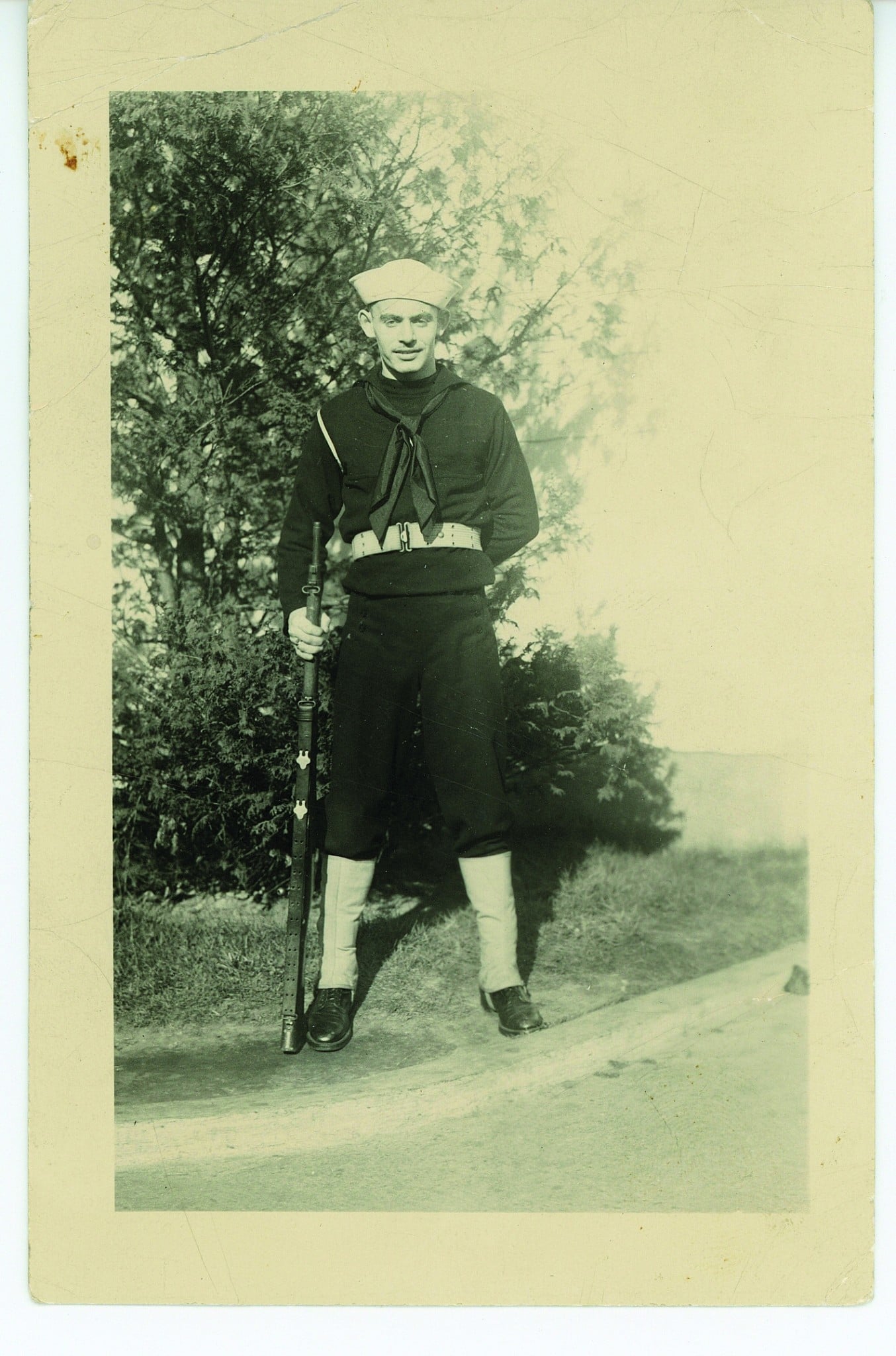
As Admiral Shelanski spoke about his grandfather, the young sailors under his command, and their families’ sacrifices, my thoughts turned to Seaman Second Class Murray A. Gross — my Uncle Moshe, an immigrant from Rumania (according to his draft registration card) and my mother’s brother, about whom I’ve written a number of times. Uncle Moshe, the eponym of Yeshiva Zichron Moshe, was lost at sea off the Normandy coast during the D-Day invasion.
(Interesting fact. The navy typically records the official date of death for American sailors declared missing in action during wartime as a year and a day after the date they went missing. Thus, although Uncle Moshe was blown overboard when his ship was bombed on June 11, 1944, his official date of death in naval records and on the Walls of the Missing at the Normandy American Cemetery is June 12, 1945.)
I was born a few years after his death, so I never met him. But that isn’t why I know very little about him. Rather, my grandparents, parents, aunts, and uncles simply never spoke about him. In every apartment my grandparents lived, a small living room table displayed his Purple Heart medal and citation in front of a framed photograph of him resplendent in his naval uniform. But that was all. The pain and grief were too raw, the loss too heavy, the sacrifice too deep, for them to talk about this handsome, talented young man.
And I, preoccupied with matters I foolishly deemed more pressing, never asked. I’d like to believe I was being sensitive, but the truth is I was simply too shortsighted to grasp how vital it was for me to uncover the details of his story. Had I asked, I suspect my family would have opened up. So let me once again offer a plea to my readers, especially younger ones, to ask about family history when there are still those around who can answer. You’ll regret it if you make my mistake and wait until there’s no one left to ask.
A second, more contemporary, thought also ran through my mind as I listened to the admiral. Hearing him speak with such deep pride about a country where the grandson of a penniless immigrant could rise to the highest echelons of the world’s most powerful navy, I felt a profound sadness that this pride has faded; that understanding that one of America’s great strengths is its being a nation of immigrants is being forgotten; that though the idea that America’s mission of welcoming the “homeless [and] tempest-tost” through our “golden door” is so important that it is inscribed on our iconic national symbol, it is disparaged by the highest levels of national leadership. Instead, potential future vice-admirals, along with their parents and grandparents, are deported, often thoughtlessly and cruelly, with scant regard for our American ethos, the rule of law, or the Constitution. What a diminishment of our nation’s core values and foundational credo. How profoundly sad.
After the program, I caught up with Admiral Shelanski at kiddush and told him about Uncle Moshe. We discussed my uncle’s sacrifice, my grandparents’ grief, and his own grandfather’s journey. All exemplified the best of America and embodied its enduring strengths.
I cherish their memories, and pray that my children and grandchildren will yet live to see an America that once again reflects President Reagan’s vision of a “shining city upon a hill,” whose “doors were open to anyone with the will and the heart to get here.”