
Rabbi Saul Berman, Smol Emuni, and the silencing of traditional Jewish debate
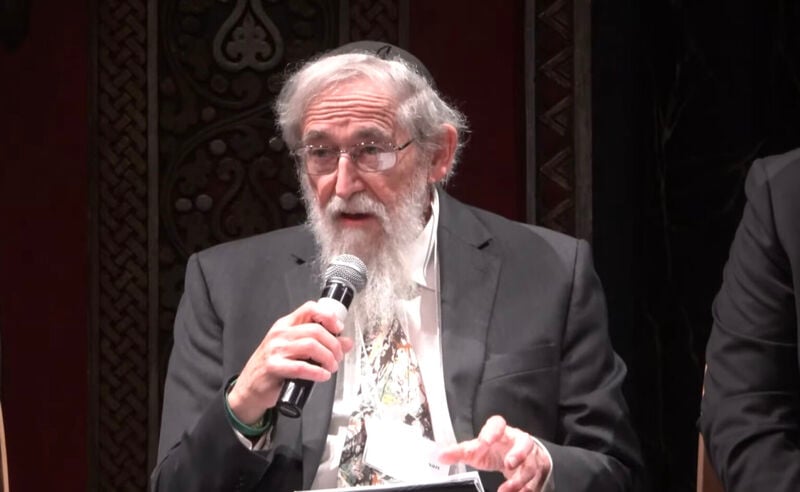
I was not at the 2026 Smol Emuni conference. But I watched the recording from Israel. And I have not stopped thinking about what I saw.
I should tell you who Rabbi Saul Berman is, though if you studied at Stern College for Women of Yeshiva University at any point in the last five decades, you probably already know. He was my teacher. I took as many courses from him as possible during my four-year tenure at Stern. In 1971, he became chair of the Judaic Studies department at Stern and built it into a serious undergraduate program. He did it deliberately because he believed women deserved Torah at the highest level. Not Torah lite. Not survey courses. The full weight of the tradition, and the intellectual tools to engage it independently.
He used to tell his students, “If you do not use a right, you will lose it.” It was not a reassurance. It was a charge.
When Rabbi Berman opened the beit midrash (study hall) at Stern to women in 1976, Rabbi Joseph B. Soloveitchik (“the Rav”) came to speak. A student asked how she should respond to people who challenged her right to study Talmud. The Rav’s answer, as Rabbi Berman later recounted it, was simple: “Do not answer him. Tell him to talk to me.”
That is the tradition Rabbi Berman comes from and helped build.
He also spent Purim 1965 in a Selma jail, arrested during the voter registration marches. An Orthodox rabbi, arm in arm with civil rights activists. He helped lead the Soviet Jewry movement before it was fashionable. In 1997, he founded Edah, devoted to what he described as a Modern Orthodoxy passionately committed to Torah and mitzvot, deeply connected to the entire Jewish people, open to the richness of secular knowledge, dedicated to expanding opportunities for women in Torah, tefillah, and community leadership, and grounded in the belief that every human being carries the image of God.
Rabbi Berman wrote that the Modern Orthodox experiment begins with the conviction that Orthodoxy can preserve its integrity and passion, and even be enriched, by its encounter with modernity, and that this encounter allows Orthodoxy to offer the broader world a clearer vision of the grandeur of Torah.
This is the man who was booed at a Jewish conference. And then publicly rebuked from the stage.
Here is what happened.
Rabbi Berman was invited to speak at the afternoon plenary of the 2026 Smol Emuni US conference. He delivered a serious, substantive address. He pushed back on an earlier panel that he felt left no room for a Jewish voice about Israel alongside the Palestinian voice. He cited Rabbi Soloveitchik. He referenced his arrest in Selma as an example of standing with the marginalized while refusing to silence another voice in the room. He argued that the Palestinian cause and the Jewish attachment to Israel must be heard simultaneously, not sequentially. He concluded with a Torah framework rooted in duties rather than rights as a possible path toward peace.
He was booed.
Then the organizer returned to the microphone and told the room, on behalf of the conference, that Rabbi Berman had been invited to speak about immigration and had expressed other views. The organizer added that the conference “respectfully disagreed.”
What does it even mean for “the conference” to disagree?
Who exactly is speaking in that moment? One person with a microphone? An unnamed organizing committee? A board that had not actually deliberated? Rabbi Berman had barely reached his seat before the declaration was made that the organization disagreed with him. No discussion. No engagement. No attempt to clarify what exactly was being rejected.
Disagreement, if it is to mean anything, requires argument. It requires reasons. It requires the humility to wrestle with complexity. None of that happened.
Instead, the audience received a kind of institutional verdict delivered in real time. The message was not simply that someone saw things differently. The message was that the acceptable boundaries of thought had already been determined, and Rabbi Berman had stepped outside them.
But how can an organization responsibly declare disagreement with a complex argument seconds after hearing it? How nuanced can that judgment be? How grounded? What ideas were actually considered?
Or is this simply another symptom of the intellectual climate we increasingly inhabit, where positions are sorted instantly into approved and disapproved categories, and the work of careful listening is replaced by the performance of moral certainty?
Pause there for a moment.
The Mishnah in Tractate Eduyot makes a striking institutional choice. It preserves minority opinions not despite the fact that Jewish law does not follow them, but precisely because it does not. The sages explain why. If a later court found reason to rely on that dissenting opinion, it would have access to it.
The minority voice was not erased. It was preserved, studied, and argued with.
The Talmud in Eruvin teaches that the positions of both Beit Hillel and Beit Shammai are “divrei Elohim chayyim,” words of the living God, even when they contradict each other. And the Talmud notes that Beit Hillel would teach the position of Beit Shammai before presenting its own.
This is not procedural courtesy. It is an epistemological commitment. Our tradition assumes that truth is larger than any single voice, that the person you disagree with may be holding something you will need later, and that silencing them damages the integrity of the conversation itself.
Ben Zoma asks in Pirkei Avot, Who is wise? He answers, One who learns from every person. Not every person who already agrees with you. Every person.
Rabbi Berman asked questions that deserved engagement, not correction.
He asked whether compassion for Palestinian lives and the Jewish attachment to Israel must be treated as opposing forces, or whether both can be honored at the same time. He asked whether generations of education that teach hatred toward Israelis and Jews have consequences for the possibility of peace. He did not deny Palestinian suffering. He named it. He held it alongside Jewish history, a 4,000-year connection to the land, the theological roots of competing claims, and the legal violations of October 7th.
He did this not to score political points but because he genuinely believes, as he has written, that all people are created in the image of God, and that all people should be treated as gerei toshav, people toward whom our ethical obligations mirror our obligations toward fellow Jews.
He was not speaking from the political right. He was speaking from the Rambam.
The Rambam writes in his commentary on Pirkei Avot: Accept the truth from whomever says it. Not only from people whose politics you share. Not only from speakers who stay within the boundaries of the topic you assigned them. From whomever says it.
What happened to Rabbi Berman at that conference was a failure of that principle.
It was also a failure of middot, a failure of character. A failure of basic decency toward a man who has spent his adult life building the institutions, scholarship, and moral framework from which many in that room have benefited, whether they realize it or not.
He rebuilt Stern’s Judaic Studies department so that women could study Torah at the highest level. He championed women’s tefillah groups when doing so carried real professional risk. He marched in Selma. He went to jail. He wore, and still wears, a Darfur bracelet, taped and stapled together after his original bracelet broke, from the inauguration of George W. Bush through the very day he stood at that podium.
And when he finished speaking, the host thanked him, and then, before the applause had faded, informed the audience that the organization respectfully disagreed.
There is a concept in Jewish law called kavod ha-briyot, human dignity. The dignity owed to every person is because they were created in the image of God. The rabbis treat it as weighty enough to override certain rabbinic prohibitions. It is not sentiment. It is a legal category.
And it applies with particular force to how we treat our teachers.
Rav Soloveitchik once told Rabbi Berman’s students not to answer their critics. Send the critics to him instead. That is what it looks like when a teacher protects his students.
Watching the recording of the conference, I found myself wishing someone in the room had done the same for Rabbi Berman. Someone who would stand and say: You may disagree with him, but this man has earned the right to speak without being managed from the microphone.
No one did.
This is not a call for Smol Emuni to agree with Rabbi Berman. Disagreement is healthy. Disagreement conducted with integrity is one of the sacred activities of Jewish intellectual life. The Talmud itself is built on it.
But disagreement requires something else as well. It requires the humility to listen before correcting or disagreeing.
The Mishnah preserved minority voices not because they won b,ut because they might still contain truth, or a question that had not yet been answered. It remains unclear either way whether Rabbi Berman’s opinion is a minority writ large, though it may have been in that room.
Rabbi Berman closed his remarks with a call for Jews and Arabs to commit together to human dignity as a shared obligation. Not as a right each side demands from the other, but as a duty each side owes.
He asked for less tribalism.
He was corrected from the microphone for it.
That is not what Jewish disagreement is supposed to look like. It is not what any of us should want our tradition to look like from the outside. And it is certainly not what Rabbi Saul Berman deserved from a Jewish audience in 2026, or in any other year.
Rabbi Berman was my teacher. He never taught us that difficult questions have simple answers. On the contrary, he insisted that we sit with complexity. Even in areas of Jewish law that might appear technical or removed from the moral life of society, he pushed us to dig deeper, to examine assumptions, to search honestly for truth.
It is therefore painful to watch a community that claims to value precisely that kind of intellectual and moral rigor respond with something so thin. The rush to declare disagreement, without reflection or engagement, closed off the very kind of searching conversation that Rabbi Berman spent a lifetime teaching his students to pursue. Conversations like that are difficult. They demand honesty, humility, and patience. But they are also the only conversations that have any hope of leading us toward truth and, perhaps someday, toward peace.