Teaching in June and the Future of Education
There is a common saying in Israel that after Pesach, the school year is essentially over, so by June there is not much school anymore. That was also the reason I never liked teaching during the second semester when I taught at the College of Management. So, last week, to make sure I had a successful English lesson with the fifth graders, I decided to teach them parts of speech using a game combined with writing on the board—a treat for the students and something that never ceases to surprise me. At the beginning of every lesson, as each group enters the room, they ask me, “Are we going to write on the board today?” The trick worked, and we had a lovely lesson.
I have no way of knowing whether my lessons actually advanced the students’ English, but in the elementary school the English lessons were a positive and even fun experience. I mention this because my experience working with 7th, 8th, and 9th graders was very different. I am afraid that something changes during the transition from elementary school to junior high school. Most of the students I worked with in junior high school were not only weak in English but were terrified of the language and didn’t dare speak, read, or write. I really hope that, in the near future, with changes in the Ministry of Education, learning English will become something students are excited about and look forward to a feeling I remember from my own childhood in Israel.
The last six months in Merhavim and observing teachers and students up close, showed me that it is not enough to be a good and caring teacher in Israel today. Teachers need much more support in order to be effective and to provide their students with a meaningful educational experience. This lack of resources and support was even more noticeable in junior high school, where teachers are dealing with teenage boys and girls at different stages of adolescence.
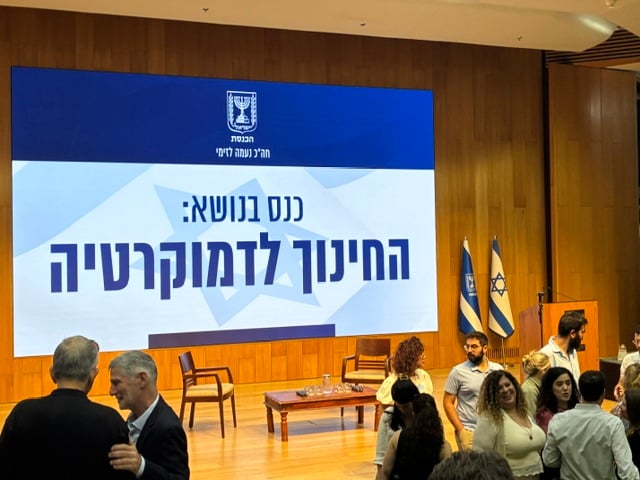
So, last Saturday evening, before I headed down to Merhavim, I saw an invitation from the energetic MK Naama Lazimi to a conference on democratic education to be held at the Israeli Knesset. I knew I had to be there. After spending six months inside the school system, I found myself thinking not only about classrooms but also about the kind of educational system Israel needs. It was an unusual gathering hosted by a member of the Knesset who truly cares about both education and democracy. As she half-jokingly put it, “In the next Knesset, I would like to be the Minister of Education. I am well qualified: my father was a school principal, I am married to an educator, and I am a mother.”
All the speakers at the conference were educators working in both formal and informal education who believe that education is the key to building a better society. Sitting there, surrounded by like-minded people—most of them young and enthusiastic—gave me hope.