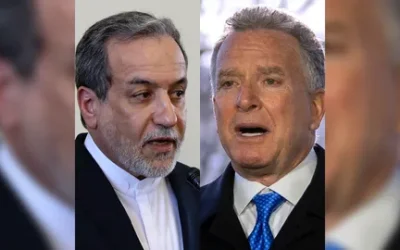
Image: US–Iran backchannel: Steve Witkoff (right) and Abbas Araghchi (left) amid rising pressure to reopen the Strait of Hormuz. (AP Photos: Stringer; Mark Schiefelbein).
The war between the United States and Iran is approaching a decisive crossroads. While mediators are working to prevent further escalation, the US president has extended the ultimatum to reopen the Strait of Hormuz by an additional 20 hours.
At the same time, it is becoming increasingly clear that diplomatic efforts are unfolding alongside distinct strategic signaling. Yesterday afternoon (US time), The Wall Street Journal reported that China had closed airspace near Shanghai for 40 days, starting March 27. On the same day, a joint China–Pakistan naval exercise began (March 27–April 2), described as protecting the China–Pakistan Economic Corridor (CPEC), a central component of China’s Belt and Road Initiative (BRI).
The message is clear: protecting trade routes has become an integral part of geopolitical strategy.
During the days of the naval exercise, the foreign ministers of China and Pakistan met, and at its conclusion China presented a five-point plan calling for a ceasefire and the reopening of the Strait of Hormuz. At the same time, reports in Chinese media indicated a joint intention by China and Russia to convene the UN Security Council and advance a resolution combining a ceasefire with the immediate reopening of the strait.
Against this backdrop, and without detailed explanation, the US president announced on his social media platform an extension of the ultimatum by 20 hours, reiterating his warning of severe strikes on Iranian infrastructure if the strait is not reopened.
This morning, additional steps toward a ceasefire were reported. Barak Ravid noted in Axios that mediators, in contact with presidential envoys Steve Witkoff and Jared Kushner, had proposed an immediate 45-day ceasefire to allow for detailed and complex negotiations. At the same time, expectations have grown that the UN Security Council may provide formal backing for such an arrangement.
Turkish media further suggested that any decision may only be taken early next week. It remains unclear whether this delay is due to the Easter holiday or an attempt to give the parties time to reach understandings outside the pressure of competing ultimatums.
Meanwhile, reports are increasing that Iran has already conveyed its ceasefire demands through mediators, indicating the existence of indirect contacts with Washington. Iranian Foreign Ministry spokesperson Esmaeil Baghaei confirmed that Tehran had presented its demands “based on national interests,” emphasizing that they are “legitimate and reasonable.”
The ongoing contacts between Iran and the United States—now receiving growing backing from China and Russia, and potentially anchored in a UN Security Council resolution—appear to represent the most viable opportunity to prevent further escalation.
Failure of these efforts could lead to a broader escalation, with devastating consequences—not only for the region, but also for the global economy and critical trade routes.
About the Author
Rafi Glick is a writer, lecturer, farmer, and business executive with decades of experience at the intersection of academia, technology, agriculture, and international trade.
• He has served as a Senior Teaching Associate at Ben-Gurion University of the Negev, Ono Academic College, Ariel University, Ruppin Academic Center, and as a guest lecturer at Sofia University’s Faculty of Economics and Business Administration (FEBA). At Ben-Gurion University he also advised the BGU–NHSA Accelerator in the Faculty of Science.
• In business, Rafi was CEO of Bidsnet Ltd., a pioneer in deploying fiber-optic cables through unconventional infrastructure (in partnership with CableRunner), delivering high-speed connectivity to homes, enterprises, institutions, and cellular networks. Earlier he held senior roles at ECI Telecom and served on the board of RLF Venture Capital, working with partners such as Intel, Teva, and the Jerusalem Development Authority.
• He contributed extensively to Israel’s trade and investment ecosystem: he directed industrial and agricultural technology divisions at the Israel Export Institute, founded Israel’s AGRITECH as international exhibition, and served on the board of the Israeli Investment Center at the Ministry of Industry and Trade.
• In his early career, Rafi established and served as the first director of the Cargo and Aircraft Supply Security Department in the Security Division at Ben-Gurion Airport (1972–1976). He lived in Kibbutz Parod until 1974.
• Rafi has also been recognized for his writing: in 2008 he was named Best Economic Blogger by TheMarker, Israel’s leading business daily.
• Today he continues to publish essays and commentary—with a special passion for astrophysics, space exploration, technology, economics, and social issues.
From Kibbutz Parod to the global stage, Rafi Glick’s career reflects a lifelong commitment to building connections—between people, industries, and ideas.
Email: rafi.glick@gmail.com