The views expressed herein are solely mine.
Tehran’s Cocaine Jihad in Bolivia
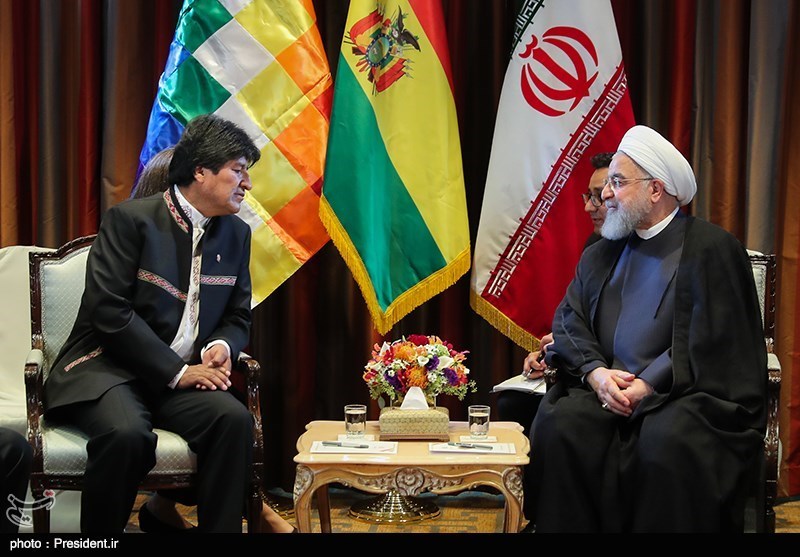
In 2018, Iranian President Hassan Rouhani and his Bolivian counterpart, Evo Morales, discussed a host of topics, including ways to deepen bilateral relations between the two countries in all economic and political areas. Credits: Office of the Iranian President.
In the tangled jungles of Latin America, a dangerous alliance has taken root. Iran—the godfather of proxy terror in the Middle East—has quietly built a beachhead in Bolivia, turning the nation into both a narco-state and a satellite of Tehran’s revolutionary empire.
What began as “anti-imperialist friendship” under Socialist strongman Evo Morales has mutated into a marriage of cocaine, drones, and covert warfare.
In July 2023, Iranian Defense Minister Mohammad Reza Ashtiani inked a secret “defense cooperation” pact with Bolivia’s Edmundo Novillo Aguilar. Officially, it covered drones, river patrols, and border security. Unofficially, it gave Iran access to Bolivia’s territory, minerals, and smuggling networks—fuel for Tehran’s military industry under Western sanctions. The full text of the agreement remains classified, and that silence should terrify every intelligence agency from Washington to Buenos Aires.
Bolivia, once defined by its Andean peaks and coca fields, has become Iran’s silent partner in a hybrid war. The same regime that funds Hamas, Hezbollah, and Islamic Jihad has embedded itself in South America under the banner of “solidarity.” Tehran is not exporting ideology—it is exporting logistics. The mullahs are building a supply chain that links opium poppies in the Middle East to coca jungles in the Andes.
The irony is grotesque. Iran, the world’s top state sponsor of terror, is “helping” one of the world’s most corrupt nations fight drug trafficking. Under the deal, Iranian drones, cyber units, and military “trainers” operate under diplomatic cover.
Today, Western intelligence officials believe that IRGC operatives are already inside Bolivia, disguised as technicians, overseeing industrial expansion, intelligence collection, and extraction of strategic minerals.
Bolivia’s cocaine empire makes it the perfect front for terror finance. Cartels ship narcotics through Argentina, Paraguay, and Brazil—routes that double as pipelines for cash, weapons, and extremists; in fact, Hezbollah’s fingerprints are everywhere in those networks.
Thus, weak institutions, porous borders, and a police force drowning in corruption make Bolivia an ideal incubator for the fusion of jihad and cocaine.
The precedent is chilling.
Iran’s Latin American infiltration did not begin yesterday—it traces back decades, from the 1994 AMIA bombing in Buenos Aires to the 2011 visit of Ahmad Vahidi, one of that massacre’s masterminds, who entered Bolivia as an “official guest.” When Argentina protested, La Paz shrugged. Tehran had already dug its claws in.
Today, Bolivia is a sanctuary for criminals and fugitives. The son of Joaquín “El Chapo” Guzmán once lived there, and Interpol’s second most-wanted man was found near its borders. Seven tons of cocaine seized in 2024 barely scratched the surface. The state does not govern anymore—the cartels and their foreign patrons do.
For Iran, the payoff is enormous.
Beyond cocaine profits, Bolivia sits on vast reserves of lithium and uranium—materials Tehran’s sanctioned military programs crave. Every so-called “defense” project doubles as a smuggling pipeline and intelligence foothold. With Iranian drones now in Bolivian hands, La Paz risks becoming both a test site and a distribution hub for Tehran’s weapons in the Western Hemisphere.
But a turning point has arrived. Bolivia has just elected Rodrigo Paz Pereira, a centrist reformer who ended nearly two decades of Socialist rule by the MAS party. His victory—confirmed Sunday night—marks the first serious break in the leftist chokehold that tied La Paz to Tehran. Paz has pledged to restore democratic institutions, rebuild trust with Washington, and confront the drug mafia strangling the nation.
This change matters. Certainly, it could be the crack in Iran’s Latin American wall.
A pro-Western Bolivia could begin dismantling Tehran’s covert apparatus—tightening borders, exposing IRGC front companies, and reopening intelligence cooperation with the United States.
On the other hand, it could bring real oversight to Bolivia’s lithium and uranium sectors, cutting off the raw materials Iran needs for its military and nuclear programs.
If Paz delivers on his promises, the narco-theocracy that Iran has cultivated in Bolivia could finally face daylight.
But if the entrenched networks of corruption, the MAS loyalists, and the Iranian operatives survive this transition, then nothing changes—and the next drone that strikes an American base or an Israeli city may still be funded by cocaine profits laundered through La Paz.
The Islamic Republic has found in Bolivia what it lost in the Middle East: a blind spot in Western oversight, fertile ground for corruption, and a new artery for its holy wars.
The next phase of that war depends on what Rodrigo Paz Pereira does next. He can break the chain—or watch his country become Tehran’s newest weapon in a war that no longer respects borders.
Related Topics
Related Posts