
Temptation of War – the Horizon Offered by Isaiah
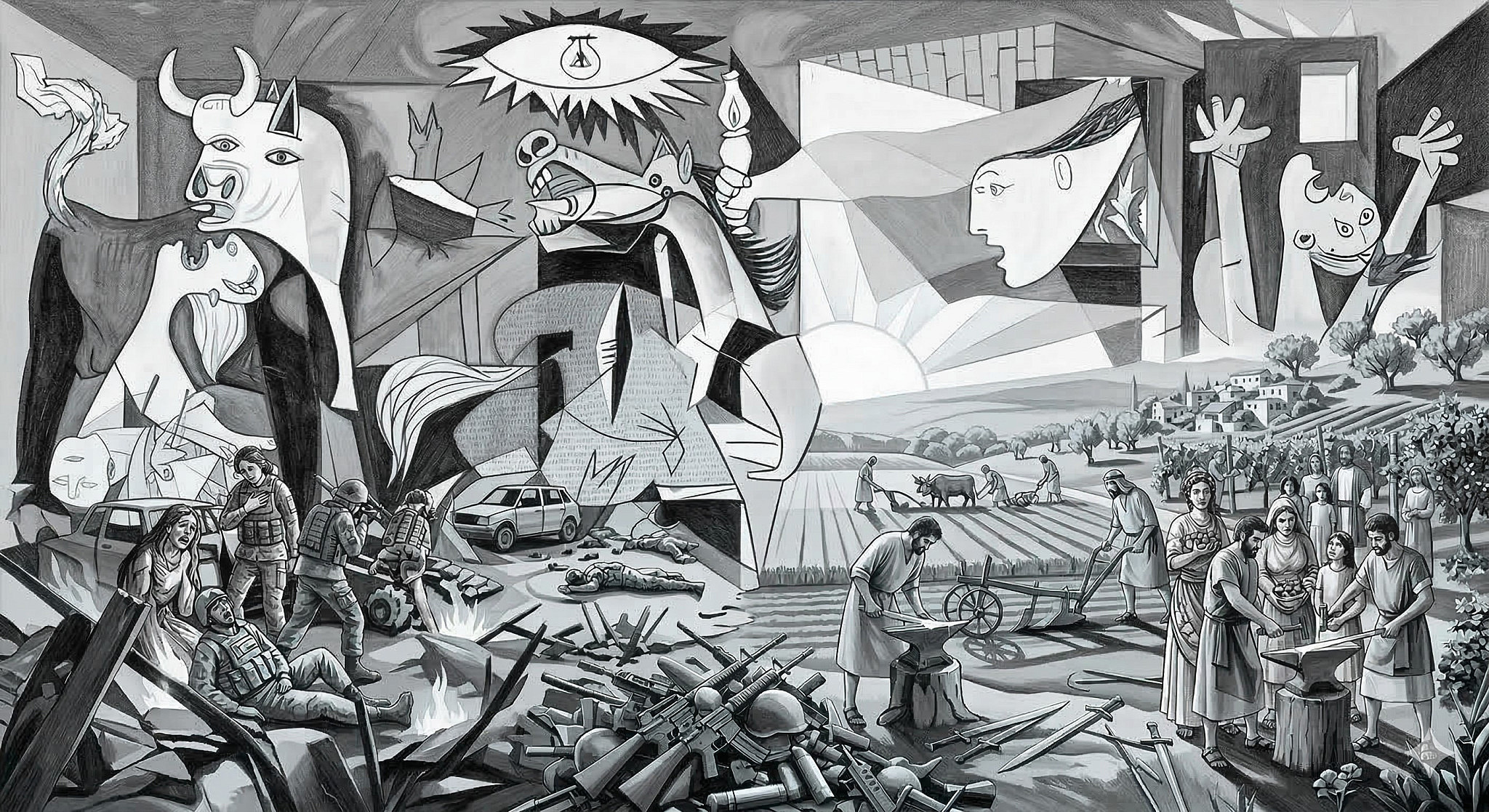
“Still, a white sail is on the horizon, facing a heavy black cloud.
Whatever we ask for, let it be.” (Naomi Shemer)
The ability to think beyond, to look toward and beyond the horizon, is what our Sages wrote in Ethics of the Fathers when they stressed the importance of what it means to ‘foresee what is yet to come’. This implies that even in the midst of difficult and trying situations, one should develop the capacity to look beyond oneself and towards a horizon of sorts. The more one reflects upon this idea, the clearer it becomes how enriching yet demanding such guidance truly is, both ethically and existentially.
It is demanding because it is exceedingly difficult to anticipate, and to sketch the contours of what has not yet occurred: it is hard to imagine how our actions in the present moment will change things, and the world around us.
We cannot think honestly about this war, the war that has been given the name ‘Operation Roar of the Lion’, without thinking of the morning of the Seventh of October.
That morning was not merely a military assault or a national attack. It was not only a military assault or an act of terror of unimaginable cruelty. It was a massacre unlike any we had known in the history of the state, and an encounter with a form of evil that seemed to cross the very boundaries of humanity. October seventh remains like an open wound at the heart of our existence. It shook the most basic sense of security of living in our own home. Out of this fracture emerged an immense and deeply justified motivation: the desire, deeply understandable, to restore security through force of arms, and through that deterrent ‘roar’.
At this moment, we owe a profound debt of gratitude to those who lead, to the quiet professionals of intelligence and defense, to those who bear the weight of command, to the women and men in uniform who answer the call, to those engaged in the difficult labor of victory, and to all who stand guard and protect the home front.
Yet precisely from this place of gratitude, we must guard ourselves against a dangerous illusion: the fantasy that a dramatic act of force, however necessary and justified, can erase trauma and restore a secure sense of reality.
War is never the final act. It is a tool within a far broader human, political, and historical undertaking, one that must also include the obligation to see humanity as beyond the front lines, and the suffering of civilians. If we allow war to become not a means but an end, we may win the battle and yet lose the horizon for which we set out.
The signal for the beginning of the war came with the decision to eliminate one of Israel’s most implacable enemies, one more name added to a long and expanding list of enemies throughout Jewish history.
From that moment, biblical verses, rabbinic sayings, and ancient maxims have returned repeatedly to my mind. Some celebrate the downfall of the wicked with song. Others warn against rejoicing at the fall of an enemy. Both voices belong to our cultural inheritance, and to the human soul. They exist side by side, and the tension between them is precisely the space in which we are tested. Our spiritual test lies in what we are moved to think within that tension.
I am not a security adviser, and my political understanding is limited.
Yet there are moments when the central question is not the military or political one,
but rather the question of the horizon. The ‘horizon’ is not a plan of action, but rather, it offers a direction towards which our current existence can be orientated.
One of the dangers of continually speaking of ‘the enemy’ as such is the gradual loss of the ability to see human beings as human. When language can no longer distinguish between a wrongful act and the existence of the other person, it does not merely declare war on the enemy, it transforms us as well.
The belief that we can define ourselves as ‘good’ simply because we know how to call others evil does not guarantee our moral or existential growth.
War, we have learned, is the moment when politics mocks philosophy. It is the moment when theology may be tempted to dismiss justice and mercy. War is the moment when power invites us into a cycle of struggle and recurring wars.
It is true that sometimes war is forced upon us. Responding to it obligates us to act in the name of justice. Yet at the same time we must recognize that war is also a form of temptation. The temptation of violence. And the temptation of a simplified mind.
War arranges the world into absolute and total categories. But the deeper problem with totalizing visions is that they are anti-human, anti-religious, and anti-existential.
In this context it is worth returning, slowly and attentively, to what Emmanuel Levinas wrote in his essay “Nameless”, reflecting on one of the lessons that may be drawn from the darkest of times: “Within the tragic situation, one must avoid delighting in the admiration of the masculine virtues of death and murder, the willingness to live in danger only in order to remove dangers and return beneath the shade of the vine and the fig tree”.
Perhaps this is precisely the moment to ask ourselves not only how to win, but which horizon we wish to leave open. When Isaiah prophesised, he did not seek merely to describe reality as it was. He sought to open a new direction for human history:
“They shall beat their swords into plowshares, and their spears into pruning hooks;
nation shall not lift up sword against nation, neither shall they learn war anymore.”
(Isaiah 2:4)
It is a vision that is difficult even to imagine from within our present bleeding reality.
And yet without it, victories risk becoming nothing more than pauses between wars.
After the War of Independence, David Ben-Gurion sat down to articulate what he called the messianic mission of Zionism. He was neither naïve nor a dreamer. He was a statesman and a commander. And yet he wrote that the purpose of the State of Israel was “to shape an independent Jewish society that will embody the three missions of the prophets of Israel: human fraternity, social justice, and peace among nations.”
Even when he was painfully realistic, he did not abandon the conviction that power must be accompanied by ethical consciousness.
I do not propose solutions, nor do I purport to know how we arrive there.
I only believe that this horizon – a horizon of peace grounded in dignity, recognition, and responsibility – is as necessary to us as the air we breathe.
And so even now, in the midst of war, between one action and the next, between attack and attack, between siren and siren, between defense and defense, we are invited to dare to imagine another course of history.
A path in which power is not the goal but a means, and the promise is not yet another victory among so many victories, but the possibility of peace.
It is a question we cannot allow ourselves to stop asking.