Terror at 34,000 Feet
At 3:05 a.m. UTC on September 30, Flydubai Flight FZ1073 lifted off from Dubai bound for Tel Aviv.
For more than two hours, there was little to distinguish it from the thousands of commercial flights crossing the Middle East every day. The Boeing 737 MAX climbed to 34,000 feet and settled into cruise. There were 174 passengers aboard, most of them Israelis. Somewhere among them were Yaniv Hayoun, Asaf Rajuan, Israeli dentist Dr. Shota Musayev and, by a coincidence that would soon matter enormously, other Flydubai pilots traveling aboard the aircraft.
At 34,000 feet, separated from them by a reinforced cockpit door, something went terribly wrong.
At 5:21 a.m. UTC, the airplane began to fall.
Flight-tracking data show a steep descent, followed by a sharp climb and then another descent. What appeared on a computer screen as a violently oscillating line was experienced inside the cabin as something passengers could not initially understand. Almog Italie later described the aircraft dropping, stabilizing and then dropping again.
The numbers were staggering. At one point FZ1073 lost nearly 14,000 feet in less than 30 seconds.
Inside the cabin, the numbers meant nothing. Passengers only felt the airplane falling beneath them.
Screams. Children crying. Prayers.
One passenger later recalled closing her eyes and praying as she thought they were going to die. Another said passengers recited Shema Yisrael. Videos from inside the cabin captured distressed voices and children crying as the plane lost altitude.
The aircraft dropped. Recovered. Then dropped again.
No one knew why they were falling.
At 5:28:48 a.m. UTC, according to Flightradar24’s detailed reconstruction, FZ1073 began transmitting 7700, the international transponder code for a general emergency.
By 5:33, the aircraft was around 15,000 feet.
At 5:35, the code changed.
7500.
Unlawful interference.
The aircraft turned west, briefly entered Jordanian airspace and then headed back toward Saudi Arabia. The emergency code later returned to 7700. Israeli fighter jets were dispatched as the emergency unfolded.
But the source of the terror was not outside the airplane.
It was already inside the cockpit.
According to Israel’s preliminary account, Captain Smit Machchhar, a 39-year-old Indian national, was attacked by his copilot inside the cockpit. Israeli officials say the copilot then attempted to crash the aircraft. Flydubai confirmed that an altercation occurred on the flight deck and said the underlying reasons remained unknown, cautioning against premature speculation.
What Machchhar did next may have determined whether anyone aboard survived.
Despite being seriously injured, he managed to release the reinforced cockpit door. Netanyahu spokesman Doron Spielman later said the captain used the “last moments of his energy” to open it.
The door opened.
Passengers ran forward.
Hayoun was first.
Rajuan followed.
Musayev ran toward the screams.
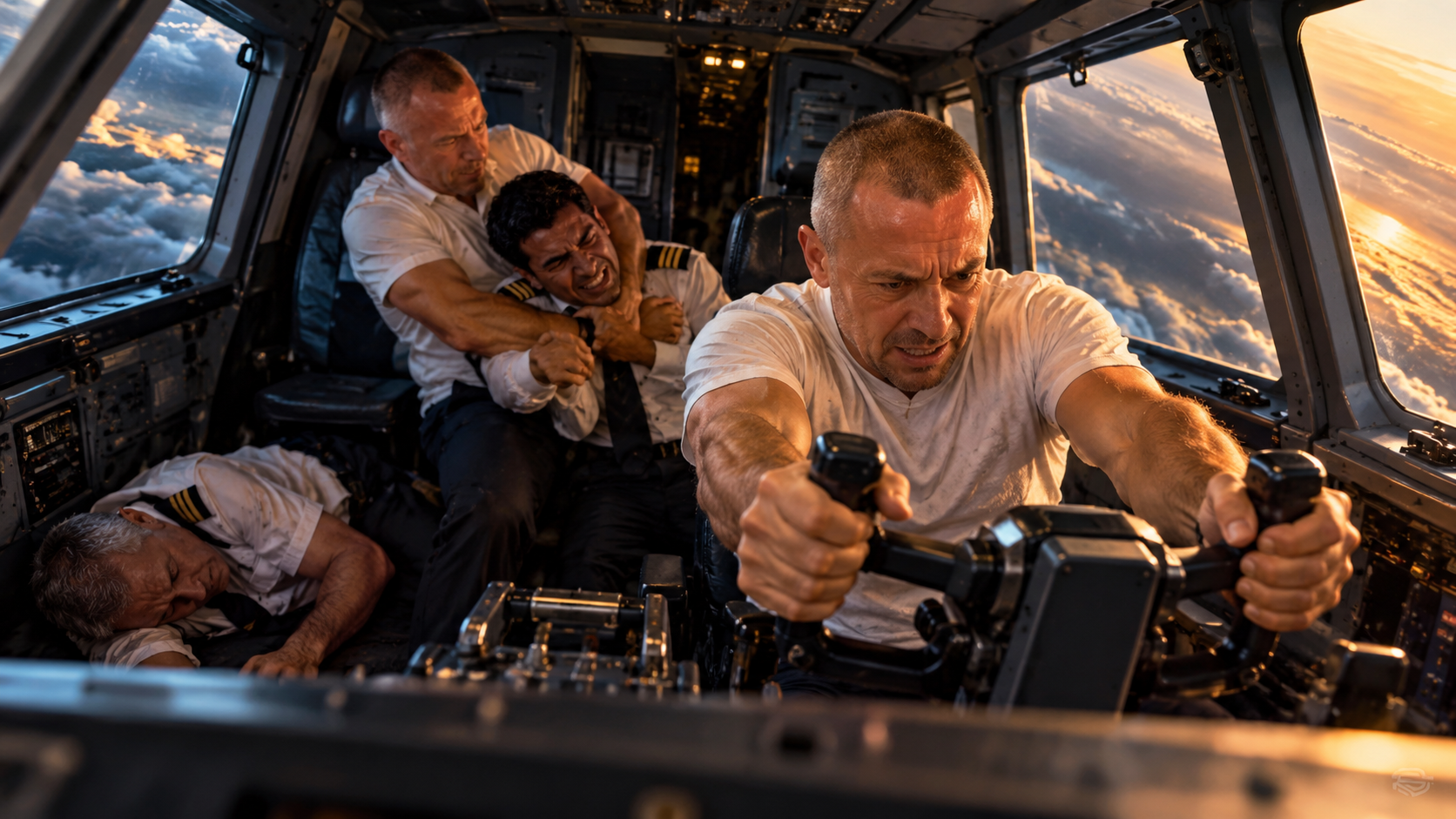
Inside, the captain was on the floor. According to Hayoun’s account, the copilot appeared to be interfering with the controls. Hayoun called for help, and other passengers joined him.
They went for him.
Hayoun, Musayev and other passengers helped restrain the copilot. Musayev later said he had run toward the cockpit not because he was a doctor, but because he had heard the screams and wanted to confront the attacker.
But restraining the copilot did not mean the airplane was safe.
The captain could not fly it.
Hayoun went back into the cockpit.
He grabbed the controls.
Later, standing beside Netanyahu at Ben Gurion Airport, Hayoun described what happened in remarkably simple terms: he began pulling the controls back. When Netanyahu asked how he knew what to do, Hayoun explained that he watched Air Crash Investigation.
For a few moments, a passenger was helping fly a Boeing 737 in distress.
Then the pilots aboard reached the cockpit.
Flydubai later confirmed that crew members traveling aboard took control.
Musayev recalled the significance of that moment: when another pilot entered the cockpit and took command, they understood that they might actually survive.
The aircraft turned toward Tabuk in northwestern Saudi Arabia.
It landed safely.
Everyone aboard survived.
Hours later, at Ben Gurion Airport, fear finally gave way to relief. Netanyahu embraced Hayoun, still wearing the shirt marked by the struggle aboard FZ1073, and called him a hero. Netanyahu then made the comparison that had already begun to haunt the episode: without Hayoun’s intervention, he said, it could have been another 9/11.
Hayoun was home.
For the passengers of FZ1073, the terror at 34,000 feet was over.
For the Middle East, another story was beginning.
The geography alone is remarkable. An aircraft operated by an Emirati airline had departed the United Arab Emirates carrying overwhelmingly Israeli passengers toward Tel Aviv. Israeli officials identified the copilot as an Omani national. The aircraft then landed in Saudi Arabia, a country without formal diplomatic relations with Israel. Netanyahu subsequently said Saudi authorities had arrested and questioned the copilot.
Israel sought permission to send military aircraft to retrieve its citizens. Saudi Arabia declined the request. The passengers instead continued their journey aboard Flydubai aircraft.
The result was a scene that would have been difficult to imagine only a few years ago: the passengers of an Israel-bound flight stranded temporarily in Saudi Arabia after surviving what Israeli authorities describe as an attempt to crash their aircraft, while the man Israel accuses of trying to kill them remained in Saudi hands.
The motive remains the great unanswered question.
Israeli officials have described what happened as an attempted terrorist attack. Flydubai has urged against premature speculation, saying the underlying reasons remained unknown. Israel’s defense minister went further, publicly describing the incident as an attempted jihadist terrorist attack, although he did not publicly provide evidence establishing that motive.
Israel nevertheless began drawing immediate security conclusions. Prime Minister Benjamin Netanyahu ordered increased security checks on pilots flying into Israel, including those working for foreign carriers.
There is also an uncomfortable historical echo.
The attacks of September 11, 2001 transformed aviation security around a fundamental problem: how to prevent an attacker from gaining control of a commercial cockpit and turning an airplane into a weapon. Reinforced doors, restricted access and multiple layers of security followed.
FZ1073 presents the inverse problem.
What happens when the potential threat is already authorized to be inside the cockpit?
Commercial aviation depends upon an enormous architecture of trust: in airports, airlines, governments, screening systems and, ultimately, the people permitted to sit behind a reinforced door with hundreds of lives under their control.
The consequences also moved beyond aviation security.
The Abraham Accords transformed relations between Israel and the United Arab Emirates and made direct commercial routes such as Dubai–Tel Aviv an ordinary part of regional life. FZ1073 was traveling along one of those routes.
Within hours of the incident, Flydubai announced that it was suspending all flights to and from Israel while the investigation continued.
Israel went further.
The Foreign Ministry’s director general, Eden Bar Tal, briefed Israeli ambassadors and heads of missions around the world. According to a ministry statement, diplomats were instructed to emphasize Israel’s position that what happened aboard FZ1073 was an attempted terrorist attack against Israelis, the United Arab Emirates and the Abraham Accords themselves.
The diplomatic consequences no longer depend entirely upon knowing the motive. Flydubai has suspended its Israel route, Israel is changing how it screens pilots, and Saudi Arabia unexpectedly became both the refuge for the passengers and, according to Netanyahu, the custodian of the suspect.
None of that establishes responsibility by any of those states.
It does mean that what happened behind one cockpit door can no longer be treated merely as an internal airline incident.
Perhaps the most remarkable aspect of FZ1073 is how many things had to happen correctly after something went catastrophically wrong.
An injured captain had to remain capable of releasing the cockpit door. Passengers had to realize that something was wrong and run toward it. Hayoun, Musayev and others had to overpower the terrorist. Hayoun then had to return to the controls and pull back on them using something he remembered from a television program. Musayev had to turn from confronting the copilot to treating the wounded captain. And qualified Flydubai crew happened to be aboard and could ultimately assume control of the aircraft.
Remove one link from that chain and September 30, 2026 might have acquired an entirely different meaning.
At 3:05 a.m., FZ1073 left Dubai as an ordinary commercial flight.
It climbed until it reached 34,000 feet.
At 5:21, it began to fall.
Somewhere between 34,000 feet and the Saudi desert, a handful of people changed what happened next.
This time, there was no second September 11.
The terror at 34,000 feet had become something else: the miracle at 34,000 feet — a story worthy of the cinema, in honor of the captain, the passengers who fought back, and all those who lived through that nightmare.
The passengers came home. There will be heroes to honor, families to embrace and, after the terror at 34,000 feet, an extraordinary story of survival for Israel to celebrate.
It is a happy ending. Israel celebrates. But Israel does not forget. This story is not over yet.