Teshuvah Is Changing What We Love
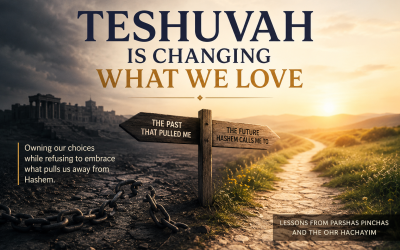
Every so often, I come across a Torah commentary that stops me in my tracks. This week, it was the Ohr HaChaim on Parshas Pinchas. At first, his words seemed to contradict one of the most fundamental principles of teshuvah: that we should stop blaming others and take responsibility for our own choices. But the more I sat with his insight, the more I realized he wasn’t contradicting that principle—he was revealing another essential step in the journey back to Hashem. His comment led me to reflect on what it really means not only to change our actions, but to change our relationship with the things that once pulled us away from the people we were meant to become.
There are moments when a single Torah commentary forces us to rethink something we thought we understood.
For years, I’ve believed that genuine growth begins by looking inward. When we fail, we shouldn’t waste our energy blaming others. We should accept responsibility, examine ourselves honestly, and ask how we can become better people.
Then I came across a remarkable comment from the Ohr HaChaim on this week’s Parshas Pinchas. At first, it seemed to challenge everything I had come to believe. But the more I reflected on it, the more I realized that it wasn’t contradicting that principle at all. It was completing it.
The Torah commands the Jewish people:
“Harass the Midianites and strike them.”
The Ohr HaChaim points out something surprising. The Torah is not commanding Israel to act against Midian because of the plague that followed the sin at Baal Peor. The plague came from Hashem as a punishment for the Jewish people’s own actions. Instead, they are to oppose Midian because they intentionally caused the Jewish people to fall into immorality and idolatry.
At first glance, this seems difficult to understand.
We’re often taught not to point fingers at others. When we fail, we are supposed to look inward, accept responsibility, and ask ourselves how we can grow. If that’s true, why does the Torah direct Israel to turn its attention toward Midian?
The answer, I believe, is that the Torah is teaching two complementary truths.
First, every person is responsible for his own choices. The Midianites did not force anyone to sin. Every individual remained accountable, and that is why Hashem punished the Jewish people. The plague itself is proof that the responsibility ultimately rested with them.
But there is another truth.
Someone who deliberately tries to pull another person away from Hashem commits a different kind of evil. The Midianites didn’t simply present a temptation. They carefully devised a strategy to corrupt Israel spiritually. Their goal was to weaken the Jewish people by separating them from their relationship with Hashem.
Once a person has fallen, part of the process of healing is recognizing that what led him astray is not his friend—it is his enemy.
That doesn’t mean blaming others for our mistakes. It means refusing to make peace with the influences that encourage us to become someone we don’t want to be.
This is why the Ohr HaChaim emphasizes that Israel’s opposition to Midian could not be motivated by the suffering of the plague. That suffering came from Hashem as a consequence of Israel’s own actions. If they hated Midian simply because they had been punished, they would be avoiding responsibility.
Instead, they were to oppose Midian because Midian sought to destroy their souls.
Perhaps this is the deepest lesson of all.
Teshuvah is not complete when we merely stop doing the wrong thing. It reaches deeper than our actions. It asks us to change our relationship with the very thing that once drew us away from Hashem.
As long as we continue to admire what caused our spiritual decline, part of us will always remain connected to it. Healing begins when we see those influences for what they truly are—not because we hate people, but because we no longer wish to love what distances us from the life Hashem calls us to live.
That is why the Torah commands Israel to oppose Midian. The battle is not only against an external enemy; it is against the lingering attraction to a way of life that threatened their relationship with Hashem.
Whether it’s unhealthy relationships, destructive habits, addictive behaviors, or ideas that slowly erode our values, we must first acknowledge our own responsibility. But once we do, we should also learn to identify those influences for what they are. They are not neutral. They are obstacles to becoming the person Hashem created us to be.
Personal growth requires honesty about ourselves. Spiritual growth also requires honesty about the influences we allow into our lives.
Parshas Pinchas reminds us that these are not contradictory ideas. They are two sides of the same process of teshuvah.
We accept responsibility for our choices while refusing to embrace the forces that lead us away from Hashem.
Because in the end, teshuvah is not only changing what we do.
It is changing what we love.
Shabbat Shalom!