This Way Up: Spiritual Means to Psychological Ends
Tevye Meets Confucius: Why Fiddler on the Roof Resonates in China
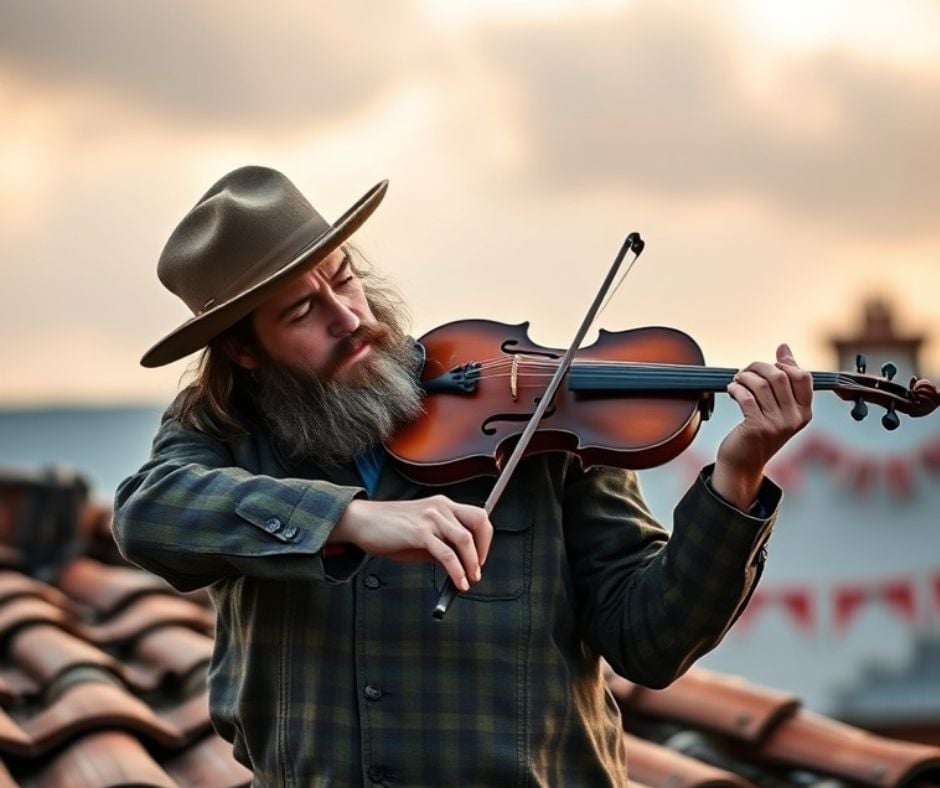
Image courtesy of Canva.com
At a recent lecture for the Canadian Antisemitism Education Foundation’s Chinese-Jewish Exchange, the renowned Chinese Judaic Studies scholar Xu Xin made a striking observation. Many Chinese people, he said, experience Jews as “soulmates.”
At first glance, the idea seems improbable. What could connect a tiny Middle Eastern people shaped by Torah, exile, and covenant with a vast East Asian civilization shaped by Confucian ethics, Taoist balance, and dynastic continuity?
And yet, the resonance is real.
One clue may lie in an unexpected place: Fiddler on the Roof.
A colleague involved in our Chinese-Jewish Exchange project recently told me that this musical deeply resonated with many in China and has been staged in Hong Kong in Cantonese. He explained that many recognized something profoundly familiar in the story. In fact, he said that seeing Fiddler on the Roof marked the beginning of his own Jewish journey.
But why should a musical about Jews in a Russian shtetl feel emotionally legible to Chinese audiences? The answer may reveal something important about both civilizations.
The emotional engine of Fiddler is not merely Jewish ritual or Eastern European history. It is the universal drama of what happens when an ancient civilization collides with modernity. Tevye struggles to preserve continuity while the world around him changes at bewildering speed. His daughters seek autonomy, romantic freedom, and new identities. The old order weakens. The younger generation walks toward a different future.
Chinese audiences immediately recognize these tensions.
China’s twentieth century was marked by enormous upheaval: revolution, ideological campaigns, the Cultural Revolution, rapid modernization, urbanization, globalization, and dramatic shifts in family structure and cultural memory. Many Chinese families experienced painful ruptures between generations. Ancient traditions were challenged, attacked, or abandoned in the rush toward modernity.
Under such conditions, Fiddler on the Roof becomes a mirror. Perhaps Chinese audiences cry for Tevye while also mourning grandparents, villages, customs, and moral worlds swept away by history.
This insight connects powerfully with the work of Professor Vera Schwarcz, who will be speaking later this month in the CAEF webinar series, Truth and the Way / Tao (道): Jewish Moral Thought in Conversation with Chinese Civilization.
Schwarcz, a historian of China and the daughter of Holocaust survivors, has written movingly about Chinese educators visiting Yad Vashem and unexpectedly finding themselves emotionally overwhelmed by Holocaust testimony. In her essay Expanding Historical Empathy, she suggests that part of what these visitors were feeling was not only empathy for Jewish suffering, but also the awakening of buried grief connected to China’s own unspoken historical traumas.
The Holocaust, she argues, sometimes gives Chinese visitors “a new vocabulary for the wounds of history,” including wounds embedded within their own historical experience.
That phrase stayed with me.
Perhaps Jewish stories can sometimes function as safe symbolic containers through which Chinese audiences process their own historical anxieties, griefs, and moral questions. Not because the histories are identical. But because both civilizations possess unusually deep relationships to memory, continuity, family, learning, and survival.
Jews and Chinese have each endured repeated historical upheavals while preserving strong civilizational identities. Both traditions place enormous emphasis upon education, ancestor consciousness, moral cultivation, and intergenerational transmission. Both understand that culture survives not only through governments or armies, but through families, texts, rituals, and memory.
In a fragmented modern world increasingly detached from history, this creates a surprising mutual recognition.
Perhaps this is why Xu Xin’s striking use of the word “soulmates” resonates.
The relationship between Jewish and Chinese civilization is not about claiming sameness. The differences are immense and should be respected. Rather, it is about recognizing a rare and meaningful conversation between two ancient traditions that still carry living memories of continuity, rupture, ethical struggle, and cultural survival.
At a time when public discourse often collapses into polarization and slogans, such conversations matter. In an era marked by historical amnesia, social fragmentation and ideological extremism, dialogue between ancient civilizations may offer moral resources modern societies are in danger of losing. They remind us that civilizations can meet not only through conflict or commerce, but through recognition.
And sometimes, through a fiddler standing precariously on a roof, trying to keep balance while the world changes beneath him.
On Sunday, May 24 at 11 a.m. EDT, Professor Emeritus Vera Schwarcz will join Dr. Elliott Malamet for the Canadian Antisemitism Education Foundation webinar Truth and the Way / Tao (道): Jewish Moral Thought in Conversation with Chinese Civilization. The discussion will explore how ancient wisdom traditions help us remain grounded and morally oriented in confusing and unstable times.
Related Topics
Related Posts