
Advancing Women's Health, One Policy at a Time
‘Thank You’ Is Not a Policy
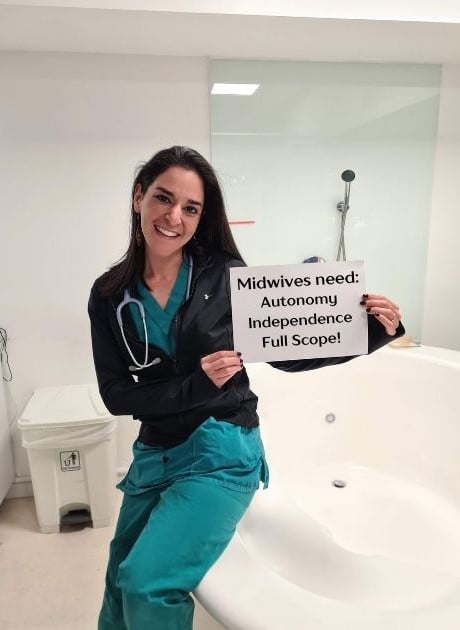
Israel does not need symbolic appreciation for midwives. It needs the courage to let them practice independently, autonomously, and to full scope. (Source: Gila Zarbiv)
Today, May 5th, is International Day of the Midwife.
Every year, the same rhetoric:
Thank you.
Angels.
Heroes.
Life savers.
The gratitude is real. Midwives deserve it. They stand with women in some of the most vulnerable, powerful, frightening, ordinary, and extraordinary moments of life. They hold clinical responsibility, emotional presence, and human dignity in the same pair of hands.
But gratitude is not enough.
“Thank you” is not a policy.
Flowers do not replace safe staffing. Compliments do not replace professional autonomy. Social media posts do not replace fair working conditions, community services, insurance coverage, legal authority, data systems, continuity of care, or the ability to practice to full scope.
This year, the global theme for International Day of the Midwife is One Million More Midwives. The message is urgent. The world is short of nearly one million midwives, and that shortage affects women, newborns, families, and health systems everywhere.
But the question is not only how many midwives we have.
The question is whether health systems are willing to let midwives be midwives.
Israel has midwives.
Highly trained midwives. Skilled midwives. Experienced midwives. Midwives whose education and clinical preparation span more than six years. Midwives who work through overcrowded shifts, emergency situations, trauma, war, uncertainty, and impossible workloads. Midwives who care for women in hospital rooms, protected spaces, operating rooms, triage units, ambulances, clinics, homes, and communities.
Midwives who know that in Israel, women’s health does not pause for war, sirens, grief, displacement, uncertainty, or fear. It happens inside the full weight of Israeli life, and midwives are there for all of it.
And yet, Israel is wasting one of the most powerful health system resources it already has by limiting midwives to a fraction of what they are trained to do.
Too often, the midwife is seen as the professional who appears at the end of pregnancy, in the labor and delivery room, when birth is already well underway. Too often, midwifery is treated as a function within an obstetric system rather than what it is: an independent, autonomous profession with its own knowledge, scope, philosophy, and public health contribution.
Midwifery begins long before labor, and continues long after birth. It is an independent profession, a scope of practice, and a model of care.
It is prevention. Relationship. Continuity. Clinical judgment. Health education. Research. Academia. Trust. Early recognition of risk. It is protecting physiology while simultaneously recognizing pathology, with the knowledge, skill, and authority to act when complications arise and to continue caring when birth becomes complex. It is care before, during, and after birth, and across the transition into parenting.
According to the World Health Organization, midwives can provide around 90 percent of essential sexual, reproductive, maternal, newborn, and adolescent health services.
That is not a side contribution. That is an entire layer of health system capacity. And in Israel, of all places, underusing that capacity should be unthinkable.
Israel has the highest fertility rate in the OECD. Based on 2024–2025 data Israel’s fertility rate was 2.8-2.9 children per woman, compared with an OECD average of 1.4-1.5. Women in Israel give birth at more than double the OECD average.
A country with this many births cannot afford a narrow vision of midwifery. Not clinically. Not economically. Not ethically.
It cannot afford to confine midwives to the labor and delivery room.
It cannot afford to keep midwifery autonomy theoretical.
It cannot afford to leave full scope midwifery unrealized while ordinary demand strains the system every day.
If any health system needs independent, autonomous, full scope midwifery, it is Israel.
Full scope midwifery is not only pregnancy and birth. It is care across the sexual and reproductive life course: menstrual health, routine sexual and reproductive health visits, contraception, family planning, abortion care and referral, sexually transmitted infection and HIV prevention, preconception care, pregnancy, birth, postpartum care, breastfeeding, newborn care, menopause related support, education, prevention, and early identification of risk.
It means midwives practicing independently. It means the ability to prescribe medications, refer, admit, discharge, diagnose, treat, and collaborate when risk emerges. It means freeing obstetric and specialist care to focus where it is most needed.
Midwives do not compete with physicians. They collaborate with them. They make the whole system work better. When midwives practice fully, pregnancy, birth, postpartum, newborn, and reproductive health needs can be cared for by midwives, while obstetricians and specialists focus on complexity, complications, and surgery.
That is good medicine, organized intelligently.
When midwives practice to full scope, women do not have to wait until a concern becomes urgent to be seen. Questions are answered earlier. Changes are noticed sooner. Postpartum care does not disappear after discharge. Breastfeeding, recovery, mental health, contraception, newborn feeding, warning signs, and routine concerns are addressed by professionals trained to see the whole picture.
Care also becomes continuous instead of fragmented. Women are known, followed, and supported by a known midwife, or a small team of midwives, rather than passed from one disconnected encounter to the next. They are not left wondering who will be with them when they give birth. They do not have to repeat their story again and again. Concerns are less likely to fall between appointments. Referrals become more appropriate. Appointments are used better. Waits become shorter. Physicians have more time for high risk pregnancies, complications, surgery, and complex medical care.
Most importantly, midwives save lives. This is not rhetoric. Global modeling shows that universal access to midwife delivered interventions by 2035 could save 4.3 million lives, by preventing maternal deaths, newborn deaths, and stillbirths.
This is what a functioning maternity system should do: allow each professional to work at the top of their training, not below it.
Israel does not need symbolic respect for midwives alone. It needs the structures that allow midwives to work independently, autonomously, and fully.
We cannot continue to celebrate midwives once a year while designing maternity care systems that stifle them. We cannot call midwives essential while limiting their scope, authority, and autonomy. We cannot say women deserve access, safety, and choice while failing to build the workforce model that could help deliver all three.
Israeli midwives need more than appreciation.
They need policy.
That means full scope practice. Independent midwifery authority. Clear referral pathways. Integration between hospital, community, and home. Continuity models. Meaningful postpartum care. Insurance structures that support women’s choice. Data systems that learn routinely, not only after tragedy. And midwives at every policy table where maternity care is planned.
The world is calling for one million more midwives.
Israel should answer that call not only by counting midwives, but by allowing midwifery to become what women, babies, families, and health systems need it to be.
Because thank you is not a policy.
And midwives, and women, deserve more than thanks.
They deserve a health system brave enough to let midwives be midwives.
(Be a part of the change and sign the global petition here: https://millionmore.org/)
Related Topics