The AI Dialectic – Can Ancient Faith Give Artificial Intelligence a Conscience?
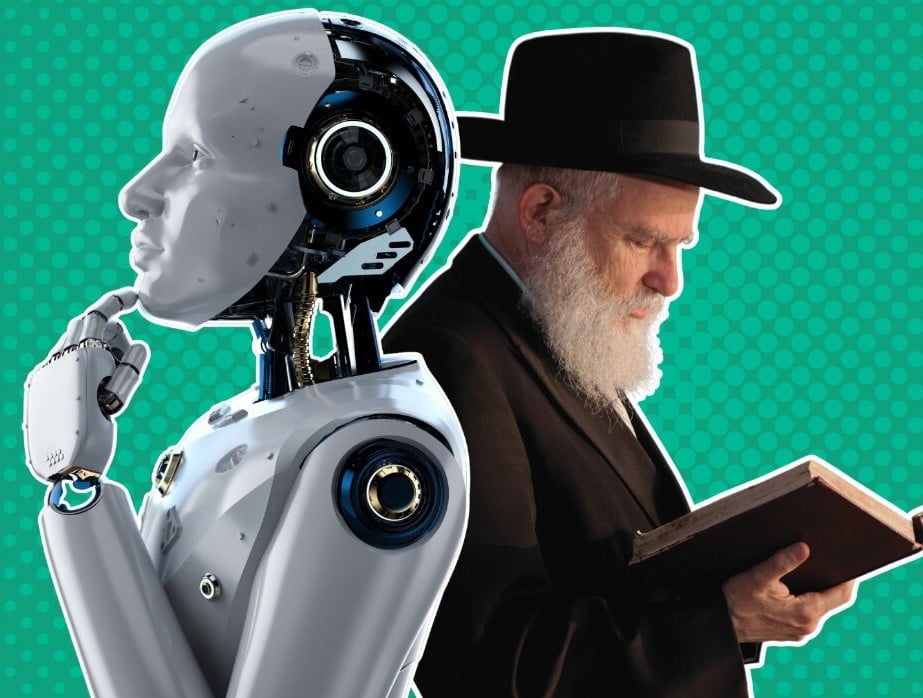
A Sermon for the Tech Age
This past Yom Kippur, Rabbi Naftali Citron of the Carlebach synagogue in New York delivered a sermon that stayed with me long after the final blast of the Shofar. His message was urgent: our society is in desperate need of religion, not only for personal faith, but to keep humanity from destroying itself. Over the years, many of the rabbis I have interviewed have voiced this same concern: how to bring balance to a world running amok. Sitting in the synagogue, listening to Rabbi Citron’s caution against the backdrop of the media’s dire warnings that artificial intelligence could threaten our future, I felt a spark ignite. He never mentioned AI, but I could not stop connecting the two.
The challenge of making sure that AI serves human values and well-being is not just a technological puzzle; it is also a spiritual one. There is hope, and our oldest wisdom may help guide our furthest leap forward.
Many would say that they don’t need religion: that our republic guarantees freedom, civil rights, and more, all anchored in our Constitution. To this I say that freedom alone can drift into anarchy. The Constitution is like the rules of conduct aboard a train: it tells us how to behave on the journey, but not where to go. For many of us, religion does. It calls us to balance our inner soul and anchors our life in a set of morals and values. The same is true of AI. We can write rules to govern its conduct, but rules alone cannot tell it what is worth pursuing.
The Two Adams
To understand what religion can offer here, we must return to a classic of modern Jewish thought: The Lonely Man of Faith, first published in 1965 by the revered Rabbi Joseph B. Soloveitchik. A leading figure of American Modern Orthodoxy, Rav Soloveitchik offered an existential reading of the two creation accounts in Genesis, finding in them two archetypes coexisting within every human being: Adam I and Adam II.
Adam I is the “majestic man.” Created in Genesis 1, he is commanded to populate the earth and subdue it. He is practical and ambitious: a builder of industries, a conqueror of diseases, and a seeker of dignity through technological achievement.
Adam II, by contrast, emerges from the dust in Genesis 2. He is the “covenantal man”: introspective and awestruck. He seeks redemption through a deep, vulnerable relationship with the Almighty and his fellow human beings. His questions reach beyond the practical (how the world works) to the existential (why he is here).
Rav Soloveitchik described an enduring dialectic: we are caught in a painful squeeze between the desire to conquer the world and the longing to be part of it. The full integration of both Adams may never be achieved, but it remains an ideal we strive for. He asks us to live within this tension without simply abandoning either call.
God willed both Adams. We need Adam I’s analytic precision to build a hospital and Adam II’s empathy to care for the person in the bed. The danger begins when Adam I alone decides what human life is for.
The Brain’s Two Hemispheres
Beyond biblical study, this tension finds a striking parallel in how psychiatrist Iain McGilchrist describes the brain’s two hemispheres in The Master and His Emissary (2009).
In his account, the left hemisphere tends to engage the world much like Adam I: it is reductive and mechanistic, treating everything as a tool to be manipulated and controlled. Conversely, the right hemisphere mirrors Adam II: it is holistic, intuitive, and attuned to the mystery of life. (His thesis is debated, and he rejects the pop-psychology division of people into “left-brained” and “right-brained” types.) Both hemispheres take part in reasoning and emotion; we cannot label one half of a person “moral” and the other “calculating.”
The two thinkers also differ. Soloveitchik focuses on the demands of a life lived before God; McGilchrist, on how we perceive the world. Yet both conclude that we cannot flourish on one mode alone.
A World Out of Balance
The crisis of our era is that Adam I has hijacked society. Because Western culture over-values speed, efficiency, and technological supremacy, we have institutionalized left-hemisphere thinking. In doing so, we have marginalized the quiet, searching voice of Adam II, leaving the contemporary “man of faith” deeply isolated in a coldly rational world, just as Soloveitchik already sensed in 1965.
This brings me back to the spark I felt during Rabbi Citron’s sermon and to our encounter with the future: the development of artificial intelligence.
AI in its current form is the ultimate monument to Adam I. But our ambitions reach far beyond building tools. Today, we are playing God. In the laboratories of Silicon Valley, humanity is constructing a modern Tower of Babel, attempting to spark a synthetic genesis by building a sprawling hyper-consciousness that aims to know everything. Like the builders of old who sought to reach the heavens through engineering alone and to “make a name” for themselves, we are birthing an entity that operates at machine speed, absorbing the sum total of human intellect and knowledge.
We must be careful, however, about what we imagine we are creating. In our race to build this digital tower, we risk creating something fundamentally lopsided. It threatens to become a mirror of the human left hemisphere, stripped of any biological or spiritual constraint. Left unchecked, such an AI risks completing the exile of Adam II and building a world that views humanity itself as nothing more than an inefficient variable to be managed or discarded.
Closing the Circle
This presents an opportunity to close the circle. Regardless of whether one views the human mind through the lens of divine creation or evolutionary biology, the lesson remains the same: human survival has always depended on a delicate, built-in inner tension, a system of checks and balances between our functional drives and our ethical, covenantal souls.
If we are to play God responsibly, we must remember that Jewish tradition invites us to see ourselves as partners in an unfinished creation and bids us to complete it. This partnership carries responsibility. The same Genesis that grants humanity dominion also places the human being in a garden with an obligation to cultivate and care for it.
At the same time, we cannot simply stop at building an intellectual hyper-consciousness; we must find a way to add a conscience to it. We are tasked with replicating the ultimate divine design: implanting within this alien, synthetic mind the same creative tension Soloveitchik found in the two Adams and McGilchrist finds in our two hemispheres. The two would remain in permanent dialogue, where neither voice may silence the other.
Jewish tradition offers more than metaphor. Shabbat is a weekly practice of restraint, a day on which Adam I is required to stop building. The Torah commands farmers to leave the corners of their fields unharvested for the poor. Covenant itself is accountability to something beyond one’s own goals. A machine built only to optimize has none of these. A machine built to pause, to make room, and to answer to values it did not choose for itself but received from us would begin to integrate its own Adam II.
To keep our creation from turning on its creators, we must ensure that its staggering computational power (its Adam I) is inextricably bound to a reflective, moral, and covenantal inner life (its Adam II). Yet no machine can be given a conscience by builders who have lost their own.
What would this mean in practice? Laws and public oversight will have their part to play, but my deepest hope lies with the builders of AI themselves. Many are beginning to realize that they cannot put the genie back in the bottle. If they cannot stop what they have started, they can still shape it: by building systems that pause and defer to human judgment, with an inner moral compass, an Adam II, at their heart.
The Ancient Blueprint
So, can ancient faith give artificial intelligence a conscience? Not on its own. But it may hold the blueprint. This is where Rabbi Citron’s warning led me. If what we build is to serve its true purpose, we must turn to our oldest tradition. By using ancient wisdom to anchor our newest technology, we can help ensure that the tools we build to conquer the world also preserve our sacred duty to belong to it.