The ambassador at Loods 24
TL;DR: The dispute at Loods 24 is not simply about criticism of Israel or the presence of an ambassador. Political parties and activist organizations are using accusations against Israel to claim authority over a Jewish commemoration and to assign 686 murdered Jewish children a political position they never expressed. Mayor Carola Schouten’s response risks converting that pressure into municipal leverage by treating the ambassador, rather than the threatened boycott, as the problem to be resolved. The result is a conditional form of solidarity: Jewish suffering is honored while Jewish continuity, agency and connection to Israel become grounds for withdrawal. That demand is antisemitic, and the mayor should reject it rather than mediate it.
The intervention
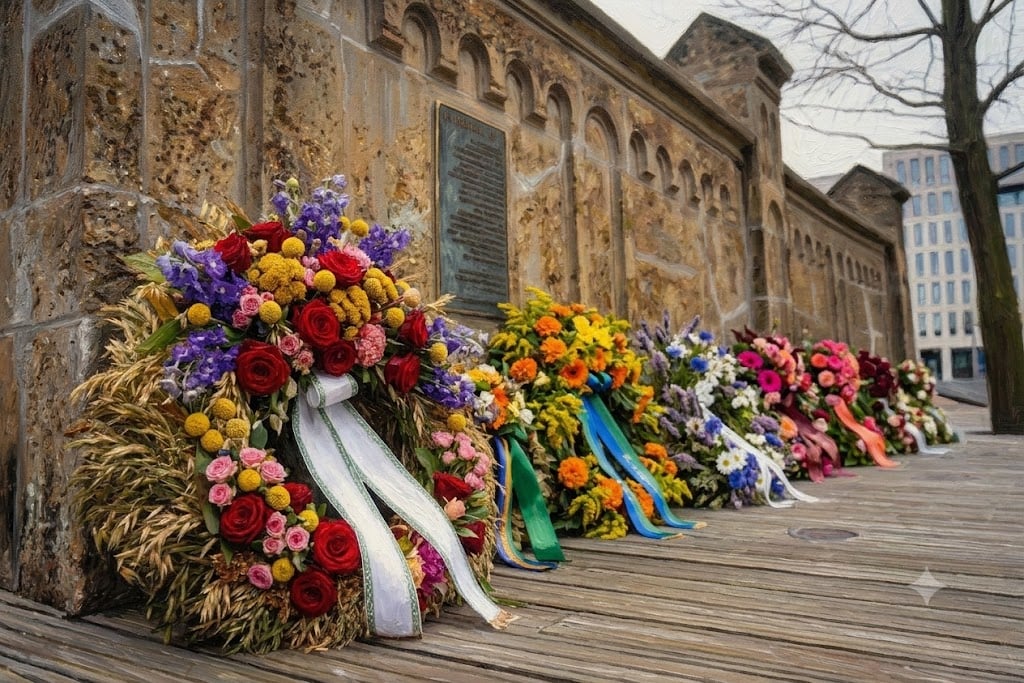
Every July 30, Rotterdam gathers beside the remaining wall of Loods 24, the warehouse compound where the German occupation authorities assembled Jews for deportation. Between July 1942 and April 1943, 6,790 Jews passed through the site in eight transports. Most were murdered at Sobibor and Auschwitz; only 488 survived. Nearby, the Jewish Children’s Monument bears the names of 686 Rotterdam Jewish children who were deported and murdered. The commemoration joins Jewish ritual and municipal presence: rabbis recite the memorial prayers, the mayor speaks, and Jewish institutions, the city and other public bodies lay wreaths. Israeli diplomatic participation has been part of the ceremony for years: an Israeli ambassador addressed it in 2018, and the embassy again provided a speaker and laid a wreath in 2025. This year, Ambassador Zvi Aviner Vapni is scheduled to speak. His presence has become the reason political parties, neighborhood bodies and activist organizations are threatening to stay away.
The initiative comes from the Rotterdam branches of DENK and the Party for the Animals, two fringe parties that each hold three of the 150 seats in the Dutch lower house. Both parties supported a parliamentary motion for a complete economic, military, political, academic and sporting boycott of Israel. Several wijkraden (elected neighborhood councils) have joined the threatened withdrawal. A separate letter signed by 63 organizations and individuals asks Mayor Carola Schouten to press the organizers to cancel the invitation and to stay away while the ambassador remains on the program.
How the burden shifts
The campaigners invoke the war in Gaza, the conduct of the Israeli government and allegations of grave violations of international law. Those claims explain their opposition and may shape how they view the ambassador. They do not give external actors authority to determine the program of a commemoration organized by the institutions responsible for it. Loods 24 commemorates Jews deported because they were Jews. It is not a tribunal on any Israeli government. Political actors may draw their own conclusions from the past; the controversy begins when those conclusions are converted into a claim over who may participate in the ceremony.
The ambassador’s participation has been described as morally reprehensible, as a desecration of the murdered children’s memory and as a threat to the dignity of the commemoration. Nothing announced for his speech is at issue. The objection precedes the ceremony and attaches to his identity as Israel’s representative. The campaigners do more than oppose his presence. They assume the authority to speak in the victims’ name, supplying the murdered Rotterdam Jewish children whose names appear on the monument with a posthumous political verdict and directing that verdict against the institutions responsible for remembering them.
Schouten’s response is where that claim begins to acquire institutional form. She has said that she understands the growing concern about the dignity of the commemoration and will consult the organizers about how that dignity can be safeguarded. The formulation is cautious and apparently open. It also changes the location of the problem. Those seeking to interrupt an established ceremony enter the municipal response as bearers of understandable concern. The Israeli ambassador becomes the object from which dignity must be protected, while the organizers are asked how the disturbance created by opposition to their guest might be resolved through a change to the ceremony. Those speaking for the victims are thereby received as guardians of their dignity. The ambassador has not changed. The institutional meaning assigned to his presence has.
Parties submit questions, wijkraden announce their withdrawal, organizations express moral outrage, and the mayor proposes consultation. None formally claims control of the program. Together, these acts give those seeking to alter it growing influence over whether the city will continue to participate.
Those threatening absence no longer appear simply as actors responsible for their own decision. Their withdrawal becomes an institutional problem the organizers are expected to resolve. The people seeking to alter the ceremony create the condition, while the people maintaining it are asked to bear the consequences.
The organizers do not decide whether the mayor or the wijkraden attend, just as those officeholders do not decide whom the organizers invite. Each remains responsible for its own decision. Schouten’s office gives her decision greater public weight, but not control of the program. Her absence would carry public meaning; it would remain her act, not a defect in the commemoration that its organizers must cure.
The terms of remembrance
Israeli diplomatic representation has been part of this ceremony because its organizers understand Israel as belonging to the history and continuity they commemorate. Yet the relationship between Israel and Jewish remembrance is treated differently according to the conclusion it is required to support. When Jewish history explains Israel’s presence, the state is declared separate from Jews and irrelevant to the remembrance of European Jewry. When Israel is accused of wrongdoing, that separation disappears, and its conduct becomes decisive in determining whether a ceremony for murdered Jews remains worthy of municipal participation. The relationship is denied as a source of standing and invoked as a source of liability. That decision belongs to the organizers; the existence of other Jewish views does not transfer control of the program to political parties, municipal bodies or activist organizations.
Here, Jews are most readily welcomed as victims. Their persecution may be mourned, their murdered children named and their vulnerability incorporated into the moral identity of the city. The difficulty begins when Jewish history appears as continuity, collective agency and sovereignty. Israel then becomes a disqualifying presence. Living Jews are expected to submit their understanding of the commemoration to a contemporary political test set by others. The campaigners have chosen a commemoration of murdered Jews as the site of an anti-Israel campaign and made Jewish refusal to accommodate it the problem. They instruct Jews, in the name of murdered Jews, what Jewish catastrophe requires of them. Jewish suffering becomes a public moral resource; Jewish conclusions drawn from it are placed under external review.
The universal significance of the Holocaust is used to authorize this reversal. Its lessons belong to humanity, but universal meaning is not universal jurisdiction. The murdered do not become available to later political movements as authorities for positions assigned to them after death.
The Nederlands Israëlitisch Kerkgenootschap, the Liberaal Joodse Gemeente and the Jewish Student Association Rotterdam have firmly rejected the ambassador’s exclusion. Their joint letter identifies Loods 24 as a place of collective mourning, explains the connection between Israel and Jewish survival, warns that removal could establish a precedent affecting other Jewish organizations and speakers connected with Israel, and asks that the ambassador remain welcome. It compares the proposed exclusion with the progressive isolation of Jews during the 1930s and offers dialogue away from the memorial itself.
The organizations are resisting the campaign; their language reveals the constraints under which they are speaking, not the source of the problem. Calling the ambassador’s presence “non-political” implies that political meaning would weaken his place, although ambassadors, mayors and public ceremonies all carry political meaning without becoming illegitimate. Presenting Israel principally as a refuge makes Jewish sovereignty intelligible through the language of victimhood. The offer of dialogue may be tactically necessary, but it grants the removal demand a standing it does not possess. Even rejection is expressed within the terms imposed by the campaign.
The mayor’s obligation
Criticism of Israel is not antisemitic because it is directed at Israel. The demand becomes antisemitic when accusations against the Jewish state are converted into a requirement governing the legitimacy of a Jewish commemoration. At Loods 24, that transfer is already visible. Accusations against a state have travelled to its representative, from the representative to the dignity of a ceremony for Jewish victims, and from the ceremony to the conduct required of its Jewish organizers. Jewish remembrance is made to answer for the Jewish state, while separation from Israel becomes the price of municipal acceptance. This is conditional separation: the campaign seeks to make the city’s solidarity with the commemoration depend on terms set by those threatening to withdraw it.
Schouten’s obligation is not exhausted by attendance. As mayor of Rotterdam, she will stand at a site recording what happened when Jews were isolated, stripped of protection, deported and murdered. Antisemitism is not only the historical object of the ceremony. It is present in the standard the campaign is asking the city to adopt: municipal solidarity with a Jewish commemoration would depend on its organizers distancing it from the Jewish state. This is not a dispute for the mayor to balance or mediate. There is no neutral municipal response once attendance itself is being used as leverage. If consultation treats a change to the invitation as the means of securing municipal attendance, the city becomes the instrument through which the demand is enforced. Her office requires her to identify that demand as antisemitic, reject it publicly and ensure that threatened absence is not converted into municipal pressure on the organizers.
Loods 24 records where the progressive normalization of Jewish exclusion ultimately led. Its lesson for the mayor begins before that endpoint, when public authorities accept that solidarity with Jewish institutions may depend on conditions imposed by others. To commemorate the consequences while accepting that principle in the present would empty the ceremony of its civic meaning.
Loods 24 reveals the terms now being offered to Jewish life. Jewish suffering remains readily intelligible and institutionally honored, particularly when it belongs safely to the past. Jewish continuity, agency and sovereignty make that solidarity negotiable. The controversy began with an invitation to an ambassador. It has become a claim of jurisdiction over the relationship between Jewish memory and the Jewish state, and ultimately over the terms on which Jews may remember their dead.