
The Ambassador at the Front of the March
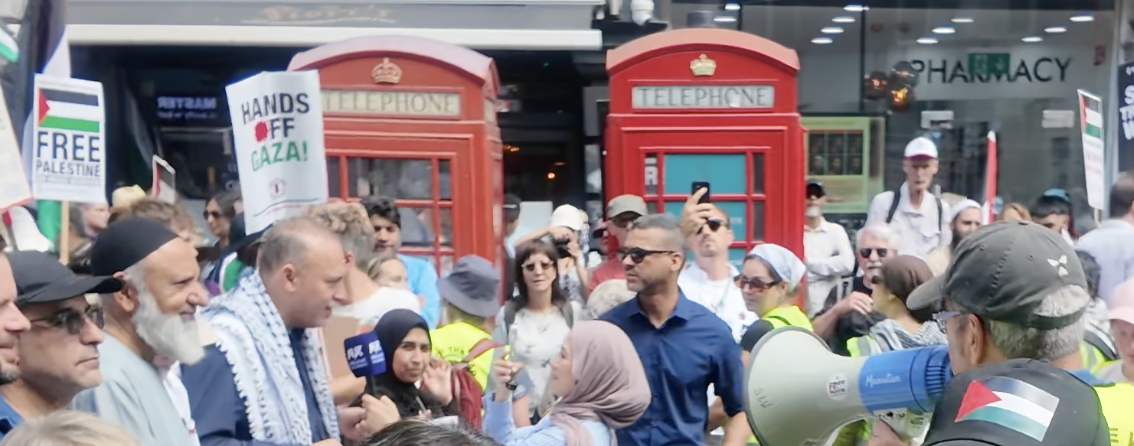
On Saturday 18th of July 2026, Husam Zomlot walked at the head of the National March for Palestine through London. If a serving ambassador leading a domestic protest doesn’t test the limits of the Vienna Convention, it’s hard to know what would.
By the time the National March for Palestine moved off from Russell Square at 12:45 on Saturday, under conditions the Metropolitan Police had imposed the day before under the Public Order Act, Husam Zomlot was not a guest of the procession. He was at its head. Palestine’s ambassador to the United Kingdom — accredited to the Court of St James’s since January, after the government formally recognized the Palestinian state — marched at the front of the column as it moved through Holborn and the Strand towards Whitehall, chanting alongside protesters and carrying, by his own account on X, the message that “the movement for justice and accountability, in Britain and worldwide, is growing louder and stronger.” He held that position through the chant of “From the belly of the beast, hands off the Middle East” — a line aimed, unambiguously, at the British state whose invitation lets him remain in the country at all.

This is not a comment on the approximately five thousand participants who marched. The right to march for Gaza, to demand your government act differently, is not in question, and the Met’s conditions on the route and timing were generally followed. Unsurprisingly, figures like Jeremy Corbyn and Mothin Ali, were present too; that’s a British citizen’s prerogative, however you consider the cause. The question being considered is narrower and more specific: whether the man representing a foreign government to the Court of St James’s should have been standing where he was standing, saying what he was saying, at the moment he was saying it.
That moment came just before the march set off, when a lead steward addressed the crowd — with Zomlot present at the front — in terms aimed squarely at Britain’s incoming prime minister. Andy Burnham, who becomes PM on Monday, had already apologized for Labour’s “silence” on Gaza under Keir Starmer. The steward was having none of it: “We know you had to apologize… but our message to you is: he did that because of us… We will judge you by your actions, not by your words.” Then the demands, addressed directly to a man about to hold the office of prime minister: stop selling arms to Israel, back a ceasefire, support boycott and divestment, end complicity in the siege of Gaza — “and you can do that on Monday.” The date wasn’t rhetorical filler; it landed on the actual day of the handover. The steward closed by promising to gather outside Burnham’s new office, confirming a return march for 10 October, and vowing to keep marching “until we see justice for the Palestinian people.”
That is a British protest movement issuing an ultimatum to an incoming British prime minister on a named day, over a named policy — arms exports, sanctions, government conduct at the UN. It is about as squarely “internal affairs” as a demonstration gets. And the ambassador of a foreign state stood at its head while it happened.
Article 41(1) of the Vienna Convention on Diplomatic Relations is not long: diplomats must “respect the laws and regulations of the receiving State,” and “have a duty not to interfere in the internal affairs of that State.” Nobody disputes that a diplomat may attend a demonstration, or even that many liberal states now tolerate diplomats speaking up on human rights issues — Eileen Denza’s standard commentary on the Convention describes exactly that erosion of the old non-interference norm. But there’s a real distance between an ambassador quietly observing a march and an ambassador visibly leading one, at its front, through the moment its organizers deliver a direct political ultimatum to the incoming head of the host government. The first looks like diplomacy adjacent to politics. The second looks like participation in it.
Whether that crosses the Article 41 line has never been tested in a British court, because it never goes to a court. Under Article 9, a receiving state can declare any diplomat persona non grata “at any time and without having to explain its decision.” No breach needs to be proven — PNG is a political act, not a judicial one, and other states have shown they’ll use it for considerably less. In February 2021, Russia expelled Swedish, Polish and German diplomats for attending a single rally in support of Alexei Navalny, citing conduct “incompatible with their diplomatic status” under the Convention — Sweden disputed its diplomat had even been there, and the EU called the expulsions arbitrary, but Moscow’s legal theory was exactly the one this article is testing. Closer to home, South Africa expelled Israel’s chargé d’affaires this year over repeated social media posts insulting President Ramaphosa — remarks made from a keyboard, not a physical presence at the front of a march past the seat of government. Washington expelled South Africa’s ambassador Ebrahim Rasool in 2025 over comments in a university webinar. If a tweet and a webinar clear the bar elsewhere, marching at the head of a procession whose lead speaker is handing the incoming prime minister a list of demands and a deadline is not obviously a lesser case.
As of writing, nobody in the British government has said a word about it. That may simply be proportional — Britain does not expel ambassadors over marches, and probably shouldn’t develop a habit of it. But it’s worth being honest about what that silence is: a political choice not to test a legal question that, on Saturday’s facts, was there to be tested. The Foreign Office’s protocol directorate will have people whose entire job is watching where the diplomatic corps stands at public events. On Saturday, they’ll have known exactly where he was standing.