
Strategic Intelligence Consultant & Insights Advisor
A Father’s Life in Art: ArtLawnik Comes to London
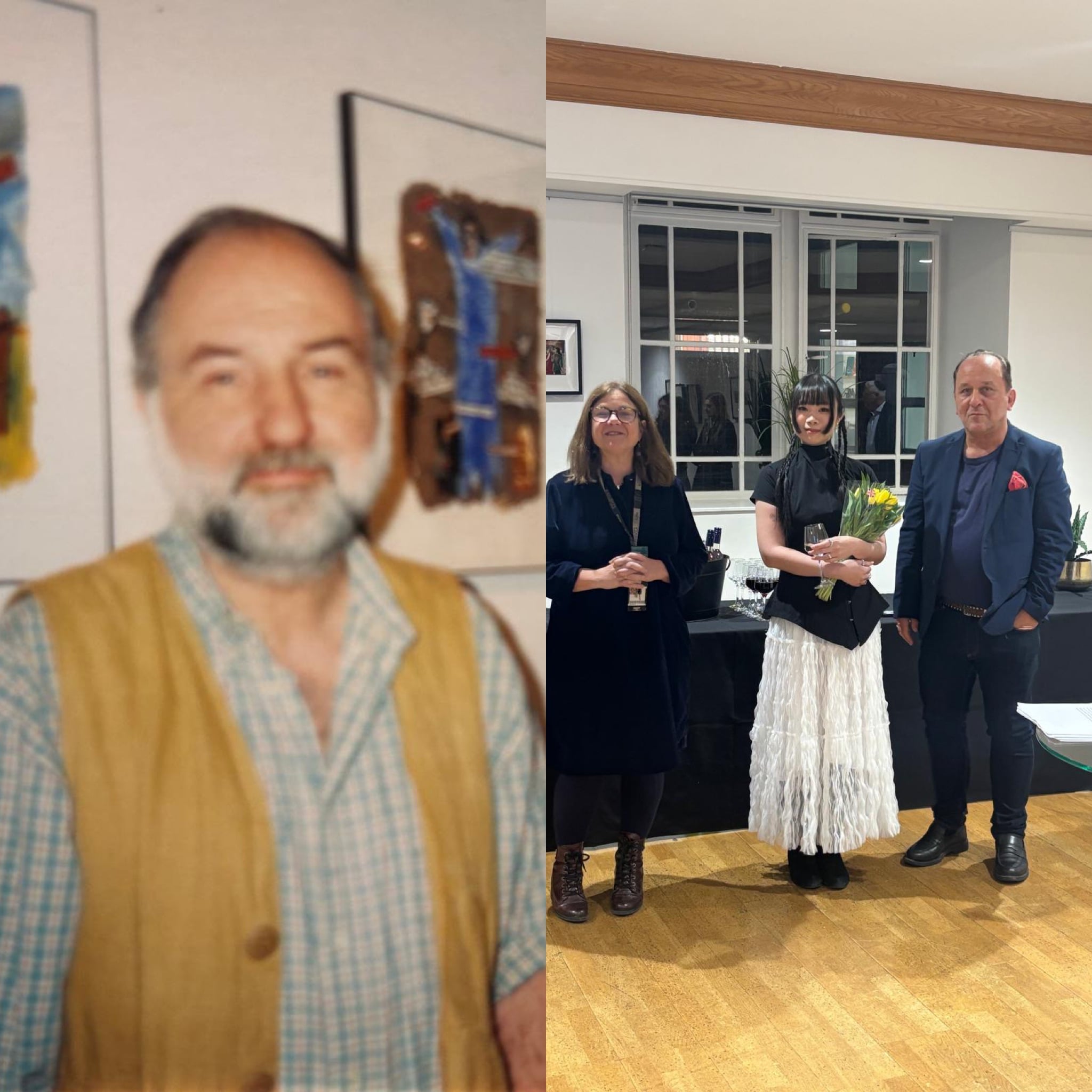
Left: A portrait of the artist. Right: His son, Professor Dr. Jacob Schmidt, alongside the exhibition’s curators at the opening of the art exhibition at Regent’s University London. Courtesy of Professor Dr. Jacob Schmidt and the exhibition team, Regent’s University London.
Oct 19, 2026 ·
On a warm October evening at the Knapp Gallery at Regent’s University London, I watched my friend Dr Jacob Schmidt, a distinguished Professor of Finance, investment expert and entrepreneur, do something few of us ever have the opportunity to do: introduce a room full of strangers to his late father through the art he left behind.
Not in person, of course. Dr Johannes Schmidt — the Austrian Jewish artist known as ArtLawnik — passed away in 2022. But as students, academics, collectors and friends moved through the gallery on 19 October, pausing before his drawings, collages and watercolours, his presence was unmistakable. The exhibition, “ArtLawnik – Ich Liebe Dich,” marks the first time his work has been shown in the United Kingdom, after exhibitions in Austria, Italy and France. And for those of us who know Jacob — Assistant Professor of Finance at Regent’s, singer-songwriter, painter, and a familiar face in London’s Jewish community — it was clear that this was more than an art opening. It was an act of remembrance, and of love.
A barrister with a painter’s eye
Johannes Schmidt was born in Graz in 1935 and raised partly in Vienna. On paper, his was a conventional and distinguished life: a respected Austrian barrister and solicitor, an author, a broadcaster. But alongside the law ran another life entirely. From the 1960s until his death, he drew, painted and assembled — drawings, newspaper collages, watercolours, canvases — moving restlessly between close observation of the people around him and compositions pulled from imagination and memory.
He signed this parallel life “ArtLawnik” — a name that winks at both halves of the man, the lawyer and the artist. A gifted linguist whose curiosity crossed national and cultural borders, he was fascinated above all by people: their faces, their relationships, the small intimacies that make up a life. That fascination never left his work, even as his techniques changed across six decades.
From Galicia to Graz — and a lifelong love of Israel
To understand ArtLawnik, you have to understand where his family came from. According to the Schmidt family, their ancestors were among the first Jewish families to resettle in Graz from Galicia in 1860, as the restrictions that had excluded Jews from the city for centuries were gradually lifted across the nineteenth century. It is a very Central European Jewish story: arrival, rebuilding, belonging hard-won — and, within living memory of Johannes’s own generation, the catastrophe that swept so much of that world away.
That history is the quiet backdrop to works preoccupied with family, memory, intimacy and belonging. And it helps explain something readers of these pages will recognise instantly. Johannes Schmidt was not religiously observant. But he was a committed Zionist and a fervent supporter of Israel, with a deep affection for the Hebrew language — striking in a polyglot who moved easily between so many tongues. His Jewish identity was not an accessory to his life; it was one of its load-bearing walls. In an era when we are so often told that Jewish identity in the diaspora must choose between religiosity and assimilation, ArtLawnik’s life is a reminder of a third way: a secular European intellectual for whom Jewishness, Hebrew and the Jewish state were simply, unapologetically, home.
“Ich Liebe Dich”: an exhibition built on love
The exhibition takes its title — “I love you” — from one of Johannes’s early drawings. Its curator, Chanya Chutimaworaphunt, a student on Regent’s MA Global Art Markets programme and an artist in her own right under the name Bambam, has selected works that stretch that phrase beyond romance into something broader: love as generosity, as attention, as human connection.
Visitors move through five thematic sections — “The Beginning”, “Fantastic Realists in the Provinces”, “The Face as Obsession”, “Body, Eros, Family” and “Fragments of Memory”. The titles alone sketch the arc of the man: an artist who began in close observation, passed through the orbit of Austria’s fantastic realists, and returned again and again to the human face, the body, the family table, and the fragments a life leaves behind.
The private viewing drew a crowd that said something about the breadth of Jacob’s world — Rabbi Rashi Simon of Kesher, Regent’s academics, collectors, finance professionals and art lovers, gathered in one room around the work of a man most had never met. The project itself began more than a year earlier, when Jacob brought a proposal to Dr Nadja Stamselberg, the Knapp Gallery’s curator and Professor of Art History, whose support — together with Chanya’s curatorial vision — brought the collection to London.
A son’s tribute
I have known Jacob for more than a decade, since I first moved to Golders Green, through our shared Jewish community. He is an active member of Kesher Kehilah and has served on the board of the Western Marble Arch Synagogue, including as its Deputy at the Board of Deputies. Before moving from Vienna to London in 1994, he also served on the boards of the Union of Jewish Students and the B’nai B’rith Maimonides Lodge in Vienna. A commitment to Jewish communal life and responsibility, in other words, has long been part of his story, alongside his family’s artistic heritage.
What moves me most about this exhibition is not any single work on the walls. It is the act itself. Jacob did not inherit a famous collection with a market waiting for it; he inherited his father’s life’s work, and chose to spend more than a year making sure a new country could meet the man behind it. There is something deeply Jewish in that. We are a people obsessed with memory — zachor is practically a commandment of its own — and here is a son fulfilling it not with a plaque or a yahrzeit candle alone, but with a gallery, a curator, and a room full of people saying his father’s name.
Why it matters now
At a moment when Jewish life in Europe so often makes the news for the wrong reasons, there is quiet power in an exhibition like this one. It tells a story that stretches from Galicia in 1860 to Graz, Vienna and now London in 2026 — a story of exclusion and return, of identity carried across borders and generations, of a secular Austrian lawyer who loved Hebrew and loved Israel, and of a son in Britain determined that none of it be forgotten.
Go, if you can. Stand in front of the faces ArtLawnik could never stop drawing, and you will understand the exhibition’s title without needing the translation. Ich liebe dich. A father to his family. A son to his father. An artist to his people.
“ArtLawnik – Ich Liebe Dich” is on display at the Knapp Gallery, Regent’s University London, until the end of 2026. Entry to the gallery’s exhibitions is open to visitors; details are available through Regent’s University London.
Related Topics
Related Posts