A Midwestern Jewish Politico
The Analogy Fits ICE Far More Than COVID-Era Public Health Policy
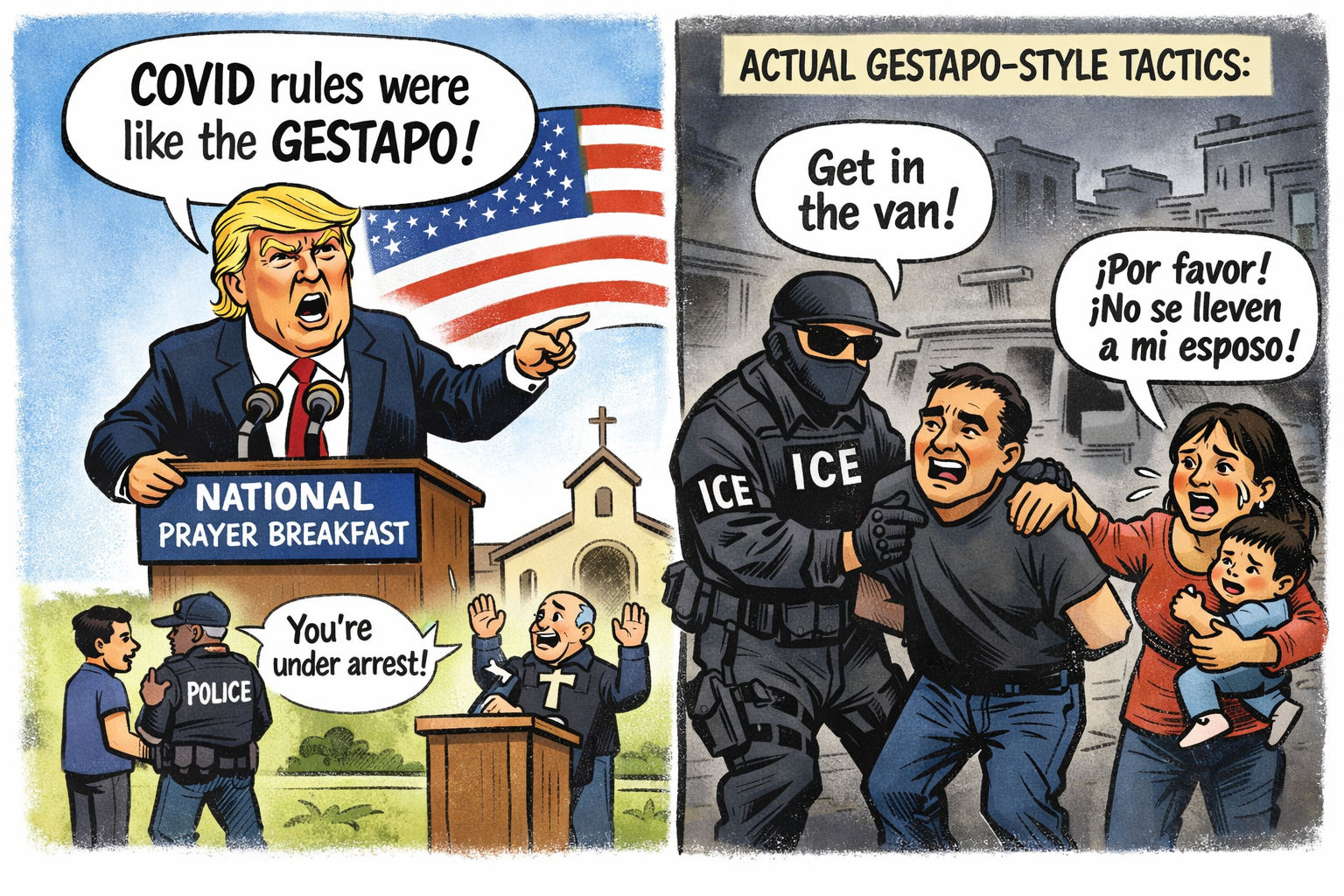
Political Cartoon depicting Trump and ICE tactics (Author/AI)
Speaking this morning at the National Prayer Breakfast in Washington, Donald Trump once again invoked one of the most loaded analogies in modern political rhetoric. Recounting COVID-era restrictions on religious gatherings, Trump claimed Democrats behaved “like the Gestapo,” arresting worshippers and persecuting pastors for holding services during the pandemic. He framed these measures as evidence of authoritarianism, contrasting them with his own self-description as anything but a dictator.
For Jewish readers especially, this language should prompt immediate scrutiny. The Gestapo was not a metaphor for overzealous bureaucracy or unpopular emergency policy. It was the secret police of Nazi Germany, tasked with identifying enemies of the state, crushing dissent, and enforcing ideological conformity through fear, surveillance, and arbitrary detention. When that history is taken seriously, Trump’s comparison collapses. Worse, it distracts from a far more plausible and disturbing analogy unfolding in the United States today.
COVID-era public health restrictions, including limits on indoor gatherings, were enacted through democratic processes. Governors acted under emergency authorities explicitly granted by legislatures. Courts reviewed and often curtailed those actions. Policies varied widely by jurisdiction, were openly debated, and were ultimately lifted. In many cases, churches successfully challenged restrictions or negotiated accommodations. While some enforcement actions were heavy-handed, they were neither secretive nor extrajudicial, and they did not target individuals based on identity or ideology.
No one disappeared for attending church. No one was placed into an opaque detention system with limited access to legal counsel. No population was systematically defined as inherently suspect for existing.
By contrast, the modern practices of United States Immigration and Customs Enforcement (ICE) increasingly resemble the very dynamics Trump claims to oppose. Masked agents in unmarked vehicles carry out street-level arrests. Individuals are detained without clear identification of authority. Families are separated. Detainees are transferred far from their communities, often with little notice, limited legal support, and minimal public oversight. For many, detention becomes a form of disappearance, not in a historical sense, but in a civic one.
This is not to argue that ICE is the Gestapo in totality. The United States is not Nazi Germany, and analogies must be handled with care. But analogies are not equations. They are tools used to identify patterns of power, not to declare identical outcomes. When viewed honestly, ICE’s tactics align far more closely with the historical functions of secret police than any temporary mask mandate ever did.
The Gestapo derived its power from fear, ambiguity, and the erosion of due process. It operated most effectively when citizens were unsure who could be detained, why, or by whom. ICE’s modern enforcement strategies, particularly those conducted in public spaces without transparency, rely on similar dynamics. The goal is not merely enforcement, but deterrence through intimidation, especially within immigrant communities already living with precarity.
Trump’s remarks at the Prayer Breakfast reveal something else as well: the weaponization of Jewish trauma for political convenience. Invoking the Gestapo to describe public health rules reframes inconvenience as persecution and elevates grievance to atrocity. It also inverts moral responsibility, allowing those aligned with state power to claim victimhood while ignoring the real coercive force being exercised against marginalized groups today.
For Jews, historical memory carries obligations. The lesson of the Gestapo is not that every disliked policy is tyranny. It is that state power becomes dangerous when it is unaccountable, opaque, and directed at populations cast as threats rather than neighbors. Jewish history urges vigilance not when authority is debated in courts or elections, but when it operates in shadows.
Trump’s comments this morning were not simply inaccurate. They were corrosive. They cheapen language that should be reserved for genuine warnings, not partisan theater. Meanwhile, the normalization of aggressive immigration enforcement continues largely unchallenged, precisely because the rhetoric of authoritarianism has been misused elsewhere.
A serious conversation would separate disagreement from persecution and reserve historical analogies for moments that genuinely resemble the past. Mask mandates were controversial. They were not Gestapo tactics. Armed agents detaining people without transparency, however, deserve far closer scrutiny.
Precision matters. Jewish memory is not a prop. It is a responsibility. And it demands that we recognize real dangers early, rather than cry tyranny when it is politically expedient.
Related Topics