
Since when does Lionel Messi stand for Zionism?
The captain of Argentina’s national soccer team, Lionel Messi, 39, left the New York-New Jersey stadium in tears after losing to Spain 1-0 in extra time at the World Cup on Sunday. Messi, who is widely considered the greatest soccer player of all time, including the greatest goal-scorer, thanked his fans on Instagram in a heartfelt message in Spanish: “The pain is immense and it will take time for this wound to heal. But I also cherish all the good… Today, it’s hard to truly appreciate what we accomplished, but this team made it to two consecutive World Cup finals. Once again, we came together as a country that stood united, sharing the immense pride of being Argentine.”
In the spirit of sportsmanship, he also congratulated Spain – a team of players he knows well, having played for Barcelona for decades – on their win. The same night Argentina lost, hundreds of thousands of Argentine fans took to the streets to celebrate their national hero and thank him for giving them hope and bringing them to the finals again.
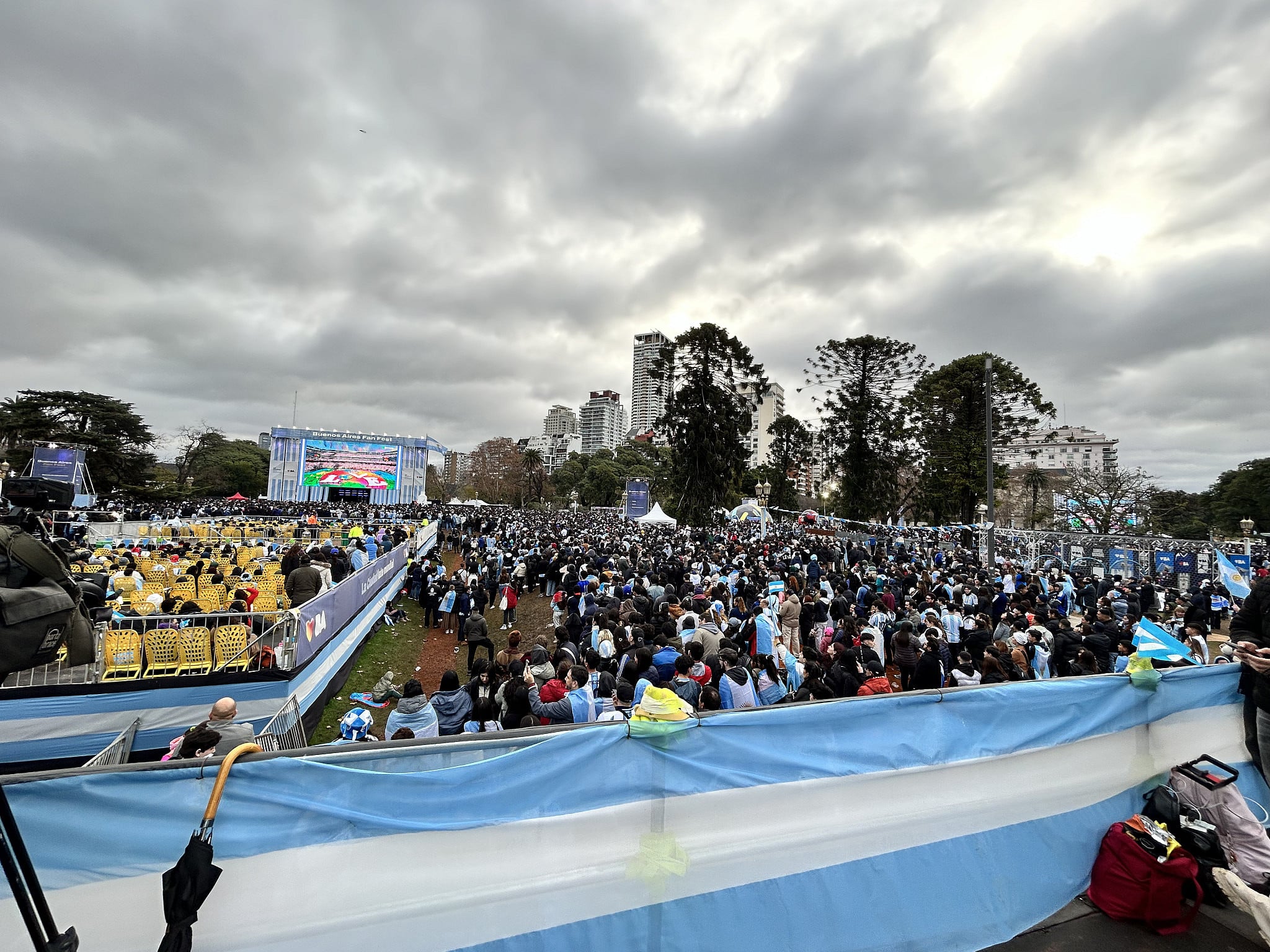
Like them, I am especially proud to be Argentine during times like these. I watched the final match Sunday at a Buenos Aires public viewing for over 5,000 Argentine fans alongside my amiga. I witnessed families, with children as young as 2 years old, embracing the cold weather to celebrate Argentina and basking in our historic win over England just days before, which sent the country into euphoria.
Newcomers to Argentine culture who watched the national team raise a banner saying, “Las Malvinas son argentinas” may have been thrown off by the grand display. (The Malvinas, also known in English as the Falkland Islands, are Argentine). However, from our perspective, the Malvinas represent not only the historical succession of the islands after gaining our independence from imperial Spain, but also a case of unresolved colonialism. Argentina is anti-colonial; online influencers have manipulated these facts.
The anti-Argentine sentiment spread like wildfire. Countless media articles capitalized on capturing a viral and manufactured disdain for Argentina and Messi, including headlines like “I Won’t Cry for You Argentina” in The New Yorker, “Argentina Tried to Win Another World Cup. Neighboring Nations Cheered Against It” in The New York Times, and an op-ed in The Boston Globe, “Sorry, Messi: Why Latinos are rooting against Argentina,” as well as conspiracy theories dubbed “VAR-gentina” referring to the use of the Video Assistant Referee (VAR), about which conspiracists cried foul, in the match with Egypt. Even New York City Mayor Zohran Mamdani, in a press conference, claimed that the Egyptian team was “robbed” by Argentina.
Of course people are free to root against Argentina and to disagree with ref calls, or to be tired of the fanaticism around Messi. But let’s let go of hate-fueled conspiracy.
In a separate video on the day of the final match, Mamdani distastefully invited disgraced ex-English footballer Gary Lineker, who once characterized Jews as rats in a since-deleted social post, to call out Argentina’s 1986 World Cup win as unfair. In all fairness, if you ask the English, they will say Diego Maradona’s “Hand of God” was illegal; an Argentine will call it pure genius. But by invoking 1986 without Maradona’s presence, the internet and its internet mayor recycled hate against the “VAR-gentina.”
Most of this year’s conspiracy theories were fueled by anti-Zionism and antisemitism. For example, French referee Francois Letexier’s Wikipedia page was edited to suggest he was born into an Orthodox Jewish family in Brittany to prove the Egypt match was rigged, and a viral claim suggested Messi was raised in Israel to heighten suspicions of hidden Zionism. To set the record straight, Messi grew up on Estado de Israel Street, a common street name in Argentina (Estado de Palestina is a street name also found in the country), and Letexier is not Jewish.
But the catch-all internet theory that described the Spain-Argentina match as a proxy for the Israeli-Palestinian conflict generated more anti-Argentine slop than a rational person could handle. In one example, Spanish actor Javier Bardem and British commentator Mehdi Hasan argued that Spain’s victory was a win over Argentine President Javier Milei, quoted as being the “proudest Zionist president in the world.”
To set the record straight once again, such anti-Argentina narratives are meant to demonize Argentina, a country with the largest Jewish population in Latin America, with an estimated 180,000 to 250,000 Jewish people, as a proxy for Zionism.
Following Spain’s win, Samuel L. Jackson used the opportunity to make baseless claims that Argentina is the most racist country in the world, writing on Instagram, “If you are a Black person cheering for Argentina, this is what you look like to me. We hear you loud and clear.”
Argentina was one of the first countries to abolish slavery in the Western Hemisphere; Brazil was the last. And let’s not ignore Spain’s last 500 years of racism and colonial abuse.
One solution for ending the anti-Argentina narrative is to bring back critical thinking. Rely on trusted sources and fact-checking sites. Break your echo chamber to challenge your worldview and offer well-reasoned perspectives.
May the next World Cup leave behind this year’s toxicity.