
One of the People
The Apostate & the Proselyte
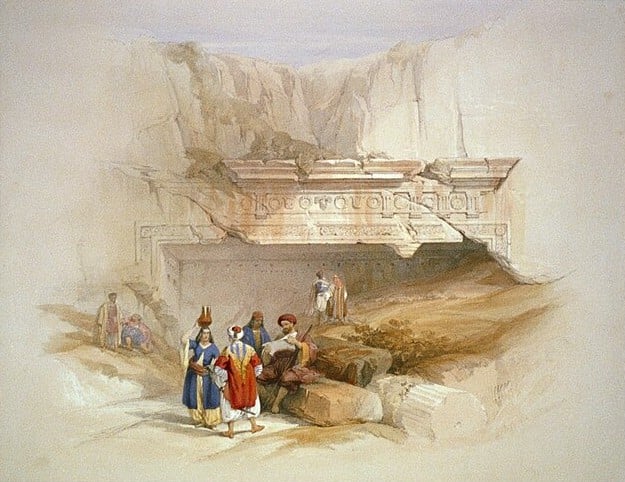
"Entrance to the Tombs of the Kings, Jerusalem", by David Roberts (1839). Wikimedia Commons.
In the first century of the Common Era, a heathen queen converted to Judaism about the same time as an aristocratic Jew deserted his heritage; an acute crisis in Roman Judea would give both the opportunity to prove their priorities and sympathies.
They were like ships passing in the night, plying the churning waters of the Mediterranean Sea when it was a Roman lake, heading at full speed in opposite directions.
Superficially, they had certain commonalities: one was of royalty, the other of nobility. Both were highborn members of small nations subjected to imperial superpowers, and both would make their way from their birthplace to sojourn in Roman-occupied Judea, where each left an indelible mark whose vestiges remain visible to this day.
Known in the Talmud as Hilni, Helena of Adiabene (c. 15 BCE–56/58 CE) was the sister-wife of King Monobaz I of Adiabene—a semi-independent region, with its capital at Arbela (modern Erbil), in what was formerly the heartland of ancient Assyria and in what is today Iraqi Kurdistan—and the mother and aunt of the princes Monobaz II and Izates II. Although likely of Hellenistic origin, the pagan queen consort was influenced by a Jewish merchant named Hananiah and converted to Judaism around the year 30; her sons also embraced Judaism and were circumcised (Izates was influenced to do so by another Jewish visitor to Adiabene, a Galilean named Elazar).
Around the year 45, by which time Izates was well established upon the throne, Helena pilgrimaged to Jerusalem to worship in its famed Holy Temple and to offer a thanksgiving sacrifice therein to the singular God she had accepted as her own. In the event, her arrival proved fortuitous and, as the priestly historian Joseph ben Mattityahu (Flavius Josephus) records in his Jewish Antiquities, “her coming was of very great advantage to the people of Jerusalem.” Although no one knew it just then, the Holy City was on the cusp of calamity.
But the proselyte Helena wasn’t the only notable outsider to arrive in Judea at the time.
Born during the reign of Emperor Tiberius around the year 15 CE in the bustling port city of Alexandria, Egypt, Tiberius Julius Alexander hailed from one of the leading Jewish families in the Roman East. He was the son of Alexander Lysimachus, the Jewish alabarch of Egypt—a high-ranking taxation official responsible for levying customs from the many civilian vessels docking in Alexandria’s busy western harbor, Port Eunostos; he was also the nephew of Philo Judaeus, the eminent religious philosopher and exegete, who was his father’s older brother.
Groomed to join the Roman administration, Tiberius studied classical languages, apparently received little traditional Jewish education, and as a young man entered Roman military service. His younger brother Marcus Julius Alexander became the first husband of Herodian princess Berenika (Berenice) II, daughter of King Agrippa I of Judea (r. 41–44 CE). His philanthropic father—whom Josephus refers to as “a principal person among all his contemporaries, both for his family, and wealth”—sponsored the adornment of nine gates in the Jerusalem Temple that were plated with gold and silver.
Yet unlike his pious father and his esteemed uncle, Tiberius himself seems to have had little connection to Judaism or to his fellow Jews; per Josephus, he “did not continue in the religion of his country”. His impiety is corroborated by his portrayal in his uncle’s philosophical dialogue On Providence, wherein he controverts divine providence. Whether or not he abjured Judaism per se, his life choices and actions conclusively evidence his abandonment of Jewry and his allegiance to Rome.
While still in his 20s, Tiberius was first appointed to a senior role in 42 when he became administrator (epistrategos) of the Thebaid (Upper Egypt), a position in which he served for four years. His competence in this post was recognized by Emperor Claudius, who was anyway a longtime family friend (Tiberius’ father became an administrator of the vast estates in Egypt owned by Claudius’ mother, Antonia Minor, a daughter of Mark Antony). In 46, he became the second ever procurator of Judea, based in Caesarea Maritima, and served a two-year term at a time when Jewish patriots were chafing under the oppressive Roman occupation and when the spirit of messianism, nationalism, and zealotry was simmering just beneath the sociopolitical surface, threatening to seethe then scald.
That year—46 CE—would be the crucial juncture when the trajectories and destinies of the apostate and the proselyte would coincide. Their reactions during an acute crisis would clearly differentiate themselves and demonstrate their contradicting attitudes toward Judaism and Jewry.
During Tiberius’ tenure, severe famine afflicted Judea. Local shortages of grain and other staple foodstuffs meant that the poor—young and old, men and women—were suffering bitterly. Only the rich were able to cope during a period of scarcity; most Jerusalemites lacked the requisite resources to import provisions from abroad, and thus many residents perished from inanition. The enfeebled, starving and desperate, appealed to heaven for salvation and to the authorities for relief.
Thankfully, help arrived—just not from the Roman administration.
Instead, Queen Helena of Adiabene intervened in a timely manner by dispatching attendants with funds to procure large quantities of grain from Alexandria and a cargo of dried figs from Cyprus for immediate distribution among the malnourished Judeans. Her son, King Izates of Adiabene, also sent great sums of money to the city fathers in Jerusalem (in the Tosefta, his older brother Monobaz II is credited). Helena’s charity and altruism were welcomed by the grateful Judeans, including a young Josephus, who affirms that she “left a most excellent memorial behind her of this benefaction, which she bestowed on our whole nation.”
But why was it left to the largesse of a benefactress—only lately arrived on the scene—to import shiploads of victuals to sustain the starving populace? Where was the provincial government?
During his fellow Jews’ time of need, Tiberius was apparently aloof and useless in Caesarea, forever to his discredit. This is especially the case since, as a native Alexandrian who retained close familial ties to his birthplace, he of all people would’ve been well aware of the abundance of comestibles still available in Egypt—Rome’s perennial breadbasket—and the substantial shipping capacity of his hometown, a robust seaport merely 2–5 days away by boat from the port of Jaffa. He had acquired sufficient administrative and bureaucratic experience by this point to grasp and master the basics of logistics, possessed adequate civilian and military personnel under his authority to organize the supply chain of grains and produce necessary to alleviate the famine, and was intimately familiar with Alexandria’s major Jewish community that might readily mobilize to assist Judeans…yet he and his administration effectively delegated the emergency rescue of their subjects to a foreign queen who just happened to be there, on the ground, a queen instinctively more caring and concerned than those whose official duty it was to maintain at all times and costs the peace and stability of their province. That this fundamental duty devolved upon a private individual who was a newcomer to the area speaks volumes about the apostate and the proselyte alike.
It is no stretch to presume that Tiberius, alienated from the Judaism of his ancestors, felt little kinship with Jewry. Blinded by his professional ambitions, he was a man estranged from himself. Judaism’s edifying tenets, practices, and values were absent from his spirit and his character. He had long ago marveled at the might and grandeur of Rome and chosen careerism over loyalty to Jewry. His procuratorship in Judea amounted to a moment of truth. While the Adiabene royal house was focused on saving Jewish lives and swung into action, Tiberius paid more attention to suppressing Jewish rebels eager to overthrow the Roman yoke, and to that end he had crucified the sons (Jacob and Shimon) of Judah the Galilean, nationalistic resistance leader and cofounder of the Zealot party. The best Josephus ever has to say about Tiberius (in The Jewish War) is that he, “making no alterations of the ancient laws, kept the nation in tranquility.”
The Jews, however, wouldn’t remain tranquil for long.
*****
Helena spent the latter part of her life in Jerusalem, where she built herself a royal palace in the shadow of the Holy Temple. Five of her grandsons, sons of Izates, also went to live and study as Jews in Judea. She further instantiated her reputation for munificence by endowing gifts to the Temple, including a golden candelabrum over the sanctuary’s door and a golden tablet engraved with the scriptural passage regarding the suspected adulteress (sotah). According to the Talmud, Helena vowed to become a Nazirite for seven years if her son Izates returned safely from war, and when this occurred, she dutifully fulfilled her oath. Late in life, upon the decease of Izates, Helena returned to Adiabene to witness the installation upon the throne of her older son Monobaz II before dying shortly thereafter, sometime in her 70s.
Helena’s remains and those of Izates were transferred by Monobaz to Jerusalem for burial in the pyramidal mausoleum, known erroneously as the Tombs of the Kings, that Helena had erected just north of the city (now in the Sheikh Jarrah neighborhood in Jerusalem). According to Greek geographer and traveler Pausanias, Helena’s tomb featured a special mechanism that kept its door shut except for once a year. A sarcophagus discovered within the catacombs in the 19th century—which contained bones wrapped in shrouds with golden embroidery and which bears the Aramaic inscriptions, in the Palmyrene and the Hebraic scripts, “Tzaddan Malkhata” and “Tzaddah Malkhatah”—was supposed to be that of Helena, but might have belonged to another member of the royal family.
Tiberius outlived Helena by at least a generation. In 63, he served as staff officer of Roman general Gnaeus Domitius Corbulo in the latter’s military campaign against the Parthian (Arsacid) Empire. In 66, he became prefect of Egypt and served for four years. Shortly after his appointment, ethnic violence erupted between Jewish and Greek residents of Alexandria: after issuing an unheeded warning, he unleashed his legions—III Cyrenaica and XXII Deiotariana—upon the rioters, which eventuated in 50,000 slain Jews and the devastation of the city’s Jewish quarter. These events occurred concurrently with the outbreak of the Great Revolt (66–73 CE) in Judea, a fateful conflict wherein Tiberius would feature in a leading role—in opposition to his own people.
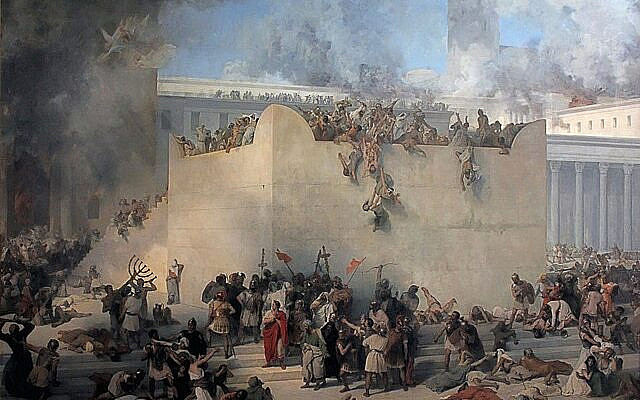
During the Year of Four Emperors (69 CE), and perhaps at the instigation of his former sister-in-law Berenika (the lover of Vespasian’s son Titus), Tiberius secretly corresponded with and acclaimed as emperor Vespasian, an instrumental factor in the latter’s elevation to the position of Caesar. In 69/70, he became chief of staff of and second-in-command to Titus, who was relatively inexperienced in military affairs. He participated in Titus’ war council that debated the fate of the Second Temple in Jerusalem—the same sanctuary adorned by both his father Alexander and Queen Helena—and voted in favor of sparing it from destruction, but in vain. The Temple was destroyed, along with most of Jerusalem, including Helena’s royal palace (believed to be the monumental structure excavated between the Ophel and the City of David in 2007). The eyewitness Josephus reports in The Jewish War some 1,100,000 slain Jews and 97,000 Jewish captives; even if his figures are inflated, there is no disputing that the widespread destruction of Judea and the mass slaughter of Judeans devastated the Jewish people and the Land of Israel. Jewry’s dreams of religious freedom and political independence had been mercilessly crushed and lay in ruins.
In the 70s or 80s, Tiberius may have risen the ranks to become praetorian prefect in Rome. It is believed that he is alluded to, unfavorably, in the anti-Semitic Roman poet Juvenal’s Satires. Some modern academics inclined toward eisegesis have sought to qualify and justify his behavior, to little avail: his recorded conduct overturns any attempt to exonerate him from the accusation of apostasy; whether or not he disavowed Judaism, and by all accounts he did, he certainly forsook Jewry and played a prominent part in its national catastrophe, for which reason he is remembered today as an opportunistic traitor who became the highest-ranking Jew in the history of the Roman Empire.
For both the apostate and the proselyte, their people ultimately was not the one they were born into by happenstance, but the one they elected to identify with: for the proselyte, but not for the apostate, the Jews were the chosen people. The pagan queen Helena of Adiabene became a lauded Jewish leader, while the leading Alexandrian Jew Tiberius Julius Alexander aided and abetted one of Jewry’s most tragic and bitter downfalls.
With the benefit of hindsight, one inclines to believe that Alexander Lysimachus the Alabarch would’ve rendered better service to his fellow Jews by transmitting his Judaic values to his eldest son Tiberius and paying for his learned tutors—teachers, perhaps, like the Hananiah and Elazar who educated Helena and Izates—with the very silver and gold used instead to overlay the gates of the Temple.
When it comes to peoplehood, membership doesn’t always mean allegiance. Doubtless it was a recognition of this truth that engendered Judaism’s seminal injunction, from the book of Deuteronomy and recited daily in the credal “Shema” prayer, to impart Judaic values and precepts to future generations: “And you shall teach them to your children and speak of them when you sit in your house, and when you walk on the way, and when you lie down and when you rise up.”
Related Topics
Related Posts