
Russian-American-Israeli Palestinian. Palestine is Israel.
The Battle Before the Battle
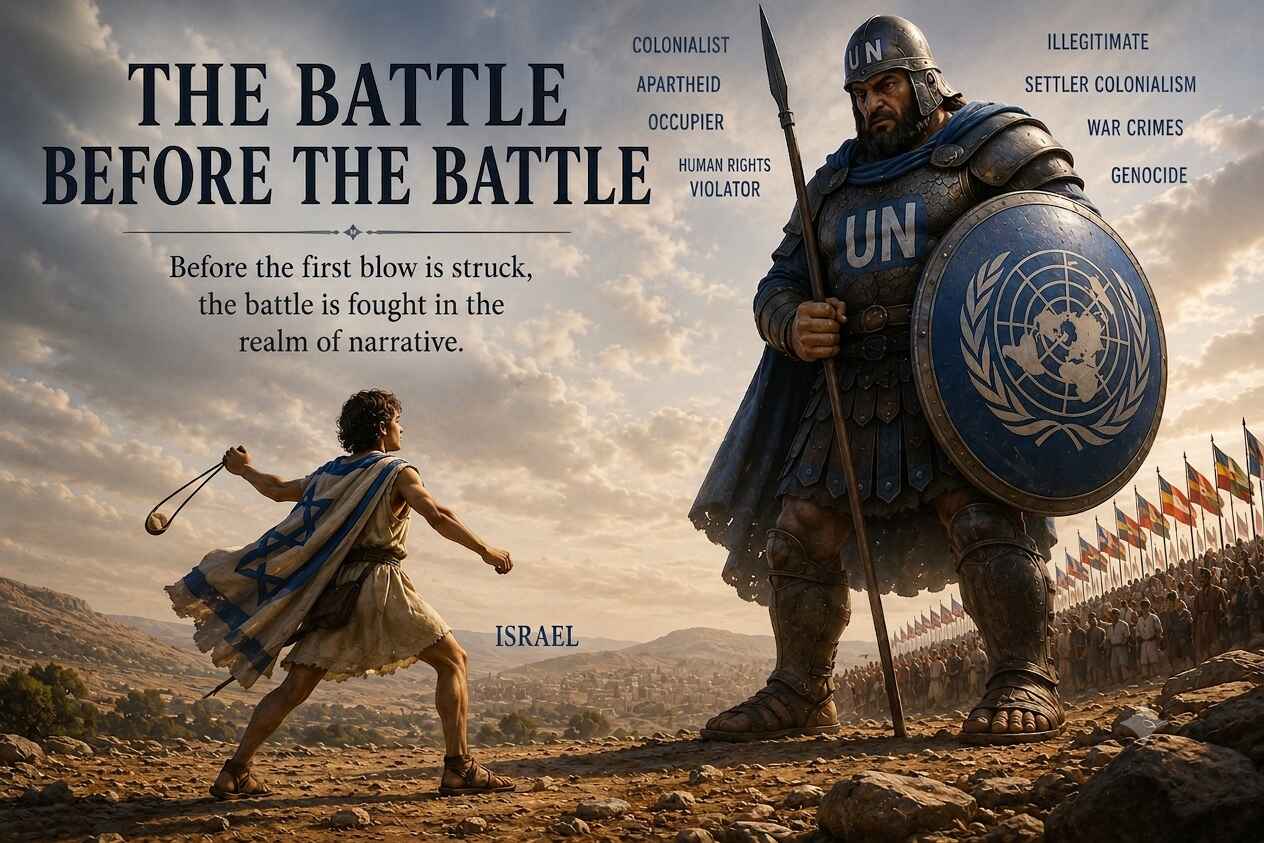
David vs. Goliath: The Battle Begins. Long before the first blow is struck, the battle is fought in the realm of narrative. Image © Ivan Bassov, 2026. Licensed under CC BY 4.0.
Before People Debate Borders, They Decide Whose Story They Believe
The phrase The Battle Before the Battle is often associated with the biblical account of David and Goliath in I Samuel 17. Whatever one takes from that story, it reminds us that decisive conflicts are often shaped before the first blow is struck. The struggle over perception, legitimacy, and narrative frequently precedes the visible confrontation.
For years, criticism of Israel followed a familiar pattern. Israel was accused of colonialism, apartheid, ethnic supremacy, or occupation. The objective was straightforward: challenge Israel’s legitimacy directly.
Increasingly, however, I have noticed a more sophisticated rhetorical approach. Instead of attacking Israel’s historical narrative head-on, it often begins with what sounds like friendly advice:
Stop arguing about names. Stop debating competing narratives. Stop discussing identity. Focus on governance, citizenship, democracy, and human rights instead. Flip the script.
Sometimes this advice is offered sincerely by people who believe it would strengthen Israel’s position. Sometimes it may be offered strategically by those who understand that changing the subject is itself part of the battle against Israel. Whatever the motivation, the effect is the same: it encourages Israel to abandon the narrative battlefield before the political discussion has even begun.
The argument usually goes something like this. Israel is already a remarkably diverse society. Roughly three-quarters of its citizens are Jewish, while about one-fifth are Arab, alongside other minorities. Many Jewish Israelis are secular rather than religious, and Israel’s Jewish population itself consists of communities whose roots span Europe, North Africa, the Middle East, Ethiopia, the former Soviet Union, and many other parts of the world. On this view, Israel is already a civic nation rather than an ethnic one.
From there, the reasoning continues. Just as the United States has evolved demographically from a society that was once predominantly Christian while remaining American, Israel can evolve demographically while remaining Israeli. What defines a nation, according to this view, is not ancestry, historical narrative, or even religion, but shared civic values and the willingness of citizens to defend their state. If future demographic changes alter Israel’s ethnic or religious composition, it would still remain Israel so long as its citizens continue to identify as Israelis and uphold democratic institutions.
The conclusion follows naturally: Israel should stop emphasizing Jewish historical continuity, ancient ties to Jerusalem, or debates over names such as Judea and Samaria. Instead, it should define itself primarily through governance, citizenship, democracy, and human rights. Competing narratives about history and identity become distractions from the real issues.
Implicit in this vision is an even broader assumption. If Israel is understood primarily as a civic democracy rather than the nation-state of the Jewish people, the long-term trajectory naturally expands outward. Not only Israel’s existing minorities, but eventually the UNRWA-registered population of Gaza and Judea and Samaria, are drawn into the same civic framework. Much as the United States and Canada are seen as countries defined primarily by shared civic values rather than a common ancestral identity, Israel is encouraged to evolve toward a similar model.
Taken to its logical conclusion, this vision leaves little philosophical basis for distinguishing between Israeli citizens and the UNRWA-registered population of Gaza and Judea and Samaria beyond temporary political circumstances. Once governance replaces historical narrative as the defining principle of the state, national identity becomes secondary.
This vision is often justified by pointing to Israel’s internal diversity. And in one sense, that diversity is real. The country is home to Jews from every continent, alongside Muslim, Christian, Druze, Circassian, and many other communities. I see that diversity as a defining feature. The same is true of countries such as Turkey and many other diverse societies, which combine a clear cultural core with significant internal diversity.
What I question is the assumption that every nation should ultimately converge toward the same civic model, becoming a version of the United States or Canada. Diversity within countries is valuable, but so is diversity among countries. If every nation abandons its historical identity in favor of an identical universal template, the world becomes flatter, not richer.
There is an old observation in urban planning: cities are most livable when they are neither too dense nor too sparse. I believe something similar applies to cultural and ethnic diversity. A healthy balance allows societies to remain open and dynamic while preserving the distinctive character that makes each nation unique. Otherwise, countries begin to feel interchangeable—a pattern visible in the glass-and-steel uniformity of many American downtown skylines and the sprawling sameness of suburban landscapes.
If the goal is to transform every nation into a post-historical civic state modeled on the United States, it is worth asking why that expectation is directed so disproportionately at Israel rather than at countries with far more homogeneous national identities. Why is Israel expected to abandon its distinctive national character before countries such as Saudi Arabia, Egypt, or Japan are asked to do the same?
The entire argument rests on one assumption: that governance precedes narrative. I believe the opposite is true.
Governance does not exist independently of narrative.
In fact, the argument itself is a narrative. It is a narrative about what defines a nation, what should matter, and what should be set aside. There is no escaping narrative. The only question is whose narrative frames the discussion.
Many people assume political reality comes first. Nations, in this view, are defined by governments, citizenship, military strength, and the willingness of citizens to defend borders. Narratives are secondary — stories told afterward to justify facts on the ground.
I see it in reverse.
Before people debate borders, they decide whose map they believe. Before they debate sovereignty, they decide whose homeland they believe it is. Before they debate democracy or human rights, they decide who is indigenous and who is a colonizer. Before they debate settlements, they decide whether Jews are returning to an ancestral homeland or expanding a colonial project.
Narrative does not follow governance.
Governance follows narrative.
This is why I continue writing about names. Not because names are inherently decisive, but because they are entry points into narrative construction.
Some proponents of the governance-first approach go even further. Language evolves, they argue. If names such as Israel or Palestine have become politically contested, why insist on using them? Why not simply adopt another historical designation—perhaps Canaan—and move on? After all, governance matters more than terminology.
But this advice misunderstands the nature of the conflict. Changing the label does not end the narrative battle; it only relocates it.
Canaan is a clear example. Attempts to appropriate that identity are already underway. In my article Arab Identity Laundering, I discuss statements by Mahmoud Abbas claiming that the UNRWA-registered population are the original Canaanites who built Jerusalem long before the Jews arrived. If tomorrow the word Palestine disappeared from political discourse, the struggle would not end. It would simply reappear under another historical frame.
That is precisely why the battle over names matters. The issue is not the word itself. The issue is the narrative it carries. That is why I do not refer to the UNRWA clientele as “Palestinians,” “Canaanites,” or by any other historical identity they seek to appropriate.
Consider a few examples. If people come to believe that Jerusalem has no meaningful Jewish history, sovereignty debates begin from an entirely different foundation. If Judea and Samaria becomes known only as the “West Bank,” the historical continuity embedded in the older names fades from public awareness. If Zionism is redefined as colonialism rather than national self-determination, Israel’s existence becomes morally suspect before policy is even discussed.
These are often dismissed as semantic disputes.
They are not.
They are disputes over the framework through which every political question is interpreted.
Even those who urge Israel to stop focusing on narratives often acknowledge that Israel is losing what is commonly called the “war of words”—a phenomenon I have described as the Narrative War of Attrition.
The contradiction is obvious. If narratives do not matter, why obsess over who wins that war? Why invest so much effort redefining terms like occupation, indigenous, colonialism, apartheid, or Zionism?
The answer is simple.
Narratives shape legitimacy. Legitimacy shapes diplomacy. Diplomacy shapes policy. By the time governments negotiate borders or human rights, the narrative foundation is already in place.
Military power can change facts on the ground. History is full of examples of borders shifting through force. But force alone does not decide how those borders are later judged.
Armies can capture territory.
Narratives decide whether that territory is seen as liberated, occupied, ancestral, or stolen.
That is why I reject the advice to treat narratives as secondary. Some offer it sincerely, believing it helps Israel communicate more effectively. Others may understand that shifting the debate away from narrative is itself a strategic advantage. I cannot always know the intent, and in a sense, it is not the decisive point.
The consequence is.
Once one side abandons the narrative battlefield, the political debate begins on the other side’s terms.
The struggle over Jerusalem, Zionism, Jewish indigeneity, Judea and Samaria, and even the meaning of the word Palestine is not separate from the conflict.
It is part of it.
Before people decide where borders should be drawn, they decide whose story they believe.
—
See Also
Related Topics