
Russian-American-Israeli Palestinian. Palestine is Israel.
Wars Are Not Fought for Land. They Are Fought for Meaning.
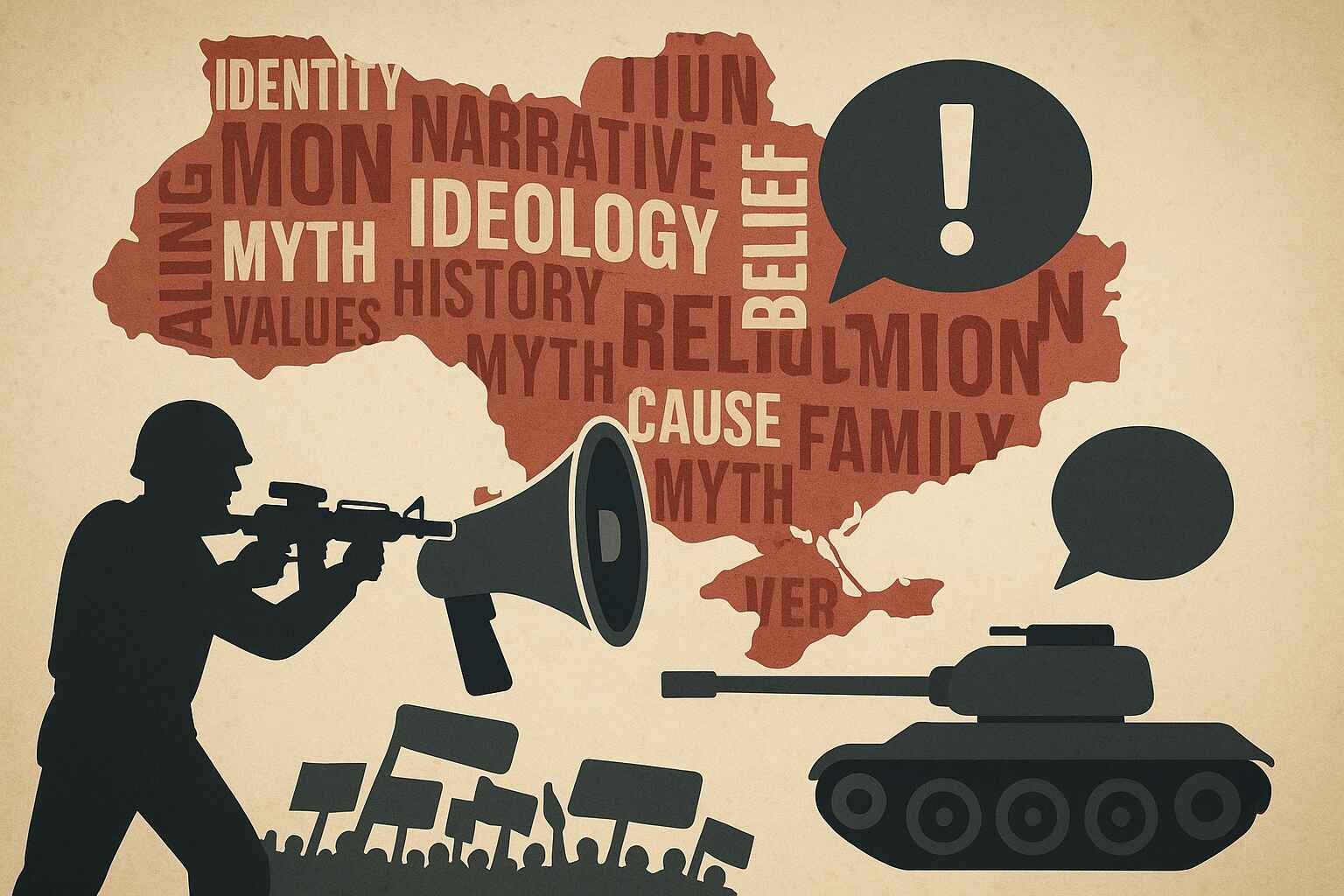
The battlefield of meaning: A war fought with tanks and rifles always begins with words, symbols, and competing narratives. Image © Ivan Bassov, 2025. Licensed under CC BY 4.0.
Understanding War as a Struggle Over Symbols, Not Territory
On the surface, wars look deceptively simple: contests over land, resources, or security. That is the language of diplomatic communiqués, the vocabulary of school textbooks, the neat abstractions of geopolitics. But this language obscures more than it reveals. Beneath every border skirmish and invasion lies something far older and far more human: meaning. Narratives, identities, collective myths, dominant ideas — these are the engines that turn fields into homelands, rivers into sacred lines, and cities into symbols worth killing for.
Scholars routinely list territory, resources, or security as causes of war. But a deeper current of anthropology, psychology, and conflict studies points toward a more uncomfortable truth: these material triggers matter only because of the meanings attached to them. Long before blood is spilled, a story is formed. And once formed, that story becomes the furnace in which conflict is forged. Wars are fundamentally struggles over meaning.
And because wars are struggles over meaning, they are always accompanied — and often preceded — by wars of narratives. If meaning is the true engine of conflict, then language becomes a weapon, sometimes more powerful than artillery. Armies mobilize only after stories mobilize; bullets fly only after words harden into identities. Every side fights not only on the ground but in the symbolic arena where legitimacy, morality, memory, and destiny are contested. Propaganda, myth-making, historical framing, and emotional vocabulary are not mere accessories to war. They are the war. The linguistic battlefield determines what the physical battlefield will mean, and therefore which sacrifices will appear justified. In wars driven by meaning, the war of words is not parallel to the war of weapons — it is the front line.
History proves this with almost mathematical consistency. The ancient Greeks did not cross the sea to besiege Troy because its land was fertile or strategically valuable. They went because honor demanded it, because a mythic narrative of wounded dignity had eclipsed every practical calculation. The Persian invasions of Greece were not about imperial real estate; they were civilizational assertions, Persia’s claim to universal order colliding with the Greek insistence on liberty as an existential identity. Even Rome’s annihilation of Carthage, often explained as the elimination of a commercial rival, was in truth the destruction of a competing destiny — a meaning Rome could not tolerate to coexist.
The medieval conflicts of Europe and the Near East followed the same pattern. The Crusaders did not march toward Jerusalem because the land itself promised economic gain; the Holy Land mattered because its meaning was cosmic. The Reconquista endured for centuries because the meaning of Christian Iberia demanded restoration. The Mongol conquests, wrongly reduced to a quest for pastureland, were propelled by a worldview that saw Mongol dominion as the natural order of the world. The material was incidental; the symbolic was absolute.
Modernity did not change this. Napoleon’s ambitions were clothed in Enlightenment rhetoric but rooted in an identity — France as the bearer of civilization. World War I erupted not because of mobilization timetables or colonial competition, but because honor, dignity, and national myth had reached a flashpoint. World War II made the primacy of meaning unavoidable: Hitler sought not territory but a redefinition of humanity, and the Allies resisted not merely for security but for civilization itself.
By the twentieth century, meaning stopped pretending to be anything else. The Cold War was fought almost entirely in the space of narrative. Two visions of human meaning — liberal democracy and communism — confronted each other across the globe. The battlegrounds of Korea, Vietnam, Angola, and Afghanistan were chosen not for resources but because each side saw them as tests of its story, its identity, its world-historical purpose.
The Russia–Ukraine war is another chapter in this larger pattern. Russia did not invade Ukraine for wheat fields or warm-water ports. Those are polite fictions. The deeper truth is that Ukraine’s independence wounds the Russian meaning-framework. A sovereign, democratic, Slavic Ukraine is an existential challenge not to Russia’s security but to Russia’s self-story. For centuries, Russian identity imagined Ukraine as inseparable from its civilizational core. Ukraine’s independence negates that narrative. Conversely, Ukraine fights not for soil but for the meaning of being Ukrainian — for dignity, sovereignty, Europeanness, and the right to exist as a people. If this were truly about territory, the war would have been resolved at a negotiating table long ago. Instead it persists with totalizing intensity because it is a war of meaning — and thus a war without a simple off-switch.
But nowhere is the primacy of meaning more stark than in the wars against Israel. For decades, analysts have insisted that the Arab–Israeli conflict revolves around borders, water, or settlements. Yet no explanation has ever matched the ferocity, longevity, or emotional voltage of the conflict. The land is small. The water is manageable. The security dilemmas, while serious, are not unique. What is unique is the symbolic density of the conflict. Israel’s existence challenges powerful narratives in surrounding societies — religious, cultural, historical. And Israel itself exists because of a meaning: Jewish homecoming, continuity, and survival.
The Arab rejection of Israel in 1948 was not about partition lines but about the meaning of Jewish sovereignty. The Six-Day War was less a strategic crisis than an existential one for the Arab world: Israel’s unexpected victory shattered deep symbolic expectations. Organizations like Hamas and Hezbollah — and states like Iran — fight Israel not for territory but because Israel’s very existence contradicts their ideological narratives. They state this openly. Their goal is not land but erasure of meaning.
Israel’s response, too, is rooted in meaning. It fights to preserve the one place on Earth where Jewish life is sovereign, safe, and self-determined. Its battles are never about real estate. They are about the meaning of Israel — the meaning of Jewish safety, continuity, and dignity.
The clearest evidence that wars revolve around meaning is what happens when meaning collapses. France and Germany stopped fighting not because Alsace-Lorraine lost value but because the symbolic charge of the territory evaporated. Britain abandoned its empire not because colonies became burdens but because empire itself lost meaning. The Soviet Union collapsed not from resource scarcity but from a narrative implosion. When meaning disappears, conflicts dissolve — even when the material conditions remain unchanged.
The verdict of history is unambiguous. Humans do not kill for minerals. They kill for stories. They die for meaning, for identity, for dignity, for the symbolic worlds that define who they are. Land becomes sacred only when meaning sanctifies it. Borders become explosive only when meaning charges them. Flags become worth dying for only when meaning animates them.
The narratives that transform into war-driving meanings are rarely spontaneous. They are often carefully manufactured by those in power, crafted to unify populations, justify aggression, and mobilize action. Sometimes, these narratives are created by foreign actors, designed to manipulate conflicts from afar. The wars against Israel provide a stark example: the PLO and the modern, so-called “Palestinian” identity were largely engineered by the Soviet KGB and have since been artificially maintained and nurtured by the wider Islamic world. These narratives provide purpose and justification to wars that, in purely material terms, would otherwise make little sense.
By contrast, many communist narratives and the violent networks they spawned collapsed with the disintegration of the Soviet Union in the late 1980s and early 1990s. Yet now, in a new form, they are re-emerging. Leftist-Islamist narratives, propagated by “the usual suspects,” are once again mobilizing populations and reshaping conflicts — a testament to how manufactured meanings, when successfully propagated, can reignite wars across decades and continents.
The truth is simple and unsettling: wars are not fought for territory. They are fought for meaning. And until we understand that, we will continue to misdiagnose conflicts — especially the ones unfolding before our eyes.
Related Topics
Related Posts