A voice from Morocco
The Battle for Islam’s Soul Begins at the Margins
The Buraq Wants a Podcast—But Only in Free Zones.
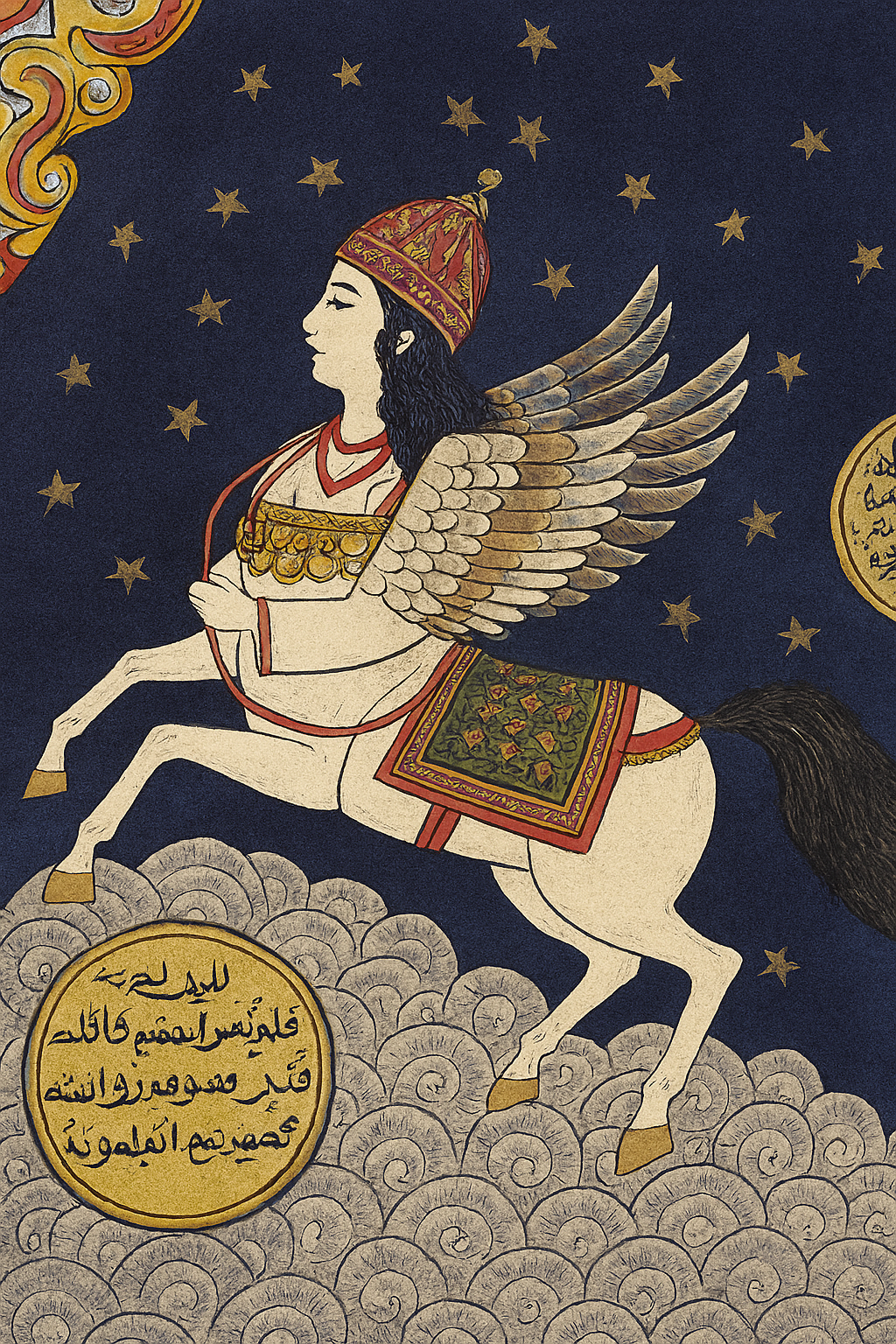
The Buraq, that winged creature of Islamic lore, didn’t land on a golden dome. It carried the Prophet Muhammad to al-Masjid al-Aqsa—a site sanctified long before Abd al-Malik’s Umayyad monument gleamed over Jerusalem. The Qur’an’s verse in Surah Al-Isra (17:1) speaks of a night journey “from the Sacred Mosque to the farthest mosque,” not to a dome, dynasty, or architectural misrecognition.
From the rock beneath that dome, Muhammad is said to have ascended through the seven heavens. But the confusion between the Dome of the Rock and al-Aqsa is more than architectural—it’s symbolic of a deeper misreading: one that extends to how Islamic tradition views Bani Isra’il, the Children of Israel.
A Chosen People, A Condemned People:
The Qur’an is not a monolith. It calls the Jews “favored above all nations” (Surah Al-Baqarah 2:47), yet also accuses them of “killing the prophets” and “breaking the covenant.” This duality—reverence and rebuke—is not contradiction, but tension. A tension that has been flattened by centuries of polemic and politicization.
In my experience, the ulema—the guardians of Islamic interpretation—almost always choose the darker lens. The verses that speak of grandeur, chosenness, and divine favor are quietly shelved. The ones that accuse, admonish, and condemn are amplified. The result is a theological imbalance that has hardened into cultural reflex.
Qatar’s Monopoly on Islam:
Qatar doesn’t own Islam because it inherited it. It owns it because no one presented an alternative. Through media empires, clerical networks, and postcolonial vocabulary repackaged in Islamic garb, Qatar has exported a singular narrative: one that conflates resistance with rigidity, and theology with geopolitics.
This monopoly has shaped minds from Tunis to Jakarta. But monopolies are fragile. They collapse not when they’re challenged, but when alternatives emerge.
Enter Jamaat al-Fitra: Gaza’s Quiet Rebellion:
In the chaos of Gaza, a quiet rebellion has begun. The Dughmush family—long known for its defiance of Hamas—has birthed something unexpected: Jamaat al-Fitra, a Sufi-inspired sect that is now battling Hamas in the streets of Gaza City.
Unlike clan chiefs who posture without valor, Jamaat al-Fitra offers something radical: a theology of dignity. A space for freedom of belief and speech that the Arab world has never truly witnessed. In a region where religious discourse is often a tool of suppression, this group dares to imagine Islam as a sanctuary, not a sword.
They are not alone. Figures like Abu Shabab, Al-Astal, and others are gradually asserting their presence—on the ground, in the streets, and in the imagination of a war-weary population. Their rise is making Hamas nervous, not because of their firepower, but because of their legitimacy. They wear Palestinian flag badges, not black banners. They speak of justice without vengeance, of faith without fear.
And yet, their appeal remains fragile. Israel, if it is serious about reshaping the narrative, must do more than tolerate them. It must elevate them. Not with weapons, but with cultural stature. Help them become poets, preachers, and public intellectuals. Give them the platforms, the protection, and the symbolic capital to challenge Hamas not only in the alleyways—but in the hearts and minds of Palestinians.
Islam at a Crossroads:
October 7 didn’t just bring Salafist militants to Israel’s doorstep—it exposed the ideological fault lines within Islam itself. The question now is not whether Islam can evolve, but whether anyone will help it do so.
Israel, with its new dominance in Gaza, has a rare opportunity to shape a theological and cultural safe zone. By allowing anti-Wahhabi voices to thrive in their neighborhoods—by protecting their freedom of speech and belief—it can corner the last remnants of Hamas not just militarily, but morally.
This is not fantasy. It is logic. And it aligns with the vision of figures like Jared Kushner and Steve Witkoff, who have long argued that Israel must embrace Palestinians—not as enemies, but as partners in a new regional order. But that embrace will only be meaningful if it comes with a strategic divorce: sidelining Qatar, the ideological exporter of rigidity and resentment.
Toward a New Narrative:
To raid the new Buraq is to reclaim the symbolic journey: not just from Mecca to Jerusalem, but from antagonism to empathy. It is to recognize that the rock beneath the dome is not just a relic—it is a launchpad. A place where heaven touched earth, and where a new theology of coexistence might yet ascend.
And perhaps, next time the Buraq flies, it won’t land in Doha. It might circle Gaza instead—where a forgotten family, a few rogue mystics, and a handful of flag-bearing rebels are quietly rewriting the script.
Related Topics