
Former journalist, now a grumpy old man
The BDS and PSC. Just how do they get away with it?
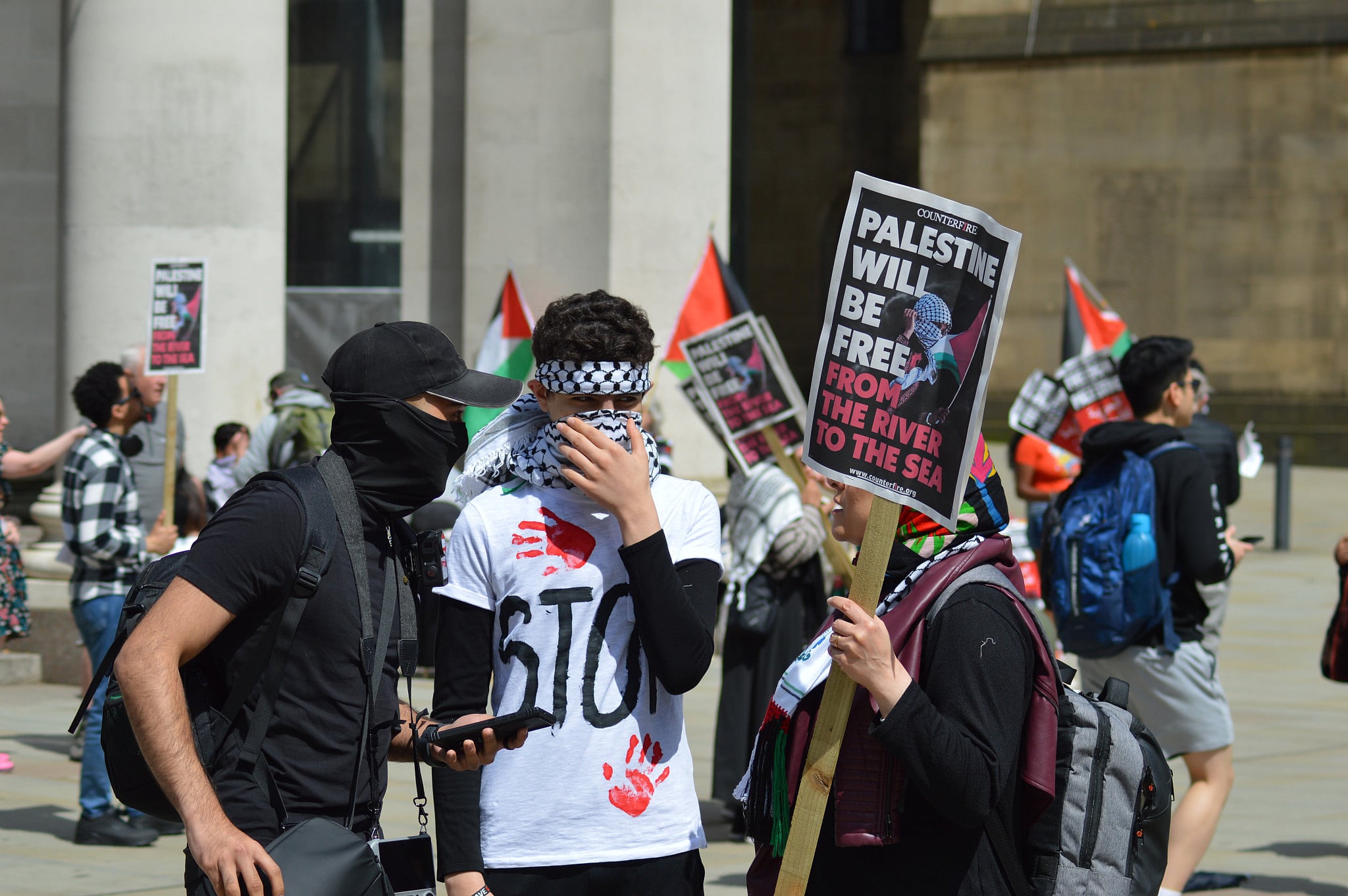
Do they hide their faces because they KNOW they are in the wrong? (Pic: Ed Moss, Manchester Palestiniain rally, March 2025)
The growth and influence of the Palestine Solidarity Campaign (PSC), the Boycott, Divestment and Sanctions (BDS) movement and other organisations campaigning against Israel raises an important question. Why is Israel subjected to a level of political, cultural and economic campaigning that is rarely applied consistently to other countries involved in serious and prolonged conflicts?
This is not an argument against legitimate criticism of Israel or its government, nor against peaceful protest. It is an argument about consistency, proportionality and double standards. Many bi-partisan reporters and observers have conceded they have never witnessed such appalling inconsistent and disproportionate double-standards.
The BDS movement describes its campaign as targeted rather than a blanket boycott of everything connected with Israel. That distinction is important. However, there have also been instances in which Israeli connections have been used as the basis for campaigns against individual businesses and organisations, including businesses in Britain and elsewhere.
Where that happens, it is legitimate to ask whether the distinction between opposition to Israeli government policy and opposition to people or businesses because of their Israeli or Jewish connections has been properly maintained. There is also the extra question about the selective application of these boycotts.
Israel has made significant contributions to fields including medicine, technology, cybersecurity, agriculture and communications, Israeli-developed or Israeli-linked technology is incorporated into many products and services used internationally. Yet campaigns against Israel do not generally call for the abandonment of every product or service containing Israeli technology.
That does not, in itself, invalidate a targeted boycott. But it does raise a reasonable question, namely what determines which Israeli connections are considered acceptable and which are considered grounds for boycott? The same applies to medical technology. Israel has been involved in the development of numerous medical devices, treatments and technologies used internationally. If Israeli involvement is considered sufficient reason to reject a product or service, why is that principle not applied consistently?
The wider question of double standards becomes particularly significant when Israel is compared with other countries. The world contains numerous governments accused of serious human-rights violations, military aggression, repression or terrorism. Syria, Iran, China, Afghanistan, Yemen, Sudan and Nigeria, among others, have all faced international criticism for different reasons.
There have been enormous civilian casualties and mass displacement in conflicts such as Syria and Sudan. China has faced extensive international criticism over its treatment of up to one million Uyghurs. 73 of the world’s 234 counties have a population lower than 1 million people! Women and girls in Afghanistan have faced severe restrictions on education, employment and public life. Iran has violently suppressed political dissent. Religious minorities, including Christians, have faced severe persecution in parts of the world.
Yet these issues do not generally produce anything approaching the same sustained British street mobilisation, boycott campaigns and institutional pressure directed at Israel.
There is an important difference between Israel and some of these cases: Israel has faced a sustained security threat from organisations operating from neighbouring territory, including Hamas, which has explicitly called for the destruction of Israel and is proscribed as a terrorist organisation by the United Kingdom and a number of other governments. That does not exempt Israel from scrutiny. It does, however, form part of the context in which Israeli actions have to be considered.
The disparity in international and domestic campaigning therefore deserves examination. It is entirely legitimate to argue that Israel should be held to high standards. The same standards should also be applied to other states.
Any serious discussion of the subsequent conflict also has to begin with the events of 7 October 2023. A legitimate question follows. How would any other country be expected to respond if its citizens had been attacked, 1200 murdered and 251 taken hostage by an organisation operating from a neighbouring territory? Hamas is proscribed as a terrorist organisation by the United Kingdom and a number of other governments.
None of this removes the right to criticise Israel’s subsequent military conduct. Civilian suffering in Gaza is a legitimate subject of concern and scrutiny. But criticism of Israel’s response should not require the circumstances that produced that response to be forgotten or rewritten.
Nor should sympathy for Palestinian civilians require minimising, excusing or rationalising the actions of Hamas. That distinction is important because Hamas and the Palestinian population are not the same thing.
One of the most striking features of the debate is the extent to which attention can become concentrated almost exclusively on Israel, while other conflicts and humanitarian disasters receive comparatively little, and sometimes very little, public mobilisation. It’s a very selective outrage. The question is not whether those other situations matter more than Gaza. They do not have to. The question is whether a movement claiming to be motivated by universal principles of human rights should demonstrate those principles consistently.
If civilian deaths, displacement, occupation, discrimination and human-rights abuses are reasons for campaigning against one country, why should substantially similar concerns elsewhere produce so much less political activity? That is a legitimate question and one that deserves an answer rather than dismissal. There is also an important distinction between criticism of Israel and antisemitism.
People are entitled to oppose the Israeli government, criticise its policies, support Palestinian statehood or advocate sanctions against Israel. None of those positions is inherently antisemitic. However, antisemitism exists, and criticism of Israel has now crossed that line when Jews collectively are blamed for the actions of the Israeli government, Jewish businesses are targeted because of their owners’ identity, traditional antisemitic conspiracy theories are repeated, or Jews are held collectively responsible for events in which they had no involvement.
The behaviour of individual activists and organisations should therefore be judged by what they actually say and do, rather than by assumptions about their motives. The central issue is therefore one of moral and political consistency. Why is Israel treated so differently? Why do some organisations demand boycotts of Israeli companies while continuing to use products containing Israeli technology themselves?
Why is Israel subjected to sustained cultural, academic and economic campaigning while governments responsible for extraordinarily serious abuses elsewhere attract considerably less attention?
Why are some political movements reluctant to acknowledge Hamas’s responsibility for the events of 7 October while simultaneously demanding that Israel’s subsequent actions be judged without reference to them?
And why does criticism of Israel sometimes appear to spill over into hostility towards Jewish individuals or institutions that have not even the slightest responsibility for Israeli government policy?
These questions do not require hostility towards Palestinians, Muslims or anyone else. Indeed, the opposite is true. But they demand honesty, yet that honesty is no longer forthcoming. A serious debate about Israel and Palestine should be based on the principle that Palestinian lives matter, Israeli lives matter, Jewish lives matter, Muslim lives matter and civilian lives matter regardless of nationality or religion.
The test of any political movement claiming to defend human rights should therefore be simple, apply the same standards to everyone. If Israel deserves scrutiny, so do Hamas, Iran, Syria, China, Afghanistan, Sudan and every other government or organisation accused of serious abuses. If boycotts are justified by a country’s policies, the criteria should be clear and consistently applied.
And if antisemitism is condemned, it should be condemned wherever it appears, including when it is found within movements that otherwise present themselves as advocates for human rights.
That is not an argument against Palestinian rights. It is an argument for universal standards, intellectual honesty, morality and consistency.
Related Topics
Related Posts