
The Beautiful Game and The Jewish Story
I hadn’t realized how much I needed the World Cup.
For the past several weeks, it has offered a welcome respite from the relentless bad news cycle. After months of war, politics, protests, and all the other stories seemingly designed to divide us, it has been refreshing to spend a few hours each day watching the world gather around something joyful.
Well, mostly joyful. FIFA remains one of the world’s most notoriously corrupt sporting organizations. Yet somehow, despite itself, and despite a few officiating follies, it has produced one of the greatest sporting spectacles on earth. I know that’s a bold statement, but after watching these past few weeks, I believe it. No other sporting event combines athletic excellence, national pride, and sheer joy quite like the World Cup.
The football has been magnificent. Team USA gave us plenty to cheer about before an all-too-familiar early and abysmal exit. Knowing they were unlikely to make a deep run, I had already purchased my England shirt, complete with the Three Lions crest, largely because I have become a huge fan of Harry Kane and Jude Bellingham. In 2018, two World Cups ago, I bought a France shirt and cheered for my favorite player at the time, the breathtakingly talented Kylian Mbappé, the youngest goal scorer in World Cup history. Apparently, every World Cup requires not only a home country but an adopted one as well.
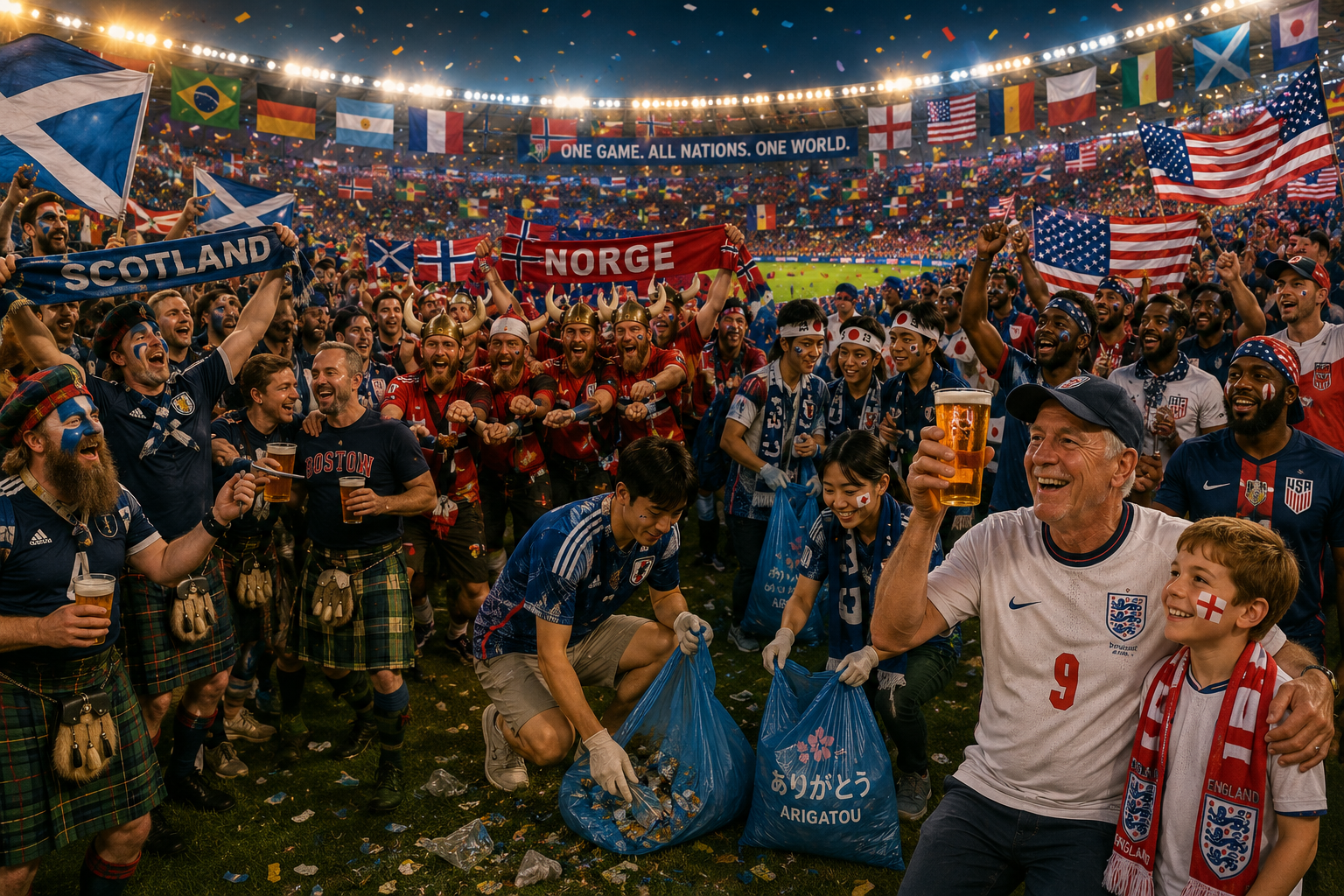
But as thrilling as the matches have been, it is the supporters who have captured my imagination.
Living in Massachusetts, we have enjoyed something close to a front-row seat. Thousands of Scottish supporters descended on Boston in their kilts and tartan, drank several local pubs dry, and somehow managed to charm an entire city into joining their celebration. At the Sam Adams taproom, they reportedly consumed four times the amount of Boston Lager normally sold over a comparable four-day holiday weekend, forcing an emergency delivery. Boston, a city with its own rather intense sporting identity, seemed delighted to surrender itself temporarily to the Tartan Army. Luckily their bond is about to be officially solidified as the process to twin their city with Glasgow has begun.
Then came the Norwegians and their infectious “Viking row,” a synchronized chant in which thousands of supporters sit together and mime the rowing of a longboat. It is clever, joyous, slightly ridiculous, and impossible not to enjoy. The celebration has traveled far beyond the stadiums, embraced by Norwegian politicians, pilots, families, and even the royal household. Norwegian striker Erling Haaland described it as “bigger than football.” For once, that didn’t feel like an exaggeration.
The Japanese offered something quieter but no less revealing. After their matches, supporters remained in the stands carrying blue trash bags, collecting litter and leaving the stadium cleaner than they found it. They even helped clean after matches in which Japan was not playing. It has become one of the World Cup’s most admired traditions, an act of courtesy that reflects not only respect for the venue but something distinctive about how Japanese supporters understand their responsibility to the community around them.
The Scots bring their songs and their prodigious thirst. The Norwegians bring their imaginary longboat. The Japanese bring their blue trash bags. Every nation arrives carrying a piece of its own story.
That may be what makes the World Cup so compelling. Watching this year’s tournament, I found myself thinking about the Jewish story in a way I never expected.
For one month, the world gives itself permission to celebrate belonging. Flags appear in windows and across shoulders. People paint their faces, sing songs learned from their parents, and stand for national anthems with tears in their eyes. Perfectly rational adults hug strangers after a goal and speak about a team of athletes they have never met using the pronoun “we.”
Nobody finds this particularly strange. Nobody tells Scottish supporters that their attachment to Scotland is outdated or exclusionary. Nobody asks the Norwegians to justify why Norway requires a separate national team. Nobody tells the Japanese that national traditions are dangerous relics best left behind.
For one month, the world celebrates a surprisingly simple idea.
Every people deserves a team.
The World Cup understands something our political conversations often forget. Nations are not merely governments, borders, or administrative arrangements. They are communities of memory. They are languages and stories, songs and recipes, shared triumphs and inherited heartbreaks. They are the things grandparents pass to grandchildren long before those children are old enough to vote.
The tournament also understands that identity can be layered. Players sometimes represent the country in which they were born and sometimes the country their parents or grandparents left behind. Supporters cheer for the nation where they live, the nation their family came from, or both. No one finds it incomprehensible that a person might carry more than one loyalty or feel connected to a homeland he has known largely through family stories.
The tournament also reminds us that a people is not the same thing as its government. After Iran’s final match in Los Angeles, the players left a handwritten note in their locker room thanking the city and its supporters for their hospitality. They had come, they wrote, with pride, competed with honor, and left with gratitude.
One can oppose the Iranian regime while still appreciating the grace shown by the Iranian team. The World Cup makes that distinction feel perfectly natural. It reminds us that governments come and go. Peoples endure.
Jews have understood this for a very long time.
Long before modern nationalism, we were already a people connected by memory as much as geography. Scattered across continents, Jews prayed toward Jerusalem, celebrated the same holidays, read the same Torah, and told their children the same story of liberation from Egypt. We carried a distant homeland through language, ritual, and longing, generation after generation.
Zionism did not invent Jewish peoplehood. It gave Jewish peoplehood a home. In that sense, Zionism was less an invention than a homecoming.
Strip away the politics that people understandably debate, and Zionism begins with a proposition that looks remarkably ordinary during the World Cup: the Jewish people, like every other people, are entitled to stand among the family of nations.
A language. A flag. A homeland. And yes, a team.
The World Cup does not ask us to endorse every government represented on the field. Cheering for England is not an expression of confidence in Downing Street. Scottish supporters did not empty Boston’s beer taps because of their admiration for decisions made at Holyrood. Japanese fans do not clean stadiums as an endorsement of every policy pursued in Tokyo.
The World Cup does not ask us to love every government. It asks us to understand why people love their people.
That distinction seems obvious when the shirts say England, Scotland, Norway, Japan, France, or Argentina. Yet when Jews express the same attachment to their people and their national home, the language often changes. What is celebrated elsewhere as pride, memory, and belonging is recast as something inherently suspect.
Perhaps that is why I have found this World Cup so uplifting. It has reminded me that national feeling does not have to be ugly. Loving one’s own country need not require hating anyone else’s. Pride can be expressed through songs, shirts, chants, courtesy, shared memory, and the delight of seeing one’s people represented before the world.
Soon the tournament will end. The visiting supporters will go home. Boston’s pubs will replenish their beer. The Norwegians will put away their oars. My new Three Lions shirt will return to the closet, hopefully after a few more outings.
The bad news cycle will still be waiting for us.
But I hope something of the tournament lingers: the recognition that nations matter because people need places and stories to which they belong. That there is nothing threatening about wanting to hear your language spoken, see your flag raised, or watch your children inherit the traditions of their grandparents.
For one glorious month, the world remembers that every people deserves a place among the nations.
Even the Jews.