The Best Books of 5786
The term People of the Book, which sounds much better in Hebrew, Am HaSefer, is indeed apt. Walk into any Jewish bookstore or browse on Amazon, and new titles arrive daily.
5786 is coming to a close, and the year, like previous ones, was blessed with many excellent books. Here is my list of the top books of the year.
My friend Meyer Mandel said a good shiur is one that, after it’s over, makes you want to open a sefer. With some license, a really good book makes you want to open up more books. And all of the ones listed here do just that.
Book of the year – Ezra-Nehemiah: Retrograde Revolution
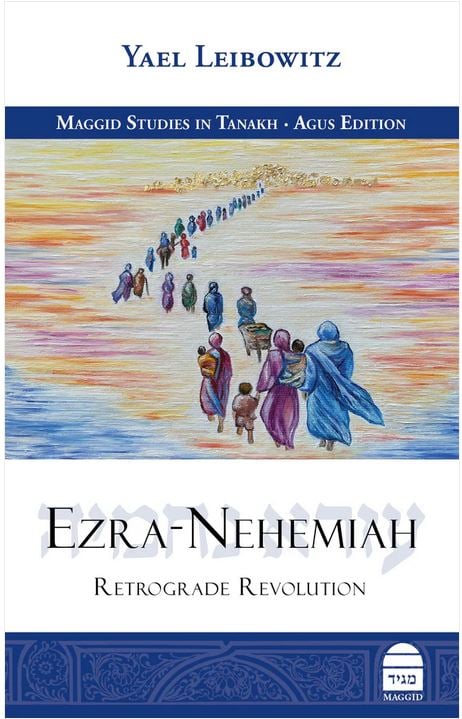
“Ta’amu u’re’u ki tov Hashem” – “Taste and see hat the LORD is good” (Tehillim 34:9). Some books are meant merely to be read; the finest are meant to be savored. Ezra-Nehemiah: Retrograde Revolution (Maggid Books) by Yael Leibowitz is one of those books.
It is a work rich in sophisticated ideas, intellectual nuance, and insights that reveal their depth with every page. Like a fine dish, it rewards careful tasting, reflection, and appreciation.
This is an unusually rich and intellectually satisfying work of Tanakh scholarship. What makes it remarkable is that Leibowitz takes a part of the Tanakh that is often overlooked and shows it is a remarkably sophisticated study of Jewish survival, identity, leadership, political reality, and religious renewal.
She examines how Ezra and Nehemiah rebuilt Jewish life after the Babylonian exile, not simply by looking forward, but by looking backward to Torah and Jewish tradition for the principles needed to construct the future. That paradox is the title’s brilliance: a revolution accomplished by returning to the past.
Leibowitz is a teacher at the Matan Women’s Institute for Torah Studies (Matan, an acronym for Machon Torani l’Nashim), a Jerusalem-based midrasha. The Kitvuni Fellowship, part of Matan, aims to promote the publication of high-level Torah scholarship by women. Leibowitz is a fellow in the program, and her book is the first to be published in English; the others are in Hebrew.
Ezra-Nehemiah was originally one book, but was later divided into two. Given her incredible writing abilities, let’s hope this is the first of many of her books.
Runners-up: in no particular order.
The Marital Knot: Agunot in the Ashkenazi Realm, 1648-1850
Taking a subject that could easily become a dry study of halakhic technicalities and turning it into a rich window into the lived reality of Jewish life in the early modern period, is not an easy feat.
But Dr. Noa Shashar of Sapir Academic College does just that in The Marital Knot: Agunot in the Ashkenazi Realm, 1648-1850 (Brandeis University Press).
The problem of the agunah, a woman whose marriage could not be dissolved because her husband’s death or whereabouts could not be established, forced rabbis, judges, families, and communities to wrestle with the tension between rigorous Jewish law and profound human suffering.
Shashar reveals the personalities and social pressures behind the legal questions, women desperate to rebuild their lives, husbands who disappeared, families fighting for particular outcomes, and rabbis trying to balance compassion with fidelity to Jewish law.
Two Sisters, One Soul: The Secret of Rachel and Leah
The Talmudic phrase “a lion has arisen from Babylon” (Sanhedrin 96b) refers to the emergence of an exceptionally powerful Torah scholar from Babylonia.
While author Avital Gastwirth is in Israel, not Babylon, her book, Two Sisters, One Soul: The Secret of Rachel and Leah (Menucha Publishers), is the work of an exceptionally powerful Torah scholar.
What makes this book remarkable is that it takes on one of the most familiar stories in Sefer Bereishit and makes you realize you may never have really understood it before.
The brilliance lies in Gastwirth’s central insight: Rachel and Leah are not simply two sisters caught in a tragic rivalry; they represent two seemingly opposite dimensions that ultimately belong to a single spiritual reality.
Gastwirth, like Yael Leibowitz, is a gifted author who has written a remarkable book.
Rabbi Yitzchak Hutner’s Theology of Meaning
The quote “If I knew God, I would be God” is most commonly attributed to Rabbi Menachem Mendel of Kotzk. The point is that God is ultimately beyond human comprehension.
Rav Yitzchak Hutner was not beyond human comprehension, but as an extraordinarily complex individual and writer, he is quite hard to understand.
In Rabbi Yitzchak Hutner’s Theology of Meaning (Brill), Dr. Alon Shalev has not simply written a book about Rav Hutner. It does something much more ambitious: it gives you a framework for finally understanding why Rabbi Yitzchak Hutner’s writing feels simultaneously brilliant, profound, contradictory, poetic, and maddeningly difficult.
He attempts something that has been remarkably difficult to do with Rav Hutner: to show that a coherent philosophical system underlies the seemingly disconnected essays of his magnum opus Pachad Yitzchak.
Ask most people about Rav Hutner and they will say he was the Rosh Yeshiva of Chaim Berlin. Shalev shows he was that, and more. He shows in this remarkable work how he was a modern existential philosopher. In fact, Shalev calls him a “post-existentialist theologian.”
Whatever you want to call him, this book shows how he answers the same questions as modern existentialists, but through Torah.
How to Read the Mishnah and Midrash: An Introduction to Early Rabbinic Literature
In the amazing book How to Read the Mishnah and Midrash: An Introduction to Early Rabbinic Literature (University of California Press), Dr. Ishay Rosen-Zvi, has written one of the most important English-language introductions to rabbinic literature in decades. It’s so good not simply because it contains a lot of information. It changes the way you see what the Mishnah and Midrash actually are.
Rosen-Zvi treats the Mishnah as a literary creation, not merely a law book. Someone encountering the Mishnah traditionally might think: The Torah gives the laws; the rabbis explain them; Rav Yehuda HaNasi compiled the explanations into the Mishnah. Rosen-Zvi shows how inadequate that picture is.
Here, he covers the inner workings of the Mishnah and the genius of Rav Yehuda HaNasi, who created an autonomous legal text that covered every aspect of Jewish life.
His treatment of Midrash is equally fascinating. Once again, he doesn’t reduce Midrash to the simplistic notion that “The rabbis found creative interpretations of biblical verses.” He doesn’t focus on what the Midrash says, but rather on what the Midrash is doing.
I Read This Over Shabbos: Reading Jewish History in the Parasha
Acharon acharon chaviv means that “the last one is the most beloved.” It comes from the idea that the final item in a sequence is especially cherished or favored.
Rabbi Dr. David Bashevkin’s I Read This Over Shabbos: Reading Jewish History in the Parasha (Koren) is the last book I read this year. I will have a full review of it next week.
But this is a wonderful book because it does something surprisingly difficult: it makes Jewish history feel intellectually exciting without turning it into either a dry history textbook or a conventional d’var Torah.
His concept is simple: each week’s parasha becomes a jumping-off point for exploring a fascinating episode, personality, controversy, or idea from Jewish history.
What Shalev did for Rav Hutner, Bashevkin does for the parasha. He found a way to use the weekly Torah portion as a doorway into the astonishing intellectual, historical, and human complexity of the Jewish people.