The best educational system in the world — at 34,000 feet
It’s almost comical. A flight attendant yelling at passengers to sit down and remain in their seats, “until the airplane has come to a full stop,” while the passengers around him completely ignore his directives. They were, instead, focusing on what was really important: Neutralizing the murderous axe-wielding perp. Stabilizing the plane that he had sent into a terrible dive. Preventing the heroic and badly wounded captain from bleeding out.
Minutes before, these passengers on flydubai Flight 1073 didn’t know each other from Adam, but here they were, functioning together as a team — a well-oiled machine where the members were both capable of taking individual initiative and of working smoothly together.
What the flight attendant was doing was nearly useless — a real failure to focus on what was most important in a crisis — but I guess that he was doing what he was trained to do: to keep passengers obedient and in their seats with their seatbelts fashioned. And the Israelis were doing what they were trained to do, trained to do by an educational system that relentlessly focuses on teaching one thing above all — how to form up and function as a team.
“Everyone understood the situation we were in and what needed to be done,” financial planner Asaf Rajuan — one of the three men who first charged the cockpit — told the New York Times in their excellent account of the incident where a co-pilot turned terrorist attacked his captain. “Everyone did what was necessary.”
Anyone who has ever worked in a large organization knows how hard it can be to get a group of people focused on one mission, how much time and effort it can take, how much resistance and in-fighting one can face in trying to make this happen. But here this kind of gelling was happening instantly.
In the field of education there is the concept of a “hidden curriculum,” something fundamental about an educational system that cannot be easily measured or even noticed at all. The Glossary of Education Reform calls it, “a set of unwritten, unofficial, and unintended lessons, values, and norms that students absorb in school alongside the formal academic curriculum.”
There has been a lot of handwringing of late about the state of the Israeli educational system. The latest international test of reading, math and science among 15-year-olds’ showed that Israel has fallen even farther behind other countries than before, now ranking 43rd in the world, down from 38th in 2022.
These numbers do indeed tell us something important, and more needs to be done to improve our schools. But what happened at 34,000 feet above the Arabian desert constituted a kind of “final exam” for the Israeli educational system. And, there, the products of this system passed with flying colors.
The definition I quoted above said that the goals of a hidden curriculum are “unintended.” But I think there is nothing unintended about the Israeli educational system’s focus on preparing its students to be part of teams where everybody works together, where everybody helps one another.
My 10-year-old daughter is, thank God, a very successful student, and we are blessed to hear words of praise from her teachers at parent-teacher conferences. But the thing that stands out to me most about those words of praise is how much they highlight how she tries to help other students in her class.
This is part of the Israeli hidden curriculum around teams peeking out at us. And I see it in so many other ways in what her school does, and even in the parts of her education that don’t happen inside the school’s walls. A major part of most Israeli kids’ experience comes after the school day in youth groups like Bnei Akiva or Noam. These too are part of the “hidden curriculum,” and their activities go a long way toward helping build this Israeli genius for team. And, of course, when high school is over, most Israeli kids serve in the army, a place where that genius for both being able to show individual initiative and to quickly fit into a team mission is particularly important, and is a major part of the training. This, too, is part of the hidden curriculum whose product we saw so dramatically at 34,000 feet.
One of the many things from the videos of the incident that brought tears to my eyes is to see Rajuan’s refusal to listen to the flight attendant’s attempt to take him off his mission, to break up his newly formed team. The attendant tells him to get out of the cockpit area, so he and the rest of the official team of the plane can take over. “No, I don’t come back,” Rajuan says, pointing out that the flight attendant had done nothing when action was most needed. This refusal — this stubbornness, this stiff-neckedness — is so Israeli, so Jewish.
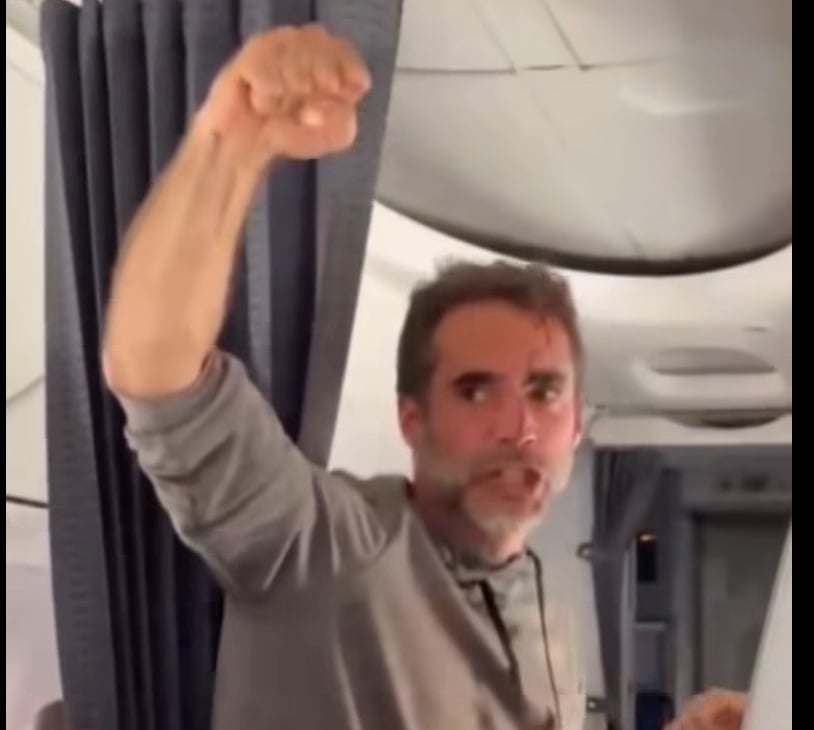
Later in the incident, there’s another video of Rajuan coming into the cabin, fist raised, and crying out, “Hevre, we’re down. We won!” What stands out to me is his use of the word “we.” It’s such an important part of the Israeli experience — and part of its hidden curriculum — his sense of “we.” (This video was taken by passenger Miryam Ochayon and is in the NYT story.)
Israel knows great success in areas like its military and its high tech industry. And the country’s access to technological marvels is a big part of those successes. But the flydubai incident underscores that the real source of Israeli successes is its people, a people who have been steeped in a deep hidden curriculum that can make them particularly effective in high stress situations that require both individual initiative and teamwork. I feel privileged to be a small part of it as an oleh and blessed to have my children being raised in it.