The ABC and terrorism – who watches the watchdog?
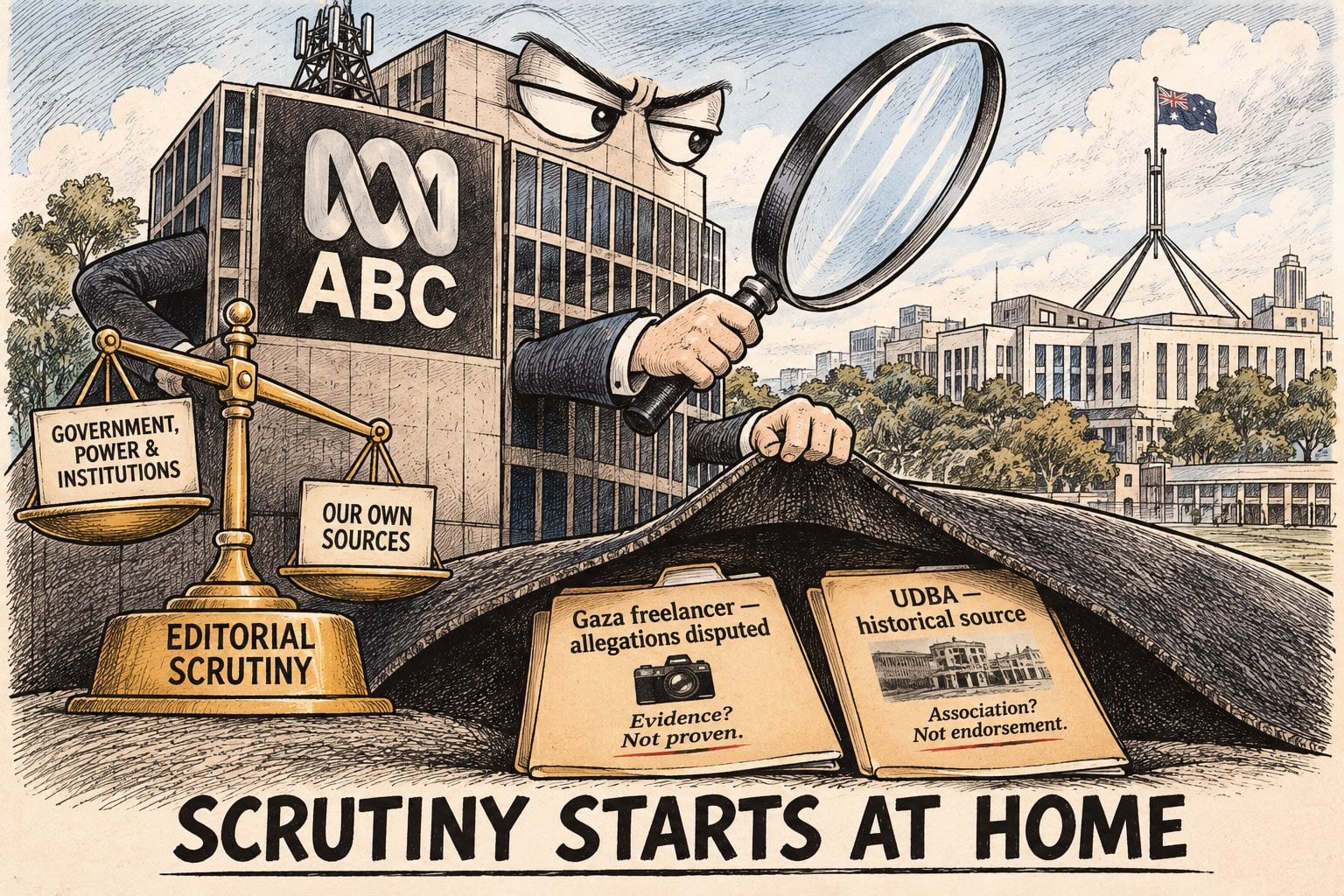
From Tony Jones’s literary association with a former Yugoslav secret police operative to Sarah Ferguson’s on-air tribute to a Gaza freelancer subsequently identified by Israel as a Hamas military operative, questions are mounting about the ABC’s judgement, its choice of sources and its apparent reluctance to address uncomfortable associations.
There is an uncomfortable pattern emerging in the relationship between Australia’s national broadcaster and individuals whose associations with authoritarian or terrorist organisations deserve scrutiny.
The ABC likes to think of itself as an institution that holds ‘power to account’, exposes abuses and challenges the propaganda of oppressive regimes. Its journalists routinely insist on transparency from governments, intelligence agencies and political organisations. Yet when questions are raised about the backgrounds and affiliations of people the broadcaster has worked with or whose contributions its prominent presenters have publicly celebrated, the same appetite for scrutiny seems less immediate.
Two cases, separated by geography, history and the nature of the allegations, raise a common question about editorial judgement.
The first concerns veteran ABC journalist Tony Jones and his 2017 novel, The Twentieth Man, and his acknowledgement of assistance from Đorđe Ličina, identified in published accounts as a former operative of Yugoslavia’s notorious UDBA secret police.
The second concerns 7.30 presenter Sarah Ferguson, who interestingly is also the wife of Tony Jones, and her public tribute to Palestinian filmmaker and ABC freelancer Roshdi Sarraj, whose subsequent identification by the Israeli military as an alleged Hamas operative has prompted serious questions about the broadcaster’s vetting procedures.
On the available evidence, neither case shows that the ABC knowingly endorsed or supported the organisations in question. But both invite scrutiny of a more fundamental issue: how carefully does the national broadcaster examine the people whose work, testimony or assistance it relies upon?
The Gaza freelancer and the Ferguson tribute
The Sarraj affair is arguably the more consequential of the two because it concerns the ABC’s actual news-gathering operations, rather than a journalist’s attempt at a brilliant literary career outside of the media group.
Roshdi Sarraj was a Palestinian filmmaker and freelance cameraman whom the ABC engaged in 2023 to provide footage from Gaza for its flagship current-affairs program, 7.30. He also worked with other international media organisations, including the BBC, France’s Radio France and Al Jazeera. The ABC was not his first rodeo, as the saying goes.
Sarraj was killed in an Israeli airstrike on October 22, 2023. Eight days later, Sarah Ferguson acknowledged his death on 7.30, offering condolences to his family and remembering that he had filmed material for the program.
At the time, this was presented as a straightforward acknowledgement of the death of a media colleague, one of many in Israel’s much-maligned Gaza War. The controversy emerged almost three years later, when the Israel Defence Forces included Sarraj among 170 Palestinian media workers it alleged had been members of terrorist organisations operating in Gaza.
The IDF identified Sarraj as an operative in Hamas’s military wing. Subsequent reporting by The Australian on November 20, 2026, described a heavily redacted document which the Israeli military said it had recovered in Gaza. According to the newspaper’s account, Sarraj joined Hamas in 2011 and was later promoted to observer and deputy squad commander.
These are serious allegations, but they remain contested. The ABC says it has repeatedly sought the underlying evidence from the IDF but has not received it. The Committee to Protect Journalists, meanwhile, has maintained that Sarraj was a civilian journalist, saying its investigation found no evidence that he was a combatant.
That distinction is essential. An allegation by a military authority is not, by itself, proof. Equally, a person’s professional association with international news organisations does not automatically establish that they had no other affiliations.
The ABC is therefore right to seek corroboration rather than simply accept the Israeli military’s claims. But the same standard of scrutiny must apply in the other direction. The broadcaster must be prepared to investigate evidence of possible militant affiliations thoroughly, including material that may emerge from Palestinian sources, militant organisations or independent investigations.
What is difficult to understand is why the public broadcaster’s response ought to be considered complete simply because the IDF has not provided the evidence it requested. It’s not up to the IDF to do the ABC’s internal checks and balances.
The question is not whether Ferguson should have offered condolences to a man she understood to be a journalist. At the time of his death, the ABC had publicly identified him as a freelancer who had supplied footage to its program. No evidence shows Ferguson knew of the subsequent allegations. The question is what the ABC has done since those allegations emerged and whether its internal examination is sufficiently rigorous and independent.
Its own Media Watch program has since acknowledged that militant groups have infiltrated parts of Gaza’s media sector and that some individuals initially counted as journalists have subsequently been identified as members of armed organisations. It also emphasised that the evidence against Sarraj specifically remained unproven.
This is precisely the kind of complicated story the ABC should be able to investigate without ideological reflex or institutional defensiveness. This is also the type of story where category bias needs to be eliminated from the process.
Tony Jones and the UDBA connection
The Sarraj controversy is not the first time an association involving a prominent ABC journalist has prompted questions about the broadcaster’s relationship with individuals connected to organisations notorious for political violence.
In 2017, Tony Jones, the former host of Q&A and one of the ABC’s most recognisable journalistic figures, published his novel The Twentieth Man. The book drew on his decades-long interest in the political violence surrounding the collapse of Yugoslavia and the activities of alleged Croatian nationalists in Australia.
As Paul Daley wrote in The Guardian in 2016, “While Jones is correct that Australia was the stage for acts of violence by apparent Croatian extremists (some of whom were Catholics), there now seems to be little doubt that some terrorist activity blamed on the Croats was actually orchestrated by undercover Yugoslav agents provocateurs. In other words, the UDBA.
But an important detail in the acknowledgements of Jones’ book deserves greater attention.
Jones thanked Đorđe Ličina, an ethnic Serb and former operative of Yugoslavia’s State Security Service, the UDBA, who also wrote an earlier book titled The Twentieth Man.
Ličina’s association with the UDBA is not an incidental historical footnote. He was not a low-level member, but by all accounts, an officer in the organisation, the intelligence and secret police apparatus of communist Yugoslavia under dictator Josip Broz Tito. It conducted surveillance, infiltration and clandestine operations against opponents of the regime, including Yugoslav émigrés living in Western democracies, including Australia, a fact ASIO has readily admitted for decades.
Its record included political assassinations beyond Yugoslavia’s borders. Historian Christian Axboe Nielsen’s scholarly study, Yugoslavia and Political Assassinations, documents the systematic use of targeted killings against opponents of the communist state.
An article published by Independent Australia in 2018 went even further, describing Ličina as an operative who publicly embraced his association with the UDBA and citing Amnesty International’s historical assessment that the organisation murdered more than 100 dissidents outside Yugoslavia during the Cold War, of whom, according to ASIO, some were in Australia.
Yugoslavia was not only a sponsor of state-based terror via its own hit squads, but it was also a supporter of extra-state terror groups like the PLO and the Abu Nidal Group.
There is nothing inherently improper about a journalist consulting a former intelligence operative. Indeed, understanding how authoritarian security services function often requires speaking to the people who worked inside them.
But there is a difference between interviewing an operative and allowing his contribution to pass without adequately examining the organisation he served.
Jones’s literary project focused on the intersection of terrorism, political extremism, and the ideological conflicts of the former Yugoslavia. That makes the gathering (and cross-checking) of his sources particularly relevant.
His 2017 interview with The Guardian explained that the novel’s origins lay in his reporting on Nazi war criminals and so-called and hitherto unproven ‘Croatian extremist networks’ in Australia. That was touted as being ‘important investigative journalism’. But it also makes the question of balance and source scrutiny more pressing, not less.
The question is not whether Jones endorsed the UDBA. There is no evidence establishing that. It is whether a journalist of his experience sufficiently considered the historical consequences of acknowledging assistance from someone identified as a former operative of a secret police organisation implicated in political murder.
A pattern of institutional defensiveness?
Taken together, the Jones and Ferguson cases raise a wider question about the ABC’s editorial culture.
The circumstances are plainly different. Jones acknowledged assistance from a former Yugoslav security operative while researching historical fiction. Ferguson offered condolences to a freelancer whose alleged militant affiliations emerged publicly years after his death. Neither circumstance establishes direct complicity, ideological sympathy or deliberate legitimisation of terrorism.
But the cases do illustrate why the ABC must be especially careful about the people whose accounts, footage and expertise it incorporates into its journalism.
In the Sarraj affair, the broadcaster has emphasised that the IDF has not supplied sufficient evidence to substantiate its allegations. That is a legitimate position. But a genuinely independent investigation should not stop there. It should examine all available material, including the reported military document, the claims surrounding Sarraj’s alleged Hamas membership and the findings of the Committee to Protect Journalists.
The ABC’s own Media Watch investigation has demonstrated why this matters. Its November 2, 2026, report, Terrorist for hire, acknowledged that Hamas and other armed organisations have infiltrated parts of Gaza’s media sector. It also reported that independent investigations had confirmed the militant affiliations of some individuals previously identified as journalists, while concluding that Sarraj’s case remained unresolved.
That is the sort of scrutiny the public should expect from the national broadcaster.
The ABC cannot reasonably demand that audiences accept its reporting as authoritative while treating questions about the credibility and affiliations of its own sources as an inconvenience.
Nor should its journalists be immune from questions about their professional associations simply because those associations arise during legitimate research or reporting.
The Australian public deserves better
The ABC is funded by Australian taxpayers. Its authority does not derive simply from its size, its history or the prominence of its presenters. It derives from the public’s confidence that its journalism is independent, rigorous and impartial.
That confidence is not strengthened by dismissing legitimate questions about source verification, nor by allowing controversies to become battles between institutional loyalty and outside criticism.
There is also an obvious danger in going too far in the opposite direction. An accusation by the Israeli military does not automatically make a Palestinian journalist a terrorist, just as a former UDBA operative’s association with the service does not automatically invalidate every historical contribution he might make. Evidence, not political affiliation, must determine the conclusions.
But the ABC must be willing to follow that evidence wherever it leads.
If Sarraj was a civilian journalist, the broadcaster should be able to demonstrate why its assessment is justified. If credible evidence shows that he also served in a terrorist organisation, the public deserves an equally clear explanation of how that association eluded its scrutiny.
And if Jones relied upon a former UDBA operative, the historical record of that organisation should not be treated as an inconvenient distraction from the literary merits of his novel.
The larger issue is not whether the ABC has a relationship with terrorism. No evidence establishes such an institutional relationship. The question is whether its editorial culture remains sufficiently rigorous when people associated with violent and authoritarian organisations enter its occupational orbit.
The ABC’s journalists and supporters have spent decades insisting on accountability from governments, intelligence agencies and powerful institutions. They should not expect a lesser standard when the questions are directed at their own colleagues, their own sources and their own editorial decisions.
For a broadcaster that so frequently tells Australians, and other media, that scrutiny is the ‘lifeblood of democracy’, there should be no special exemption or caveats, irrespective of where you sit in the journalistic pantheon of Australia’s publicly funded national media behemoth.