
Articles Crafted for Action
The Bet My Grandmother Won
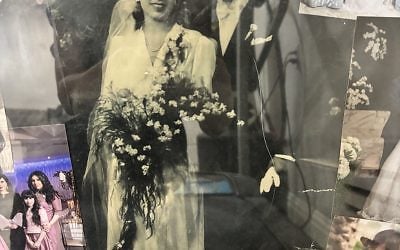
My grandparents, Calomira Shemesh and Edward Kerub, around the time of their wedding in Egypt. In 1957 they left the only home they had known, rebuilt in Milan, and later in Montreal
A letter to my Jewish friends who voted for Abdul El-Sayed
This fall, every Shabbat table I sit at arrives at the same question, usually somewhere between the soup and the main course. Is our time in America up? Jews in Spain asked it before 1492. Jews in Germany, Poland and Hungary asked it in the 1930s. My own family asked it in Cairo. Nearly every Jewish community in history has eventually sat around a table and wondered whether the country it loved still wanted it. This week, many of you answered that question at the ballot box, and I want to talk with you about how.
I am not writing to shame anyone. Most of you voted for your party, your values and your health care, the way you always have. But according to an exit poll of Jewish early voters in Michigan, close to six in ten backed El-Sayed, roughly twenty points fewer than voted for the Democrat running for governor on the same ballot. That gap tells me many of you hesitated. You saw him rally college students alongside Hasan Piker, a streamer who has called Orthodox Jews “inbred” and said Hamas is “a thousand times better” than Israel. You noticed that he distanced himself only late in the race. And you voted for him anyway, because you believed loyalty to the party would be returned.
Look at what happened to the most loyal Jew in the Democratic Party. El-Sayed spent his primary campaign saying Chuck Schumer should be replaced as the party’s Senate leader. The day after El-Sayed won, Schumer endorsed him. The highest-ranking Jewish official in America backed the man who had already announced he wanted him gone. That is what loyalty buys when the other side has decided you are in the way.
My family has seen this before. My grandmother, Calomira Shemesh Kerub, was friends with Leila Murad, the daughter of a Jewish cantor who became the biggest film star in the Arab world. Leila did everything a Jew could do to belong. She married a Muslim actor and converted to Islam. In 1953, Egypt’s revolutionary government chose her over Umm Kulthum as its official singer. Then rumors spread that she had given money to Israel’s army. The government investigated and found nothing, but the suspicion followed her, and by the mid-1950s her film career was over. She proved her loyalty in every possible way, and it was never enough.
My grandmother made a different bet. After the Suez crisis, Egypt treated its Jews as enemies of the state, and roughly 25,000 of them left between late 1956 and the end of 1957. My grandparents were among them. They did not survive by being accepted. They survived because their people looked after them: my great-uncle Jacques had the connections to get them out, and family carried them from Cairo to Milan, then to Montreal, where I was born.
Two Jewish women in the same city at the same moment. One staked everything on being wanted. The other staked everything on her people. Only one of those bets has ever paid off for us.
Our own tradition says the same thing. When Esther entered the king’s palace, Mordechai told her not to reveal her people, and for years she kept quiet to be accepted. The Jews were not saved by her acceptance. They were saved on the day she stood before the king and said who she was, and asked for her life and the life of her people. Hiding bought her a crown. Speaking up saved a nation.
Here is the good news, and it is the difference between Michigan and Cairo. My grandmother could not vote out a government that called her an enemy. You can. You can also do something more powerful than switching parties: you can make your vote conditional. Show up in the primaries, where El-Sayed won by a razor-thin margin. Tell every candidate who wants your support exactly what it costs. Refuse to share a stage, a fundraiser or an endorsement with anyone who shares one with people who call us inbred. A community that votes the same way no matter what has already told the party it can be taken for granted.
The question at our Shabbat tables is the right one to ask, but we have been answering it backward. We keep asking whether they still want us. My grandmother’s life says the better question is whether we are strong enough, as a people, to stop needing them to. Leila Murad never got to ask it. We still can.
Related Topics
Related Posts