
The Bill Comes Due
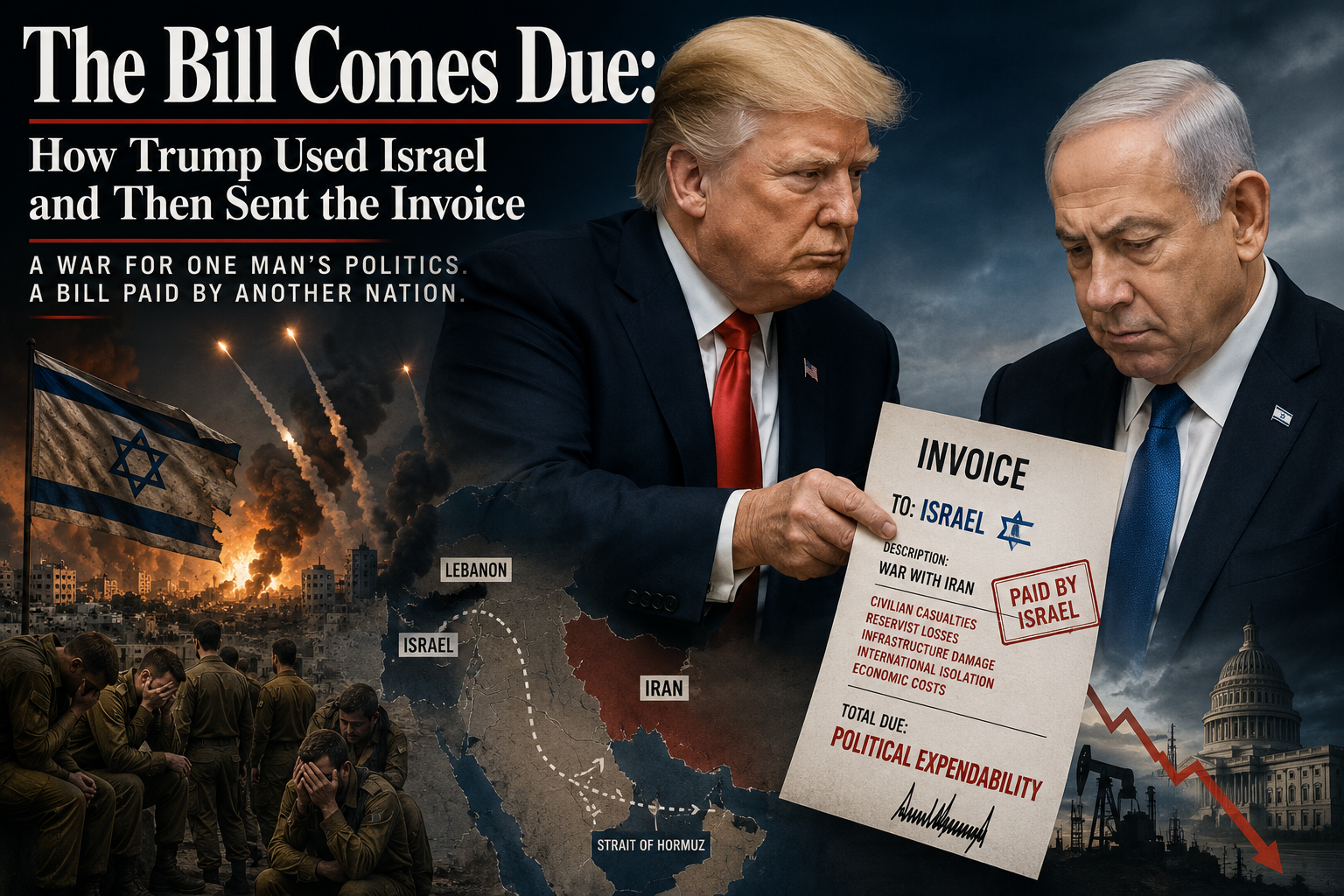
How Trump Used Israel and Then Sent the Invoice
On 28 February 2026, the United States and Israel struck Iran together. For a few days, they looked inseparable. Netanyahu said the aim was to cripple the Islamic Republic’s military, destroy its nuclear and ballistic-missile programs and bring down the regime. Trump announced the death of Iran’s supreme leader in the opening barrage and urged Iranians to “take back” their country.
Then came the admission that mattered. Trump later acknowledged that he may have forced Israel’s hand. That single remark stripped away most of the theatre surrounding the operation. It had been sold as a joint war. It was never a partnership between equals.
The objectives started moving almost immediately. Stop an Iranian attack. Destroy the missile arsenal and the navy. End the nuclear program. Remove the regime. Each new objective dwarfed the one before it, and none came with a credible answer to the only question that mattered: what happens when Iran does not collapse? There was no closed exit. There was momentum, and both men mistook momentum for strategy.
Trump wanted a fast, dramatic victory he could sell at home. Netanyahu saw the opening he had waited years for — strike Iran with the United States beside him, perhaps topple the regime, then return to the Israeli public as the man who had finally answered 7 October. They entered the same war for different reasons. Trump needed strength on television and movement in the polls. Netanyahu needed to recover the image of protector. And, bluntly, to survive.
When the war stopped working for Trump
Iran did not fall. Its nuclear program remained unresolved. Hezbollah remained intact. The Strait of Hormuz stayed under threat, energy prices climbed and the cost began reaching ordinary Americans. Trump’s approval sank to roughly 35 per cent. Only a minority backed the conflict, and barely a quarter believed the gains were worth the price. With the November midterms approaching, the war had stopped looking like strength. It looked like a Republican liability.
That was the turn.
Trump no longer needed to defeat Iran. He needed to escape the trap he had helped build — reopen Hormuz, push fuel prices down, rename withdrawal as peace. The military objective slid into second place behind the political exit.
Netanyahu still wanted to press on, because Israel’s objectives had not been met. From that point, Trump stopped treating him as a partner and started treating him as the obstacle between the White House and a deal. He negotiated with Iran without Israel, brought Lebanon into the arrangement and warned Netanyahu that he could be left alone. Trump reportedly called him and asked him not to retaliate. Israel struck Iran anyway. Speaking to Axios, Trump said he had warned Netanyahu about the consequences of continuing the war: “Bibi, you better be careful, or you will be on your own very soon.”
That sentence was not merely an angry outburst. It exposed the chain of command.
Trump used Israel, then sent the bill
The conclusion drawn from Trump’s behavior is hard to avoid. He used Israel as his regional arm for as long as the war served his interests. Israel supplied the territory, the civilian population, the reservists, the infrastructure, the direct exposure to Iranian missiles. Israelis were killed. Hundreds were wounded. Families lived under alarms while the political calculation was being made in Washington.
Once the economic and electoral cost began landing on Trump, he changed direction. Israel’s losses became a sunk cost — that had already happened. Now he needed his agreement, his lower fuel prices, his exit photograph.
Then he humiliated the partner that had fought beside him. Not because he had suddenly discovered that Netanyahu was reckless — Trump knew exactly who Netanyahu was when the operation began. He turned on him the moment Netanyahu stopped being useful and started making the exit harder.
That is when the invoice arrived.
Netanyahu mistook coincidence for alliance
Netanyahu appears to have believed that because Trump temporarily shared Israel’s objective on Iran, the United States would remain in the war until Israel’s objectives were completed. Trump was never subordinate to Israeli security. His order of priorities was always visible: Trump first, then the American economy, the American elections, the image of Trump as the man in control. Israel came after.
While those interests aligned, Trump could be presented as the greatest ally Israel had ever had. The moment they diverged, the “special relationship” revealed a very ordinary hierarchy. Washington decides when the war begins, when it becomes inconvenient, and how much room Israel has once the American decision has been made.
Netanyahu can say that Israel is not party to the deal. Formally, that may be true. Operationally, Israel depends on the United States for munitions, interceptors, intelligence, military resupply, diplomatic cover and deterrence against other states. The dependency is material — it cannot be erased by a press statement.
That is why Trump’s warning — you will be on your own — struck Israel’s deepest fear. It was not a metaphor. It meant: without my weapons, my shield and my veto, see how long you last.
What Bennett said
Bennett was not simply arguing that Netanyahu governs badly. He described a society being drained by prolonged war: the public, the reservists, the economy and Israel’s international standing wearing down at the same time. His warning was brutal — four more years of this government and “we won’t have an economy, we won’t have a society.”
He tied the war directly to the Haredi enlistment crisis. Roughly 20,000 Haredi soldiers are missing from the force, while close to 90 per cent of the secular and religious-Zionist public serves and ultra-Orthodox participation remains close to zero. Bennett called the arrangement “national suicide in slow motion.” The phrase is harsh because the structure is harsh: a shrinking share of the population works, pays tax, fights, and returns again and again to reserve duty, while a growing share sits outside both the army and the productive core of the economy.
This is more than exhaustion. The social contract is beginning to split. The same people fight. The same people pay. The same people lose months of work, bury their dead, hold the state upright. Each year, proportionally, there are fewer of them.
The full picture
Trump entered a war he believed would be quick, spectacular and politically profitable. Netanyahu joined him because he thought a military opportunity could become political salvation. The war gave neither man what he had promised himself.
Trump found himself trapped by oil prices, Hormuz, inflation and his own polling. So he negotiated an exit directly with the enemy, excluded Israel, brought Lebanon into the arrangement, indirectly protected Hezbollah’s survival, and publicly disciplined Netanyahu. Israel had carried the physical exposure. Trump kept the right to close the operation the moment it stopped serving him.
Netanyahu cannot confront that reality honestly, because his own national strategy depends on the man now humiliating him. He built policy around American backing, American weapons and Trump’s personal commitment — then discovered that a personal commitment lasts only as long as Trump’s interest in it.
Israel did not have an alliance of equals. It had a managed dependency. While it served the shared objective, it was called an ally. The moment it tried to continue toward its own objective, Trump reminded it who controls the weapons, the timetable and the door.
Bennett’s warning makes the timing worse. The external dependency is being exposed just as Israel’s internal structure is already worn down. He is not saying Israel disappears tomorrow. He is describing something slower, and harder to reverse: a country trying to sustain prolonged war, unequal sacrifice, international isolation, and a leadership that survives by postponing the reckoning.
That strain is not theoretical. It is already inside the army, the economy, and the families being called back again.