Senior Rabbi at Temple Sholom, Vancouver BC Canada
The Blessing of Curses – Ki Tavo 5785
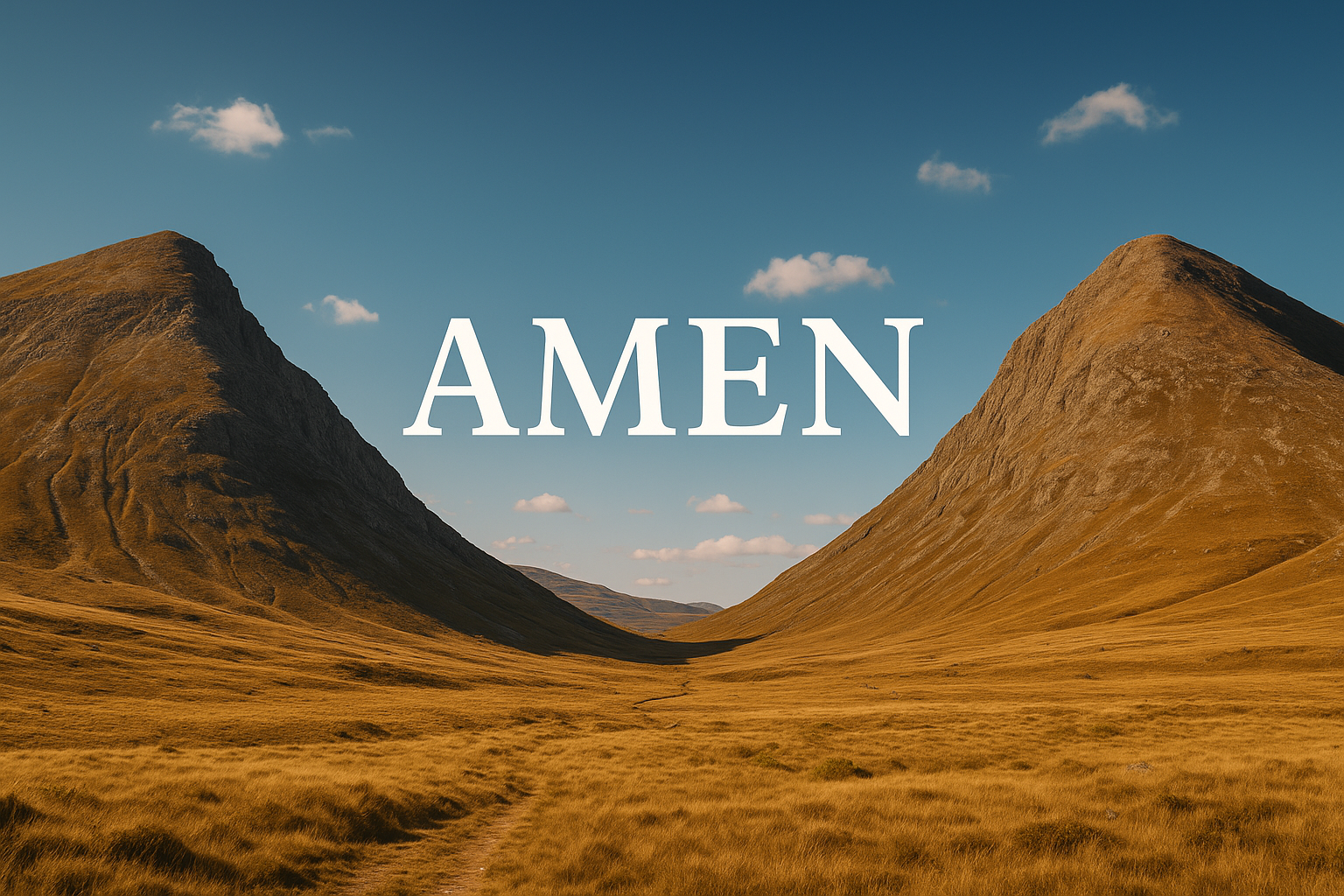
Amen v' Amen
There is a striking scene imagined in this week’s Torah portion, Parashat Ki Tavo (Deut. 27:11-26): Upon crossing the Jordan, the 12 tribes of Israel will divide into two groups. Six tribes will stand on a southern mountain facing the other six tribes on a northern mountain. The Levites will then scream a catalogue of 12 sins, each beginning with the phrase “Cursed be the one.” After each articulated sin, the other 11 tribes call out: “Amen!”
The tribes answer the curses in unison.
Cursed be a person who insults their parents – AMEN Cursed be a person who desecrates another person’s land. – AMEN Cursed be a person who misdirects a blind person. – AMEN Cursed be a person who subverts the rights of strangers. – AMEN Cursed be a person who ridicules their fellow in secret. – AMEN Cursed be a person who accepts a bribe. – AMEN Cursed be a person who will not uphold the terms of the covenant between God and the Jewish people. – AMEN
Note how these curses have to do with how we treat others, how we care for those who are in our community, who we interact with.
Imagine the world we would have if we simply did not permit ourselves to be a curse upon others. If we lived to bring blessing, and not curse on others.
And sit for a moment with the power of the word “Amen”. That simple word holds so much. For many it’s a throw away, like asking someone how are you, or like clicking ‘I agree’ to terms and conditions we’ve never read.
But Amen as bible frames it is not a throw away, it’s our communal act of acceptance and adherence to the covenant. You don’t say it, or you’re not supposed to say it for frivolous things, but rather for holy things.
“Amen” comes from the root “firm.” To say amen is to make something more solid, literally, to “affirm” it. Saying amen creates a communal reality by strengthening shared commitments. Judaism normally has us say amen to blessings. We are used to calling out amen for things that we believe or wish to be true. We say amen happily, with great hope, at the blessings offered at weddings, baby namings and holidays. In Jewish law, answering “amen” after a blessing is considered more praiseworthy than saying the blessing oneself (Shevuot 29b).
What does it mean to say amen to a curse? It means that we, together, declare that there are certain things we will not allow. We will not permit disrespect of parents. We will not allow injustice toward strangers. We will not tolerate bribery or cruelty. Each curse, affirmed in unison, sets the moral boundaries of our community.
In Jewish life, we usually emphasize blessings — the positive commandments, the ideals we aspire to, the hope we invoke. But Ki Tavo forces us to confront another dimension: the power, even the necessity, of saying no. The parashah dramatizes that clarity: sometimes the most important thing a society can do is name loudly — in ritual, in collective voice — what it refuses to tolerate. The curses, the “Asur” proclamations, are not negative only; they draw the line.
Rabbi Abraham Joshua Heschel, in “God in Search of Man”, reminds us that Judaism is a covenantal faith, deeply rooted in moral action and prophetic accountability. In Heschel’s view, the prophets do not merely comfort the afflicted, but afflict the comfortable. They insist on boundaries: what ought to be, what cannot be ignored. Saying “no” is part of holiness. Heschel writes that “Self-respect is the root of discipline: the sense of dignity grows with the ability to say no to oneself.” That inner “no,” and its outward counterpart, guard our humanity.
Similarly, Rabbi Lord Jonathan Sacks, in his many writings on moral responsibility and community, decried relativism — the idea that when “every thing goes,” nothing is sacred. He argued that a people without fixed moral reference points lose the capacity to aspire. Boundaries are not barriers between us — they are the scaffolding of a civil society, the structure that allows values to hold.
Sacks puts it starkly: “We should challenge the relativism that tells us there is no right or wrong, when every instinct of our mind knows it is not so.” In other words — even when culture tells us everything is subjective or that all opinions are equally valid, we know inside that some things cross a line.
When the Torah recounts the curses in Ki Tavo, this is exactly what’s happening. The community is naming those crossings, those boundaries — these acts are intolerable. Saying amen is not a casual assent; it is a covenantal assertion that justice matters, that dignity matters, that our morals are not up for negotiation.
As Abraham Joshua Heschel taught, holiness often begins with saying “no” to injustice, even when it is socially accepted. It means resisting the noise that says “what you choose is fine so long as nobody is hurt,” because often those choices do hurt, especially the weak, the vulnerable.
And David Brooks reminds us that our character is built by what we refuse as much as by what we embrace. Integrity isn’t just doing good things — it’s also saying “no” to shortcuts, to easy compromises, and to ways of thinking that let us off the hook morally.
Thus, the curses are moral fences: communal, loud, ritual boundaries that help define who we are. They encourage not isolation, but dignity; they don’t separate us so much as hold together the shared ground on which blessing, trust, and justice flourish.
We are living in a time and sadly a country when and where those fences are being eroded — when violent and hate-filled rhetoric directed at Jews is too often met with silence.
Yes as Jews we are screaming from the rooftops but as Canadian journalist and ally Pat Johnson, has often said, “antisemitism is not a Jewish problem to be solved by Jews. It’s a non-Jewish problem.”
When the rest of society fails to call it out, fails to disavow it, curses and hate begin to flourish until we can no longer see the boundary between moral speech and accepted hatred.
Deborah Lyons, Canada’s former Special Envoy on Antisemitism has spoken of being “despondent and despairing… that it was hard to get people to speak up, to speak with clarity, to speak with conviction” about the rise of antisemitism on Canadian soil.
Michael Geist has echoed this: in a piece titled “The Sound of Silence: On Being Jewish in Canada in 2025”, he argues that “the sound of silence is loud in Canada” precisely because many voices hold back, or hedge their words.
This silence is not benign. Jewish-Canadians were the target in nearly 900 police-reported hate crimes in 2023 — a 71% increase over the previous year — even though Jews make up less than 1% of the population. Senator Leo Housakos has said that “Jews are no longer safe in Canada,” calling on leadership to move beyond words to real protections and education.
To mis-quote the great rabbis Simon and Garfunkel, “The sound of silence is loud in Canada”
Silence is not benign. It’s a curse.
Heschel taught, “indifference to evil is more insidious than evil itself.” When we are silent in the face of hate — when we tolerate it because speaking out is difficult or unpopular — we are not neutral. We are complicit. To allow hate-speech or dehumanizing rhetoric to grow without challenge is to let the moral fence rot, the boundary blur.
The Torah insists there must be lines we do not cross, words we do not legitimize, actions we cannot abide. To bless without also cursing is to bless superficially, without protection. To say amen to blessing but never to curse is to build a house without a fence, to leave the garden of justice vulnerable to trampling feet. We learned in last week’s parasha of the commandment to build fences on our roof so no one falls.
Our tradition calls us to say no — visibly, audibly, covenantally — to hate, to violence, to the denial of human dignity. But not only us, this is where as an or l’goyim as a light unto the nations we are commanded to shine that light on the darkness in our society so that others recognize it and call it out. Because if we fail to name what is out of bounds, then the boundaries vanish. And when boundaries vanish, curses multiply.
As the poet Robert Frost reminded us, “Good fences make good neighbors.” And as Brene Brown teaches, boundaries are not selfish, they are acts of compassion. Both echo what Torah insists: that our fences, our boundaries, are what allow blessing to flourish.
If the tribes of Israel once gathered on two mountains to shout their amens together, maybe we, too, need moments when we gather to say out loud: these are the things we will not accept. Imagine if our voices joined in unison today:
Cursed is the one who spreads lies on social media. Amen. Cursed is the one who profits from another’s desperation. Amen. Cursed is the one who turns away from the hungry, the refugee, the unhoused. Amen. Cursed is the one who ridicules or bullies their fellow in secret. Amen.
What would you add? What communal sins do we need to collectively reject by saying amen? In a few days we will list them as part of the vidui in our High Holy Day services but what would you add right now?
Each amen is a communal act of resistance,
Each amen is a way of reaffirming our shared moral immune system.
By naming and rejecting what corrodes justice, we carve out space where blessing can thrive.
Blessing calls us toward hope and possibility.
Curse sets the boundaries that protect that hope.
Amen is what makes both real.
When we affirm the curses, we give them teeth. When we affirm the blessings, we give them wings. And together, blessing and curse make us a people bound not just by history, but by responsibility.
Amen v’ amen
Related Topics
Related Posts