
The Blockade – Part 2: Aid Diversion
A potential reason for the discrepancy described in Part 1 between food supplied to the Gaza Strip and food accessible to the population was simultaneously the reason given by the Israeli government for the blockade itself as well as many of the aid restrictions during the war: diversion by Hamas.
If Hamas was stealing and stockpiling food for its fighters, it could explain why not enough was getting to the rest of the population. But this claim is itself contentious.
Where did all the food go?
UNRWA as well as WFP Executive Director Cindy McCain deny having seen any evidence of aid diversion by Hamas.
In a recent op-ed former Biden Ambassador to Israel Jack Lew and Special Envoy to the Middle East David Satterfield acknowledged that “Hamas did find ways to tax, extort, and to some extent divert aid” but stated that the IDF never “shared evidence with us – or asserted to us privately – that Hamas was physically diverting US-funded goods provided by the World Food Program or international nongovernmental organizations” and that “there was no evidence of substantial Hamas diversion of any major assistance funded by the UN or nongovernmental organizations”.
The New York Times (NYT) reported in July that the IDF never found proof that Hamas had “systematically stolen aid from the United Nations” citing two unnamed senior Israeli military officials.
The qualifiers in these reports appear to be doing a lot of heavy lifting. While the IDF has not publicly shared evidence of “systematic”, “physical” theft of UN supplied aid specifically, it did declassify captured Hamas documents indicating Hamas was confiscating 15-25% of all aid shipments in what might be termed “systematic diversion” although not specific to UN organizations as the NYT article points out.
Evidence implicating Hamas
In intercepted communications Hamas operatives referred to overflowing warehouses under its control, indicating a substantial amount of theft though again not specific to the UN. Another intercepted communication shows low-level operatives complaining about Hamas leaders hoarding aid. This evidence aligns with multiple accounts by Gazan locals going back to December 2023, including allegations that Hamas controls UNRWA.
The Wall Street Journal citing unnamed Arab, Israeli and Western officials reported in April that throughout the war Hamas had used the flow of goods to generate income by charging taxes on merchants, collecting customs and commandeering goods for resale.
Similarly, a recent BBC report confirmed that Hamas generated income through taxes on traders and cited anonymous Gazan sources as saying Hamas had taken “significant quantities of aid” during the January-March ceasefire.
The Washington Post cited Gazan residents as confirming Hamas had taxed and stolen commercial as well as humanitarian shipments. A Gazan contractor working at border crossings told the paper that Hamas had regularly demanded protection fees under threats of violence and said he knew at least two truck drivers who were killed by Hamas for refusing to pay. A Gazan businessman confirmed that Hamas would impose taxes of at least 20% on many goods and divert trucks carrying flour and fuel meant for aid groups.
There has also been a seemingly endless supply of evidence of Hamas stealing UN aid specifically, such as interrogation footage of a former UNRWA security guard testifying to a Hamas takeover of an UNRWA facility, commandeering of aid trucks and UNRWA vehicles as well as multiple accounts by Gazan residents of Hamas stealing from UN agencies.
Additionally, there have been several reported cases of clans taking revenge on Hamas gunmen for killing a member of their family while waiting to collect food at UNRWA warehouses – such as the Abu Samra clan of Deir Al-Balah and the Hassanein clan of Gaza City – indicating regular Hamas presence at UN aid distribution centers.
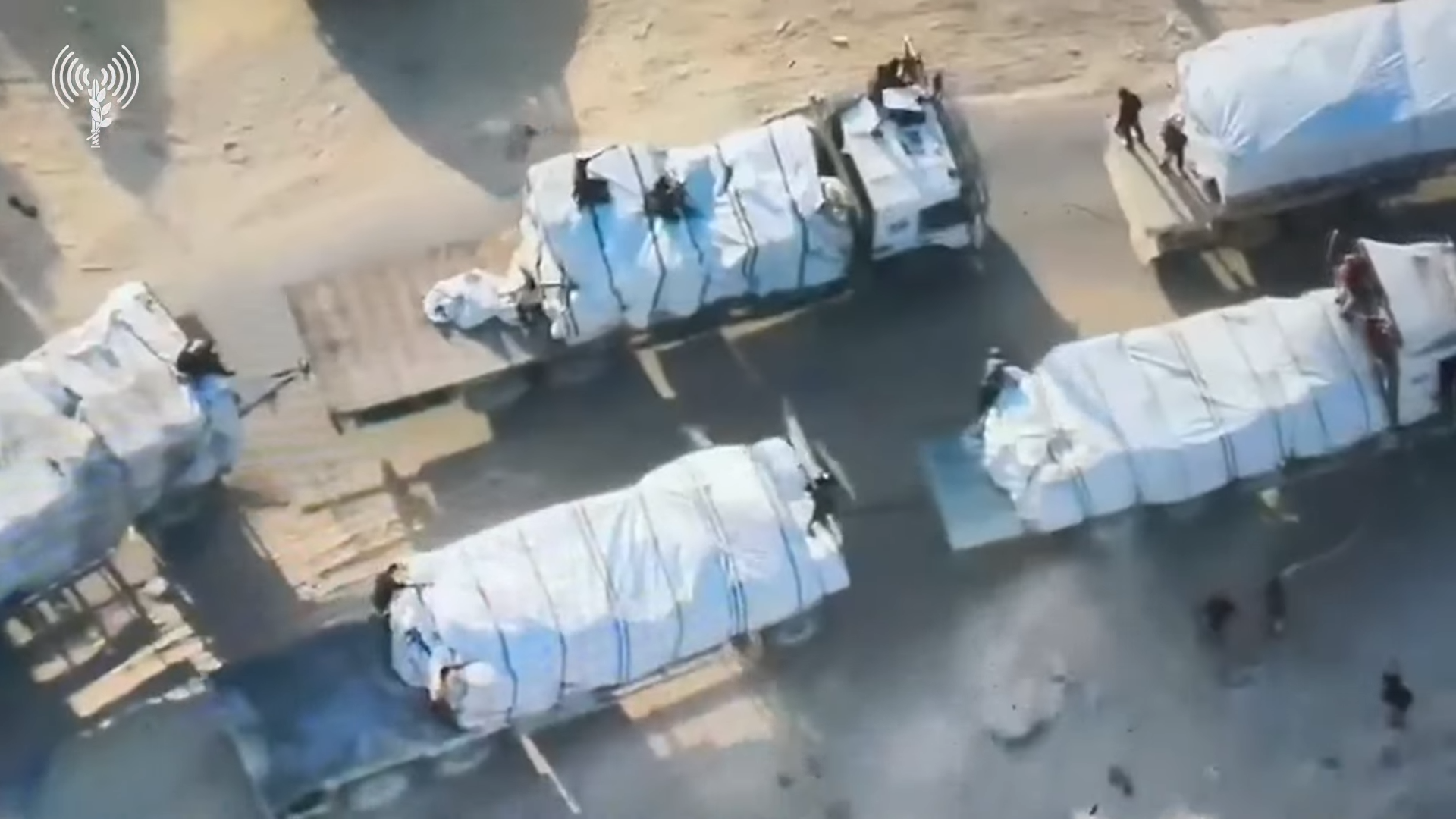
Frequent images show Palestinian gunmen – Hamas terrorist in most cases according to the IDF – atop aid trucks or inside UNRWA logistics centers. Since Hamas fighters do not wear uniforms, it is impossible to identify them as such from the images alone. But Palestinian Authority President Mahmoud Abbas agrees with the Israeli assessment holding Hamas affiliated gangs primarily responsible for looting and theft.
Despite this convergence of evidence for most of the world the debate seemed settled when Reuters reported on a leaked internal investigation by the United States Agency for International Development (USAID), until very recently the largest foreign aid agency worldwide. Among 156 incidents of loss or theft of US-funded supplies reported by local partner organizations in Gaza (USAID itself has no staff there) between October 2023 and May 2025 it found no evidence of systematic theft by Hamas. In fact, while 35 incidents were reportedly perpetrated by armed actors the review found no affiliations with US-designated terrorist organizations like Hamas in any of the 156 cases.
Of course, the inherent drawback of relying on self-reporting by partner organizations – who may or may not be involved with or intimidated by Hamas to varying degrees – was pointed out by none other than the USAID internal oversight body in a report from July 2024. The report singled out UN organizations as especially reluctant to report misconduct. Of the 17 such reports it had received at the time only 2 originated from UN organizations, even though over 50% of USAID funding in Gaza was awarded to them.
But even leaving aside the reliability of self-reporting, the findings of the USAID investigation do not even really seem to contradict alleged Hamas behavior. 85 of the 156 cases (54%) were attributed to unknown perpetrators (63), corrupt subcontractors (11), corrupt aid group personnel (5) and “other” (6) accounting for commodities stolen under unknown circumstances.
“The majority of incidents could not be definitively attributed to a specific actor”, Reuters cited the findings. “Partners often largely discovered the commodities had been stolen in transit without identifying the perpetrator.”
A Gazan researcher, who has investigated the UN aid system, may just have solved the riddle: “The drivers of these trucks alert Hamas before they enter with the aid. They hand over a portion to Hamas and also take some for themselves and their people.”
Not surprising
In summary, while it is true to say that we have strictly speaking not seen evidence of “systematic theft of UN aid” we have seen both evidence of “systematic theft” and evidence of “theft of UN aid”. Israeli, Palestinian, Western and Arab sources all agree that there is widespread diversion of humanitarian aid by Hamas.
This should really come as no surprise to anyone. Aid diversion and other forms of corruption are ubiquitous and some of the biggest challenges facing aid organizations, particularly in conflict regions. However, it is somewhat surprising – given the universal and unambiguous condemnation of Israel’s actions – how these organizations and its donors often deal with it: by suspending aid.
—
Part 3 of the series to appear tomorrow.
A German version of this article was first published by the Austrian think tank Mena-Watch.