A student of Indian History
The Bnei Menashe soldiers of the IDF
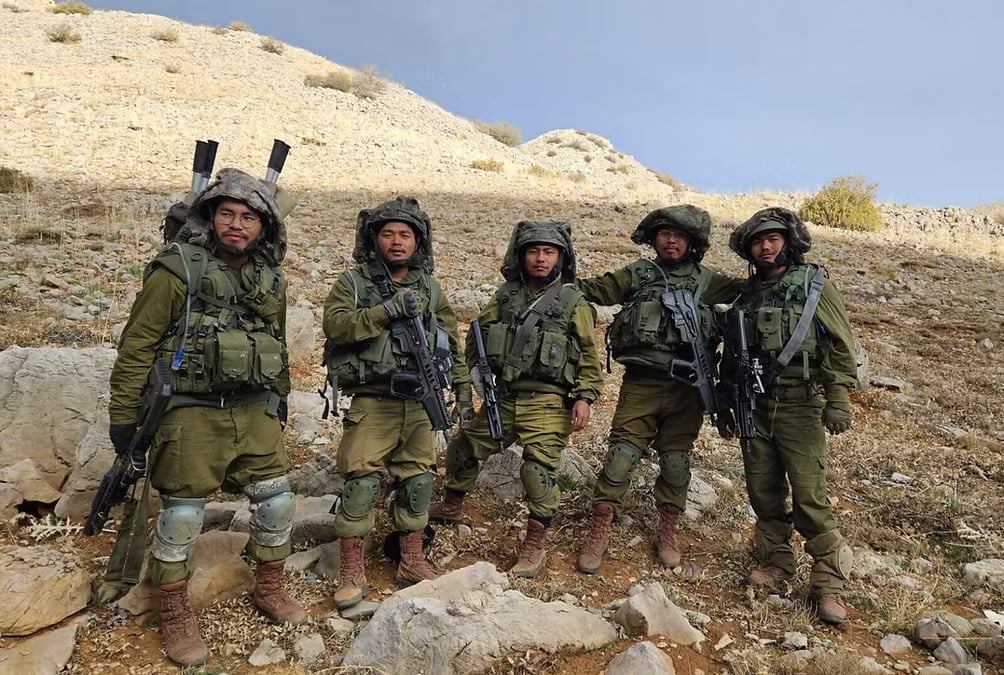
Members of the Bnei Menashe community in full tactical gear during their military service in the IDF. (Photo: Courtesy of Degel Menashe)
The Bnei Menashe (also spelled Bene Menashe) community emerged in the 1950s as a result of a Judaizing movement among the Kuki-Zo-Mizo tribes of the North-East Indian states of Manipur and Mizoram. They trace their ancestry from the Lost Israelite tribe of Manasseh (based on their ancestral figure Manasia or Manmasi). Since the 1980s, many among them have made Aliyah to Israel aided by Amishav (and later Shavei Israel since the mid-2000s). The 10,000-strong community is almost equally divided between Israel and India. In India, the Bnei Menashe (due to their Kuki ethnicity) have been caught up in the Meitei-Kuki violent conflict in the state of Manipur since May 2023 with a couple of them being killed. Their brothers and sisters in Israel are currently bolstering the country’s fight against Hamas and Hezbollah (also spelled Hizbollah) militants, and in the recent conflict against Iran. The Bnei Menashe tradition of serving Israel stretches back to their arrival in the country in the 1990s. In 2006, Tamir Baite, serving with the elite Shaked unit of the IDF’s Givati Brigade, was among the 120 Israelis honored as outstanding soldiers.
Operation Wings of Dawn: In November 2025, the government of Israel permitted the emigration of the entire community in India to Israel. On April 23, 2026, about 250 Bnei Menashe community members reached Israel under ‘Operation Wings of Dawn.‘ Unlike the previous migrations, which were mostly sponsored by Israel-based organizations or the community members themselves, this time it’s largely funded by the Israeli government. As they set foot in Ben Gurion Airport, waving Israeli flags and singing Hebrew songs, they were warmly welcomed by their community members already settled in Israel.
Witnessing the October 7 Attacks: During the surprise Hamas attacks, on the early morning of October 7, in Sderot, the Bnei Menashe residents of the town were caught unaware. Although the community miraculously suffered no casualties, a couple (Zevulon Guite and Zivka Guite) lost their home to Hamas rockets. 71-year-old Yaacov Tuboi termed it “the scariest experience“ of his life. He could only helplessly watch the attack by automatic-rifle-armed Hamas terrorists unfold from his apartment windows. He saw about ten of them getting out from a pickup truck and heading towards the nearby police station. He even witnessed the terrorists taking two young kids (not more than 3-4 years) as hostages. Unlike Tuboi, other Bnei Menashe residents of the town couldn’t get immediate information, as they were forbidden from using electronic devices (such as mobile phones) to get information according to Jewish religious law till the Sabbath ended that evening. Though Jewish religious law allows for the breaking of Sabbath rules when human lives are endangered. Later, on October 13, Sderot’s entire population was evacuated by the Israeli government due to incessant rocket attacks by Hamas, to be put into hotels in safer locations.
Daughters of the Frontline: Like all Israelis, at least 300 reservists of the Bnei Menashe community have been called up for their duty (while 100 were already serving) as soon as the war with Hamas began. Some of them have been put on combat duties. The two daughters of 54-year-old Rivka Lunkhel (who resides in Kiryat Arba, outside Hebron)—Yael (a reservist) and Shirel (currently serving)—have both been called up for duty. They are among the few Bnei Menashe women in the IDF (Israeli Defense Forces). On October 7, Shirel was patrolling the Gaza border along with her platoon when the Hamas attack began. In the 12-hour-long fight, Shirel’s platoon stood their ground, taking defensive positions even as three of their members (one boy and two girls) were wounded till reinforcements arrived to fend off the attackers and relieve them. Degel Menashe is an Israel-based NGO working for the Bnei Menashe community in both Israel and India. Its newsletter mentioned D., a soldier in the Golani Brigade who had just completed his regular military service earlier this year. He quickly rejoined his duties after making alternative arrangements for his newly married wife, asking his mother to come over and stay with her.
The Legend of “Nun-Tet”: Natanel Touthang (31 years), the only Bnei Menashe soldier to have been injured in this war, was serving on the northern border with Lebanon (on the slopes of Mount Hermon) in October 2023. His bunker (from where he was doing surveillance missions) was hit by an anti-tank missile fired by the Hezbollah (also spelled Hizbollah) militants. Originally hailing from Lamka (formerly Churachandpur, Manipur), Touthang made Aliyah in 2018 and was only allowed two years’ service in the IDF instead of the customary three, as he was past his conscription age. After being discharged in September 2022, he married and settled in Bet-She’an. Despite not being initially called into service this time, Touthang called his commanding officer and volunteered to serve on the frontlines. The debris from the missile attack rendered his right eye fully blind, left eye partially blind, and injured his right arm. He received initial treatment at Rambam Hospital, Haifa. After three surgeries by January 2024, his vision has been restored. Regarding his future, Touthang noted, “I’ll live with whatever happens without weeping and wailing over it.” Degel Menashe Newsletter noted that it was indeed ironical that he was wounded by an anti-tank missile, as his fellow combatants nicknamed him Nun-Tet (based on Natanel Touthang’s initials), shortened form of Neged Tankim in Hebrew literally meaning against tanks (referring to anti-tank missile). Some more Bnei Menashe soldiers have been injured such as Itzkhak Chawngthu (21 years) in November, and Yonathan Hmar (23 years) in December 2023 while taking part in IDF’s counter-attacks in Gaza. Both were released after treatment at the hospital for a few days.
The Ultimate Sacrifice: A couple of Bnei Menashe soldiers have also laid down their lives to defend Israel. On September 11, Sgt. Gery Gideon Hangkhal (24 years) was serving in the Kfir Brigade, manning a security booth near Beit El, West Bank. His life was cut short when a truck driven by a Palestinian rammed into his checkpoint. Migrating to Israel only in 2020, Hangkhal struggled with Hebrew, but that didn’t reduce his desire to make the ultimate sacrifice in his duty towards Israel. Another Bnei Menashe soldier of the Kfir Brigade, Sgt. Gary Lalhruaikima Zolat (21 years), was killed on November 11, 2024, in a missile attack by Hamas near Jabalia in Gaza. For Zolat, serving in the IDF was like a ritual that transformed him from the carefree, chubby teen to the mature and highly motivated soldier. Degel Menashe held a program on May 27, 2025, along with the Indian Jewish Heritage Center and Cochin Heritage Center to commemorate and mourn the fallen soldiers of Indian descent in the IDF.
A Community Transformed: While the Bnei Menashe men (and a few women too) are serving in the IDF, the women from the community have come forward to play their part in Israel’s war effort in various ways—collecting funds (despite the Israeli Bnei Menashe community as a whole not being that well off), essential supplies, cooking hot meals for the combatants, and finally engaging in day-long prayers alongside other Israelis. Some have engaged with organizations such as Unity Warriors, which is currently aiding the IDF. Aviela Singsit (55 years) who runs a business of guest houses in Tzfat neighbourhood of Safed, has provided one of her guest houses for lodging IDF soldiers. Her son is also currently serving in the IDF. Alona Haokip (31 years), a kindergarten teacher by profession, has taken up the task of single-handedly running their household at Nokdim village near Jerusalem in the absence of her husband, Sagi (who has reported for duty).
Integrated in Israel: The Bnei Menashe community, despite being small, came forward to contribute towards Israel’s war effort in their own ways. Hence, Degel Menashe’s executive director, Yitzhak Thangjom, noted, “I think that when this is over […] we B’nei Menashe will feel Israeli in a different and more profound way than we have felt until now. We’ll have put our lives on the line for this country, as so many Israelis are doing and have done. In the fighting ahead, there will inevitably be more casualties among us. Some of us may be killed. If Israel will be, as many people are saying, a different country when this is ended, we B’nei Menashe will certainly be a different community.”
By early 2026, the transition Thangjom predicted has shifted from a local sentiment to a formal state policy. In November 2025, the Israeli Cabinet approved a 90 million shekel (US$ 27 million) five-year roadmap aimed at bringing the remaining 5,800 Bnei Menashe to Israel by 2030. Spearheaded by the Ministry of Aliyah and Integration, the initiative represents a historic shift; for the first time, the Israeli government has moved beyond mere recognition to fully funding flights, Hebrew immersion, and housing. However, the plan carries a distinct strategic weight. The majority of the 1,200 arrivals scheduled for 2026 are being resettled in the Galilee region, specifically in cities like Nof HaGalil. This move places the community directly into a northern frontier that has been thinned by years of Hezbollah rocket fire, effectively asking these families to trade the ethnic “hill war” of Manipur for a permanent role as a demographic and civil bulwark on Israel’s northern “Blue Line.” For them, the sirens of the Galilee are a stark reminder of the violence they left behind in Lamka. For families like the Lunkhels and the Touthangs, the “Lost Tribe” label is no longer a matter of DNA or tradition; it has been redefined by the sheer reality of their presence in the Galilee.
Related Topics
Related Posts